
"Skip the startup phase and generate profitable revenue on day one."
That line hit me around the 20-minute mark while I was reheating leftover jjigae at 11pm, and I actually set the spoon down. Because that's not a revolutionary insight. That's what my parents did in 1987 when they bought a struggling dry cleaner on Western Ave instead of starting one from scratch. They didn't call it "acquisition entrepreneurship." They called it "not being stupid with money."
But here's the thing - Walker Deibel turned their instinct into a framework, and the framework is actually good.
What Your Parents Knew But Couldn't Put Into a Pitch Deck
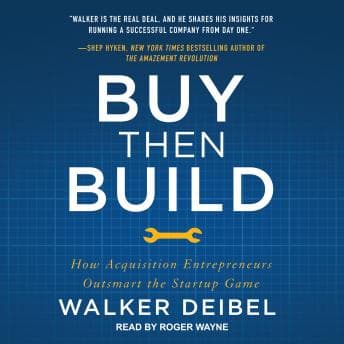
Bottom line: Buy Then Build makes one argument and makes it well - buying an existing business is a statistically smarter path to entrepreneurship than starting from zero. Deibel backs this with data on startup failure rates, time-to-profitability comparisons, and the concept of what he calls the "acquisition entrepreneur" - someone who identifies undervalued small businesses, acquires them (often with creative financing), and then applies growth strategies to scale them.
The strongest chapters cover deal sourcing and valuation. Deibel walks through how to find business brokers, generate your own deal flow, and evaluate a company's real worth versus what the seller claims. He talks about quality of earnings analysis, seller discretionary earnings, and how to spot an owner who's been running personal expenses through the P&L. This is practical stuff. I've seen exactly this kind of due diligence failure tank acquisitions at companies with entire M&A departments, let alone first-time buyers working solo. The underlying economics here aren't magic - they're the same supply-demand fundamentals I kept bumping into in Principles of Economics, just applied to deal tables instead of lecture halls.
The SBA loan chapter is genuinely useful too - he explains how you can acquire a $1-2M revenue business with relatively little cash down through SBA 7(a) loans, which most aspiring entrepreneurs don't even know exist. Skip to chapter 5 if you want to get straight to the financing mechanics. Thank me later.
Where the 8 Hours Start Feeling Like 8 Hours
Here's my frustration: Deibel spends too much time selling you on the concept of buying versus building. By chapter 3, I was like - yes, I'm convinced, I literally bought the book about this, can we move on? The first third is heavy on motivation, light on tactics. At 2.0x speed it was tolerable. At 1.0x I would've rage-quit.
And if you're looking for detailed financial engineering - leveraged buyout structures, earnout negotiations, complex deal terms - this isn't your book. It stays at the "here's how to think about this" altitude rather than getting into the weeds of term sheet specifics. For a first-time acquisition, that's probably appropriate. For anyone who's already done a few deals or has an MBA, you'll find yourself nodding along without learning much new after the midpoint.
The key takeaway is worth the listen. The other 7 hours? Not so much. There's probably 3.5 hours of genuinely actionable content here - the deal sourcing framework, the valuation shortcuts, and the integration playbook. The rest is padding and pep talk.
Roger Wayne Does the Job Without Getting in the Way
Roger Wayne narrates like a good management consultant presents - clear, professional, measured pacing. No dramatic flourishes, no weird character voices (thankfully, this isn't that kind of book). His delivery is warm enough that the instructional content doesn't feel like a textbook reading, which is the minimum bar for business audiobooks and one that maybe 40% actually clear. Clean production throughout, no audio artifacts or weird editing jumps.
That said, there's nothing distinctive about the performance either. Wayne is the kind of narrator you forget about - which for a business book is actually a compliment. You're here for the ideas, not the voice acting.
Who Gets ROI From This
If you're a W-2 employee dreaming about entrepreneurship but terrified of the startup grind - this is your on-ramp. Deibel makes a persuasive case that you don't need a revolutionary idea, a technical co-founder, or venture capital. You need deal flow, due diligence skills, and an SBA loan.
If you've already done acquisitions, or if you want the advanced financial playbook, this will feel surface-level. You're better off with something like HBR's guides on M&A or just hiring someone who's done it.
Jenny would say I'm being harsh. Jenny is right. But Deibel wrote a solid 101-level guide for a path to business ownership that doesn't get enough attention. My parents figured it out through necessity and 14-hour days. Having a structured framework would've saved them years of expensive lessons.
Not every book needs to be groundbreaking. Sometimes it just needs to save one person from burning $200K on a startup that was never going to work. This book does that.