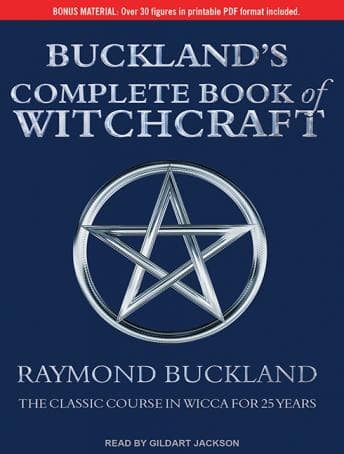

"The Witch knows that there is no death" — somewhere around the two-hour mark, Gildart Jackson delivers this line with such matter-of-fact British calm that I nearly spit out my coffee. I was sitting in my home office at 6 AM, supposedly prepping a pitch deck for a fintech startup, and instead I'm getting lectured on reincarnation by a guy who sounds like he should be narrating a BBC nature documentary.
Look, I need to be upfront: this is way outside my lane. I review business books. I measure things in ROI and TAM. Jenny bought me this credit as a joke because I once said "my parents' work ethic was basically a daily ritual" and she said "see, you're already halfway to Wicca." She thinks she's hilarious.
But here's the thing — I actually finished it. All 13 hours and 52 minutes. And I have thoughts.
A Textbook That Accidentally Taught Me About Organizational Design
Buckland structured this thing like a course. Lessons, exam questions, progressive skill-building. And my consultant brain couldn't help but notice — this is basically an operations manual for a decentralized organization. Covens have governance structures, defined roles (High Priest, High Priestess, Maiden, Summoner), initiation processes, and meeting cadences (sabbats and esbats). He lays out how to run a coven with more operational clarity than half the startup founders I advise.
I'm not joking. The section on coven organization — how to handle disputes, how to structure leadership transitions, when to split a group that's gotten too large — this is what my parents did instinctively. Now it has a TED talk. Or, well, a Book of Shadows.
The herbalism chapters, the divination sections, the spellwork — I can't evaluate any of that on merit. That's not my world. The closest I've come to sitting with this kind of mind-body practice literature was Tai Chi: The only introduction you'll ever need — same problem there, I kept filtering the discipline through an operational lens and missing whatever the actual practitioners were getting out of it. But structurally? Buckland respects your time more than most business authors. Each lesson builds on the last. There's no filler chapter where he tells you the same concept three different ways with three different anecdotes. Fourteen hours of content and almost all of it is instruction, not padding. Finally, a book that respects your time — even if the subject matter is, shall we say, outside my quarterly review.
The British Professor You Didn't Know You Needed
Gildart Jackson. The man narrates this like he's teaching a particularly fascinating university seminar. His British accent lends the whole thing an air of academic credibility that — and I realize the irony here — actually helps when you're listening to detailed instructions on how to consecrate a ritual knife. His pacing is measured and calm, which works beautifully for the instructional content but does get monotonous during the longer ritual descriptions. Around hour nine, the guided meditations and channeling exercises started to blur together at even 1.5x speed.
Here's my real complaint with the audio format, though: this book has exam questions at the end of each lesson. Diagrams. Tables of correspondences. Lists of herbs and their properties. That stuff desperately wants to be on a page in front of you, not flowing past your ears at 2x. I found myself rewinding constantly during the sections on runes and tarot spreads because — surprise — absorbing visual reference material through audio is like trying to read a spreadsheet over the phone. My 2.0x speed couldn't save this one in those chapters.
What a Dry Cleaner's Kid Learned From a Witchcraft Manual
Here's what stuck with me, and I genuinely didn't expect this. Buckland talks about the history of persecution — the Burning Times, the way folk practitioners were systematically targeted and their knowledge systems destroyed. The stress biology of that kind of sustained, existential threat — communities holding together under pressure with no institutional safety net — is something Robert Sapolsky maps out with cold precision in Why Zebras Don't Get Ulcers, and reading it permanently changed how I think about what chronic adversity actually does to people who build something anyway. And he frames Wicca as a reconstruction effort. A community rebuilding its practices from fragments.
My parents rebuilt their lives from fragments too. Different context entirely, but the mechanics of preserving knowledge, passing down practices, creating community structures when the dominant culture doesn't make space for you — that hit different than I expected. Jenny would say I'm being sentimental. Jenny is right.
The self-dedication ritual for solitary practitioners is genuinely moving in audio. Jackson slows his pace, drops his voice slightly, and you feel the weight of someone committing to a practice alone, without institutional support. I thought about every small business owner who wakes up at 4 AM with no safety net and no one telling them they're doing it right.
Who Gets Value Here (and Who Doesn't)
If you're genuinely interested in Wicca, this is the foundational text and Jackson's narration is solid — but buy the physical book too. The audio alone won't cut it for the reference material. If you're a business person with zero interest in spirituality, this is obviously a skip. But if you're like me — someone who reads systems and organizational design into everything — there's a weird amount of applicable insight here about how intentional communities actually function.
Bottom line: I came in expecting to roast this for Jenny's amusement. Instead I got a surprisingly well-organized instructional manual with a competent narrator, hampered only by the fundamental problem of converting a visual reference book into audio. The key takeaway is worth the listen. The other 7 hours of ritual specifics? Grab the paperback.