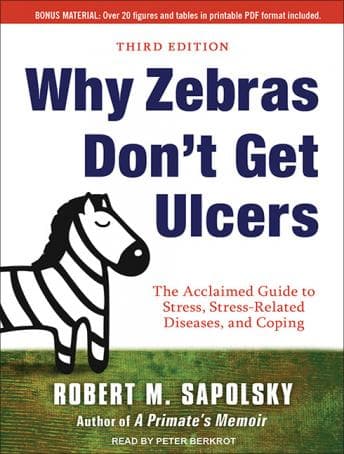

Three AM, jet-lagged in a hotel room in Singapore, waiting for a 7 AM client meeting with a founder who's burning through runway faster than I can say 'pivot.' I'm stress-eating room service satay and listening to a Stanford neurobiologist explain why my body is basically trying to kill me. The irony was not lost.
Sapolsky's thesis is elegantly simple: zebras sprint from lions, dump their stress hormones in about three minutes, then go back to grazing. Humans? We marinate in cortisol for months worrying about quarterly projections, difficult conversations, and whether that email sounded passive-aggressive. Our stress response evolved for emergencies. We've turned it into a lifestyle.
The Business Case Against Chronic Stress
Here's what made this worth 17 hours of my life: Sapolsky doesn't just tell you stress is bad. He shows you the exact biological mechanisms—how elevated glucocorticoids literally shrink your hippocampus, how chronic stress response suppresses your immune system, why executives who feel powerless in their roles have worse cardiovascular outcomes than those who don't. This is the science behind why my parents' dry cleaning business stress was different from McKinsey stress. They had control. Most middle managers don't.
The key takeaway is worth the listen. The other 7 hours? Actually, most of it holds up. Sapolsky is that rare scientist who can explain complex neuroendocrinology without making you feel stupid, and he's genuinely funny about it. His riff on the evolutionary disadvantages of being a subordinate male baboon—basically the primate equivalent of a junior associate—had me laughing out loud at 3:47 AM.
But let's be real: this is a dense, academic book dressed in accessible clothing. At 17 hours, it's a commitment. Some chapters on the molecular biology of stress hormones could've been trimmed by 40% without losing the actionable insights. I found myself at 2.0x for the deep biochemistry sections, then slowing down when he got to the practical applications.
The Berkrot Question
Peter Berkrot is a skilled narrator—Audie winner, clearly knows his craft. His delivery of Sapolsky's dry humor lands well, and he brings genuine intelligence to the material. But here's the thing: some listeners swear Sapolsky himself is a better interpreter of his own work. I've seen the documentary. They're not wrong.
Berkrot occasionally tips into what I'd call 'stagey emphasis'—hitting certain words with theatrical weight that feels a bit much for a science book. It's not a dealbreaker, but by hour 12, you notice it. Jenny would say I'm being harsh. Jenny is right. The narration is solid B+ work. Just not the A+ the content deserves.
What My Parents Knew (Without the PhD)
The most valuable section for me was Sapolsky's analysis of control, predictability, and social support as stress buffers. My parents worked brutal hours, but they owned the outcome. They had community—Korean church, other shop owners, extended family networks. Sapolsky's research on baboon hierarchies and British civil servants confirms what immigrant communities have practiced forever: social connection and perceived control matter more than objective workload.
I've seen this fail at three different companies. Founders who think 'unlimited PTO' and 'wellness stipends' will fix burnout while maintaining command-and-control management. Sapolsky would tell them they're treating symptoms while amplifying causes. Breaking the Habit of Being Yourself tries to address the neurological rewiring part, though it leans harder on visualization than Sapolsky's hard science. The science is clear: autonomy and predictability reduce stress response more than any meditation app.
Who Gets the ROI (And Who Doesn't)
Essential listening if you're a leader trying to understand why your team is burning out, a high-performer wondering why you can't sleep, or anyone who's ever been told to 'just relax' and wanted to throw something. Skip it if you need quick tactical tips—this is the 'why' book, not the 'how-to-fix-it-in-five-steps' book.
The third edition adds chapters on sleep and addiction that feel particularly relevant post-pandemic. Sapolsky connects chronic stress to everything from weight gain to depression to why some people age faster than others. It's comprehensive to the point of being overwhelming, but that's also its strength. 12 Rules for Life attempts similar comprehensiveness with self-improvement, though Peterson trades Sapolsky's neuroendocrinology for evolutionary psychology and biblical references.
The Satay Verdict
Bottom line: a science book that respects your intelligence while actually being useful. Yes, it's long. Yes, some chapters get deep into molecular weeds. But Sapolsky delivers genuine insight backed by decades of research, and he does it without the self-help pablum that usually comes with stress books.
I finished it before that Singapore meeting. The founder's still burning through runway, but at least I understand why my body was screaming at me to run. Now if only I could convince my clients that their chronic stress response is a bigger threat than their burn rate.
Skip to chapters on control and social hierarchy if you're short on time. But honestly? The full listen pays off.