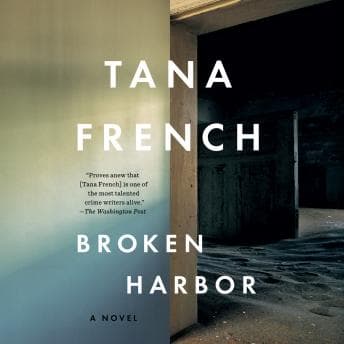

Everyone kept telling me Tana French is the gold standard for literary crime fiction. I've had her on my list for years but kept putting her off because - honestly? - I was afraid she'd get the procedural stuff wrong and I'd spend 20 hours yelling at my dashboard. I should've trusted the woman sooner.
I didn't listen to this one on my commute home. I started it on a rare stretch of days off when Carlos took the kids to his parents' in Tucson and I had the house to myself. Insomnia's a gift when you work nights - your body doesn't know what to do with free time at 2 AM, so I cleaned the kitchen, folded three loads of laundry, and let Stephen Hogan's Irish lilt fill every room. Twenty hours is a commitment. But this book earned almost every one of them.
The Crime Scene That Actually Made Sense
Let me tell you what Tana French gets right that most thriller writers bungle: the mess. Not just the physical crime scene - though the detail of baby monitors pointed at holes smashed through the walls of the Spains' house is the kind of specific, deeply unsettling image that sticks with you - but the emotional mess. The way a family falls apart isn't cinematic. It's ugly and slow and mundane before it's violent. Patrick Spain and Jenny Spain aren't thriller props. They're people who bought into the Celtic Tiger dream, moved into a half-abandoned luxury development that was already dying before they unpacked their boxes, and then something cracked.
And Scorcher Kennedy. Oh, Scorcher. He's the kind of detective I've met in real life - the ones who come into my trauma bay at 4 AM convinced they've got everything figured out, clipboard tight, jaw tight, everything tight. He plays by the book because the book is the only thing keeping him from unraveling. French doesn't just tell you this. She shows you the seams splitting over 20 hours, and it's uncomfortable in the way that watching a colleague lose it on shift is uncomfortable. You want to look away but you can't.
The medical details are accurate. Finally. Jenny Spain in the ICU isn't treated like a plot device waiting to wake up and deliver exposition. The clinical details around her injuries felt like someone actually talked to a nurse or - radical concept - did research. I didn't yell at my dashboard once. (Well, once, but it was minor enough that I'll let it slide.)
Hogan's Voice and the Slow Burn That Tests Your Patience
Stephen Hogan. Here's the thing. His narration is genuinely strong - the Irish lilt is authentic without being a caricature, and the way he differentiates Scorcher from his rookie partner Richie is smart. Scorcher gets this controlled, clipped energy, almost brittle. Richie gets something looser, younger, a little uncertain. You hear the power dynamic before French even writes it into the dialogue.
But - and this matters - the first third of this book is slow. Like, folding-laundry-and-checking-the-clock slow. French is building something. I know she's building something. She's laying out the ghost estate, Scorcher's obsessive need for control, his sister Dina's mental health spiraling in the background like a second crime scene nobody's investigating. It's all necessary. But at hour six I caught myself wondering if I should bump the speed to 1.25x. I didn't, and I'm glad, because when the last quarter hits, it hits like a trauma activation page going off in a quiet unit. The tension doesn't just increase - it detonates. But you have to be patient enough to get there.
Hogan occasionally loses some of the subtlety in the emotional peaks - there are moments where Scorcher's unraveling could use a quieter touch, a more restrained delivery. Small misses. The kind of thing where you think, "Almost. Almost perfect." But his control of pacing in those final hours is excellent. I burned through the last five hours in one sitting, sitting on my kitchen floor at 3 AM eating cold lumpia because I couldn't stop.
The Part Nobody Warns You About
This isn't really a whodunit. I mean, technically there's a murder and technically you find out who did it. But the real investigation is into Scorcher himself - his childhood at Broken Harbor, his mother, his sister, the way he's built his entire identity around being the guy who never cracks. French is asking you to watch a man discover that the control he's worshipped his whole career is just another kind of breaking.
As someone who's actually worked a code, I know what it looks like when someone holds it together for everyone else and then falls apart in the supply closet. Scorcher Kennedy is that guy. And French doesn't give you a neat resolution. The ending doesn't wrap up clean. Some threads stay loose. Some damage stays done. My mom would love this - she's always telling me life doesn't come with neat endings, usually right before asking when I'm going back to school for my MD.
Carlos asked why I was sitting on the kitchen floor crying when he got back with the kids. I blamed allergies. In July. In Phoenix. He didn't buy it.
Who Gets This and Who Doesn't
If you need a fast-paced thriller with a twist every chapter, skip this. You'll be frustrated by hour four. If you want a character study wrapped in a murder investigation, set against the wreckage of Ireland's economic collapse, and you've got the patience for a slow burn that pays off hard - night shift approved. Last Call at the Nightingale scratched a similar itch for me - atmospheric, character-driven, the kind of crime fiction where the world being dismantled around the investigation matters as much as the case itself. This is focused listening. Don't put it on during a busy shift or while grocery shopping. Give it your attention. It asks for it and earns it.
Perfect for that post-shift decompression - but only if you've got consecutive days off, because you will not want to stop at 45 minutes once it gets going.