
"What was real and what was not real."
That line — or something close to it — keeps circling back through Tom Kettle's mind like a prayer he can't stop saying. And about three hours into this audiobook, sitting alone in my apartment with Shirley curled up on the radiator and the rain doing its Oregon thing against the windows, I realized I couldn't tell either. What was memory. What was happening now. What Tom had invented to survive.
This understands that horror isn't about gore — it's about dread. And I know, I know, this isn't marketed as horror. It's literary fiction. It's a Booker-adjacent prestige novel about a retired Irish policeman. But I'm telling you: the terror baked into this book is deeper and more suffocating than ninety percent of what lands on my horror shelf.
The Haunting of Tom Kettle
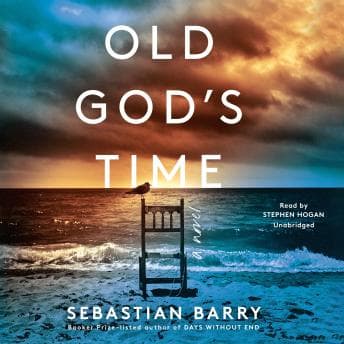
Sebastian Barry does something here that I've only seen a handful of writers pull off — he makes unreliable narration feel like a haunting rather than a gimmick. Tom Kettle has retired to a lean-to attached to a Victorian castle in Dalkey, overlooking the sea. He's alone. He's quiet. He's fine. He is absolutely, catastrophically not fine.
Two former colleagues show up asking about an old case — one involving institutional child abuse, the Catholic kind, the kind Ireland spent decades burying and is still excavating. And from that knock on the door, the novel starts to unspool Tom's grip on linear time. His dead wife June appears. His children drift in and out. A young mother moves in next door and Tom becomes protective in ways that feel both tender and alarming. You're never quite sure what's happening in the present and what's a memory Tom is reliving because the alternative — the truth of what happened to his family — is too much.
Barry writes in this stream-of-consciousness Irish cadence that doesn't use quotation marks, doesn't announce scene changes, just flows like someone talking to themselves at 3 AM. It's disorienting. It's supposed to be. By hour five, I was so deep inside Tom's fractured perspective that when something shifted — when a detail didn't match what I thought I knew — I felt it in my chest. Not a jump scare. Something worse. The slow realization that the ground you've been standing on was never solid.
Stephen Hogan Carries a Dead Man's Weight
The narrator commits. That's rare.
Stephen Hogan's soft Irish accent does something crucial here — it makes Tom sound gentle. Tired. Like a man who has folded his grief into politeness and routine. He doesn't perform Tom's pain with big dramatic breaks or theatrical trembling. Instead, there's this quality of exhaustion in his delivery, like every sentence costs Tom something. The way Hogan handles the passages where Tom is remembering June — the domestic details, the way she moved through a room — you can hear a man replaying footage he's watched a thousand times, trying to keep the image sharp.
And because Barry's prose doesn't signal who's speaking with standard formatting, Hogan has to do that work himself. He shifts register subtly — a slightly harder edge for the detective colleagues, something warmer and more tentative for the scenes with Tom's children. It's not flashy voice work. It doesn't need to be. This is a one-man show about interior collapse, and Hogan reads it like he understands that Tom Kettle is holding himself together with string and routine and the view of the sea from his window.
The AudioFile Earphones Award this won? Earned.
A Content Warning That Actually Matters
I need to be direct. This novel deals with child sexual abuse within the Catholic Church. It's not graphic in the exploitative sense — Barry is too careful a writer for that — but it's present and it's devastating, and the damage it does to Tom and to the people around him is the engine of the entire story. If that's a boundary for you, respect it. This isn't the book to push through on.
For those who can sit with it: Barry handles the subject with a kind of furious dignity. He's angry. You can feel it underneath the lyricism. But he never lets the anger flatten the characters into symbols. Tom is complicit and compassionate and broken and decent, often within the same paragraph.
Who Needs This (and Who Doesn't)
If you need plot mechanics — clear timelines, reveals that snap into place, a procedural structure — you will be frustrated. This is not that kind of mystery. The mystery here is psychological. It's about what Tom knows and when he lets himself know it.
If you love books that operate the way memory actually operates — looping, unreliable, suddenly vivid, then gone — this is extraordinary. Shirley Jackson walked so this author could run, honestly. Different tradition, different continent, but the same understanding that the scariest place in the world is inside a mind that can't trust itself. That slow interior unraveling is something I kept coming back to in Happy Ever After too — a very different book on the surface, but with the same unsettling quality of a narrator whose version of events you can't fully sign off on.
My podcast listeners are going to love this. I'm dedicating an episode to it.
The Light I Had to Turn On
I listened in the dark. Mistake? Maybe. Worth it? Absolutely. Somewhere around the seventh hour, when the shape of what actually happened to Tom's family becomes — not clear, exactly, but legible — I sat there in the silence after the chapter ended and didn't press play for a good five minutes. Shirley (my cat) was unimpressed. I was gutted.
This is an eight-and-a-half-hour audiobook that feels both too short and exactly right. It demands your full attention — do not put this on while doing dishes, you will miss the moment the floor drops out — and it rewards that attention with something that stays. Not comfortably. Not cleanly. But it stays.
Finally, horror that respects the genre. Even when it doesn't know it's horror at all.