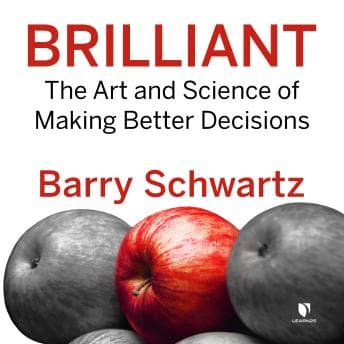

Look, I have a bone to pick with Barry Schwartz. Not because he's wrong—he's frustratingly right about almost everything—but because I finished this audiobook and immediately felt attacked by my own decision-making patterns. You know that thing where you spend forty-five minutes choosing what to watch on Netflix, then give up and scroll your phone instead? Yeah. He explains exactly why we do that. And now I can't unknow it.
The research actually shows that more choices don't make us happier. They paralyze us. Schwartz has been saying this for decades, and hearing him lay it out across fourteen lectures while I was doing my morning jogs through Cambridge was... honestly kind of therapeutic? My therapist would have thoughts about this. Mostly along the lines of "I told you so."
Why Lecture Format Actually Works Here
So here's the thing about author-narrated audiobooks: they're a gamble. Sometimes you get someone who clearly should have stuck to writing. But Schwartz? The man has been teaching undergrads at Swarthmore for five decades. He knows how to hold attention. His delivery is warm, clear, and peppered with these little anecdotes that make you go "oh, that's why I did that dumb thing last week."
Is it going to feel like a professional narrator with seventeen different character voices? No. But that's not what this is. This is sitting in on a really good college lecture series, except you're in your running shoes and nobody's going to quiz you afterward. The pacing works for absorbing complex ideas without feeling like you're drowning in academic jargon.
I will say—and this is important—if you're expecting a traditional audiobook experience, you might be disappointed. Some listeners apparently wanted more production value, more dynamic storytelling. I get it. But for me, the lecture format matched the content perfectly. You're learning decision science from someone who's spent his career studying it. Why would I want an actor interpreting that?
The Psychology That Actually Sticks
What makes this audiobook compelling is how Schwartz connects abstract research to stuff you actually deal with. Buying a birthday gift. Choosing a career path. Making moral choices when there's no clear right answer. He doesn't just tell you "here's what the studies say"—he shows you why it matters in your daily life.
The concept of satisficers versus maximizers hit me hard. (Maximizers are the people who need to check every option before deciding. I am unfortunately one of these people. It's exhausting.) Schwartz explains why maximizers are consistently less happy with their choices, even when they objectively make better ones. It's a different angle on self-sabotage than what you'd find in something like Girl, Wash Your Face, but with significantly more empirical backing. The research is solid, the examples are fresh, and I found myself nodding along like an idiot on the bike path.
He also gets into public policy and professional contexts, which—okay, I'm an academic, so this is my jam. But even if you're not, the principles transfer. How do institutions make decisions? Why do some systems produce worse outcomes despite more options? It's fascinating watching individual psychology scale up to organizational behavior.
Who This Is (and Isn't) For
Best for: Anyone who's ever stood in a grocery store aisle paralyzed by seventeen types of peanut butter. Fans of psychology and behavioral economics. People who learn well from lecture formats. Commuters who want something substantive but not overwhelming. If you liked Thinking, Fast and Slow but wanted something more accessible, this is your book.
Skip if: You need high production value. You find academic tones dry even when they're engaging. You want a professional narrator with vocal range. (Though honestly, Schwartz's warmth surprised me.)
At 5 hours and 44 minutes, it's the perfect length for a week of commutes or a couple of dedicated listening sessions. I'd actually recommend 1.25x speed if you're comfortable with that—Schwartz speaks clearly enough that it works without losing anything.
My Satisficer Moment
I walked away from this audiobook genuinely thinking differently about how I approach choices. That doesn't happen often. Schwartz isn't trying to sell you a life-changing system or seven steps to better decisions. He's giving you the science, the context, and the tools to figure it out yourself. Which is way more useful, honestly.
Will I stop agonizing over restaurant menus? Probably not. But at least now I understand why I'm doing it. And that's something.