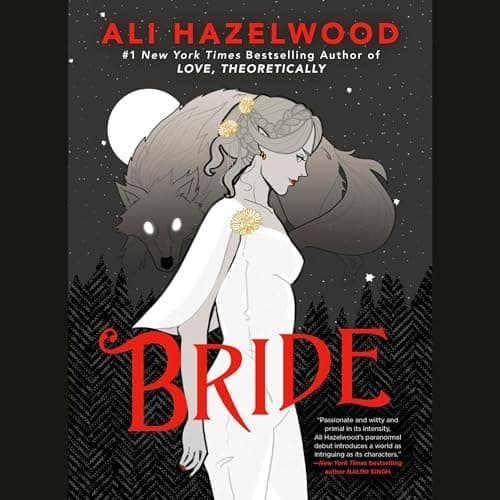

I was shelving returns in the back of the library — the part where the fluorescent light flickers in a way that's either a wiring problem or a poltergeist, take your pick — when I hit the scene where Misery Lark first enters Were territory. And I thought: okay, Ali Hazelwood. You have my attention. A neuroscience professor writing paranormal romance about a Vampyre bride traded to a werewolf pack like political currency? This shouldn't work as well as it does. But here we are.
A Neuroscientist Walks Into a Werewolf Den
Let me be upfront: I came to this as a horror person, not a romance person. My podcast listeners know I'll take dread over desire any day. But Bride does something I genuinely respect — it builds a three-faction world (Vampyres, Weres, Humans) where the political tension actually feels like it has stakes beyond who's going to kiss whom. Misery is an outcast in every direction. She's too Vampyre for the Humans, too independent for the Vampyre Council, and a literal interloper among wolves. Hazelwood leans into that isolation, and the first half of the book really hums because of it.
The paranormal worldbuilding is fresh in a way I didn't expect from someone known for STEM-nerd romances. The Vampyre society has this cold bureaucratic cruelty to it — Misery's father treats her like a chess piece, not a daughter — and the Were pack operates on instinct and loyalty in a way that creates real cultural friction when Misery shows up performing detachment like it's a survival skill. Which, for her, it is. That particular flavor of isolation — an outsider learning to survive inside a world with rules designed to exclude her — is something I kept turning over in my head, and it reminded me of the quieter existential displacement I wrote about in French Gardener.
Where the second half loses some momentum — and I know I'm not alone in this — is when the political thriller elements start competing with the romance for oxygen. There's a mystery thread involving someone Misery is desperate to find, and while I won't spoil it, the resolution felt rushed compared to how carefully everything was set up. The pacing shift around the midpoint is noticeable. Not fatal, but noticeable.
Thérèse Plummer Carries This on Her Back
Here's the thing about this audiobook's structure that drove me a little nuts: Will Damron — who is a genuinely talented narrator — gets maybe one sentence at the start of each chapter. One sentence. As Lowe. That's it. Then Plummer takes over for everything else, including Lowe's dialogue. It's not dual narration in any meaningful sense. It's dual narration as a garnish.
And look, Plummer is excellent. Her Misery is dry, guarded, and occasionally devastating — she nails the sarcasm that's clearly a defense mechanism, and there's this moment where Misery's emotional walls crack that Plummer delivers with this quiet break in her voice that genuinely got me. She understands that Misery's humor is a shield, and she plays the difference between performed indifference and real vulnerability with precision.
But Damron is right there, clearly capable of doing more, and the production just... doesn't let him. It's like hiring a fantastic guitarist and only letting them tune up. My podcast listeners are going to love debating this one because the narration is simultaneously the audiobook's greatest strength and its most frustrating limitation.
Yes, Let's Talk About the Knotting Scene
I'm a horror person. I've listened to descriptions of body horror that would make most people turn off their headphones. So when I tell you that the knotting scene in this book made me pause and stare at the ceiling of my apartment while Shirley (my cat) judged me from the bookshelf — you understand that Ali Hazelwood committed to the bit. The spice is here. It's paranormal-specific spice. If you know, you know. If you don't know, you're about to find out.
The romance itself is slow-burn in the best way. Lowe tracking Misery's movements, the gradual erosion of distrust, the way physical proximity becomes emotional proximity — it works because Hazelwood earns it. These two have legitimate reasons not to trust each other, and the book doesn't rush past that for the sake of getting to the good stuff.
Who Gets This and Who Bounces
If you're coming from Hazelwood's contemporary romances expecting the same energy — recalibrate. This is darker, weirder, and the humor is more biting than cute. If you need balanced dual narration where the male lead gets equal time, this audiobook will frustrate you. But if you want a paranormal romance that actually builds its world with some teeth (pun earned, not sorry), and you can accept that Plummer is essentially running a one-woman show with occasional guest appearances — this is a genuinely fun thirteen hours.
I listened in the dark. Mistake? Maybe. Worth it? Absolutely. Not because it scared me — this isn't horror, despite the vampires and werewolves — but because Plummer's delivery of Misery's loneliness hits different when there's nothing else to focus on.
Shelving This Under "Pleasant Surprise"
I went in skeptical. A bestselling romance author's first paranormal outing, narrated in a format that underuses half its cast? Every instinct said this would be background noise. But Hazelwood understands something important: monsters are only interesting when they're people first. Misery Lark is a person first. And Plummer makes sure you never forget it.