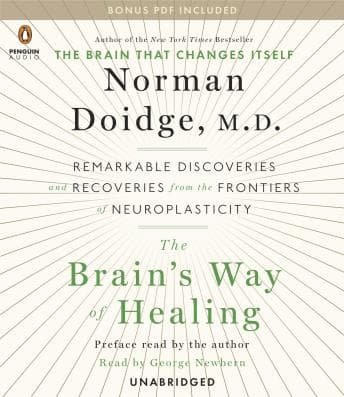

"The brain is not a machine... it's alive, and it's doing things all day long to keep itself in working order."
That line hit different at 6:17 AM on a Tuesday, half-conscious on Caltrain, staring at a guy across the aisle who was also clearly running on caffeine and spite. I was about seven hours into Doidge's book at that point, and something had shifted in how I was thinking about - well, about thinking itself.
Your Brain Is Running Self-Healing Microservices and You Didn't Even Know
TL;DR: Worth your commute. This is basically a well-documented bug report on why we've been wrong about the brain for centuries, plus the hotfixes that actually work.
So here's the thing. I debug distributed systems for a living. I think about fault tolerance, redundancy, graceful degradation. And Doidge basically convinced me that the brain has been doing all of this since before we had words for it - we just kept treating it like a static hardware problem instead of a dynamic, self-modifying system. That framing alone made this book click for me in a way that pure neuroscience texts never have.
Doidge structures the book around case studies, and they're wild. There's a man with chronic pain so severe he could barely function who essentially rewired his pain pathways through specific visualization exercises. There's the Parkinson's patient who uses conscious walking techniques - breaking each step into deliberate micro-movements - to override the disease's disruption of automatic movement. The chapter on the South African doctor (Masgutova, actually Russian, but working globally) using reflex integration for children with cerebral palsy had me genuinely pausing the audiobook to google her protocols, which is not something I do lightly at 1.5x speed on a moving train.
What makes Doidge credible versus the usual "your brain can do ANYTHING" self-help crowd is that he actually explains the mechanisms. He breaks down how light therapy at specific frequencies can affect mitochondrial function in neurons, why low-intensity laser light penetrates tissue differently than high-intensity, why some sound frequencies seem to activate the vagus nerve in ways that reduce sensory hypersensitivity in autistic children. The science actually holds up - or at least, he's honest about where it's established vs. where it's still experimental. He flags the gaps, which I respect.
Where the Signal-to-Noise Ratio Dips
Okay, here's my complaint. At 14.5 hours, this book is long. And around the middle chapters - particularly the extended section on the Feldenkrais method - I felt like I was reading documentation that could've used a tighter PR review. Doidge clearly loves Feldenkrais (like, a lot), and the detail on Moshe Feldenkrais's personal biography, while interesting, goes deep enough that I lost the thread of the neuroplasticity argument for stretches. I bumped to 1.75x for about two hours in that section. Not because it was bad, but because the ROI on my attention was dropping.
Also - and this is minor - some of the recovery stories feel almost too clean. Patient has devastating condition, tries unconventional approach, experiences remarkable improvement. Doidge does include caveats and acknowledges that not everyone responds the same way, but the case-study structure naturally selects for success stories. My engineer brain wanted the failure cases too. What about the people who tried these approaches and got nothing? That data matters.
George Newbern Keeps the Fantastical Grounded
Newbern's narration is exactly what this material needs. He reads with a moderate, even pace that keeps you from either zoning out or getting overhyped. When Doidge is describing something that sounds borderline miraculous - like a woman recovering significant function after a stroke that doctors said was permanent - Newbern doesn't lean into drama. He just... delivers it straight. And that restraint actually makes the science more convincing. If the narrator had gone full TED-talk energy, I think I would've trusted the content less.
His diction is clean enough that I never had to rewind for a medical term, which at 1.5x speed on a noisy train is not nothing. No funny accents, no character voices (it's nonfiction, obviously), just consistent, intelligent reading. The Earphones Award it won makes sense.
Perfect For: Train, Long Walks, Focused Housework. Skip For: Gym.
This isn't a book you can half-listen to while deadlifting. The case studies require enough attention that you need at least 60% of your brain available. But for a commute? Ideal. I finished this in about 5 commutes (round trips), and it genuinely changed how I think about recovery, aging, and what "fixed" means when we're talking about the brain.
If you read (or listened to) The Brain That Changes Itself - this is the practical sequel. Less "here's what neuroplasticity is" and more "here's what people are actually doing with it." If you're a software person, think of the first book as the whitepaper and this one as the implementation guide.
Kevin asked me what I was listening to last week and I spent 20 minutes explaining the light therapy chapter. He now regrets asking. But he also ordered a copy, so. (Unrelated to neuroplasticity, but also in my recent commute rotation and also causing me to corner people with unsolicited summaries: Simon vs. the Homo Sapiens Agenda — completely different subject matter, but the same quality of making you want to press it into someone's hands on a train platform.).
Ship It
Get this if you're even mildly curious about how the brain repairs itself, or if you've ever been told "that's just how it is" about a neurological condition and thought, that can't be right. Doidge makes a strong case that it often isn't. Not perfect - a bit long, a bit too optimistic in spots - but the signal is strong and the narration is clean. Worth your credit.