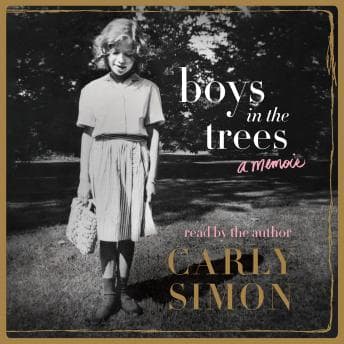

"I stuttered all through childhood and I stutter now." Carly Simon says this early in the audiobook, and it's not a disclaimer — it's a declaration. She's telling you: this is me, unpolished, unperformed. Take it or leave it. I took it.
I was up past midnight, supposedly grading sophomore essays on The Great Gatsby — the irony of listening to a memoir soaked in old money, artistic ambition, and doomed romance while marking up seventeen-year-olds' attempts to explain the green light was not lost on me. But somewhere around hour three, the essays were face-down on the kitchen table and I was just... sitting there. Listening. Denise came downstairs, saw my face, and said, "Bad book?" No. Good book. The kind that makes you forget you're supposed to be doing something else.
The Daughter of Simon & Schuster Who Chose Songs Over Sentences
Here's what gets me about this memoir: Carly Simon grew up in a house where books were literally the family business. Her father co-founded Simon & Schuster. She was raised among writers, intellectuals, musicians passing through their living room like it was some kind of cultural revolving door. And yet the secrets in that house — the ones that surface in the middle chapters with devastating quiet — remind you that proximity to culture doesn't protect anyone from damage.
The section about her childhood molestation by a family friend is handled with this strange, almost clinical tenderness. She doesn't sensationalize it. She doesn't rush past it either. You hear it in her voice — this husky, slightly unsteady register that drops lower when she's approaching something painful. That same quality — trauma recalled without theatrics, just the weight of it sitting there in the room with you — is exactly what made What Happened To You? one of the more unexpectedly affecting listens I've had this year. It's not performance. It's memory working in real time. This reminds me of what Hemingway said about writing — you leave out the thing you know, and the reader still feels it. Simon does this with her voice. The pauses between sentences carry as much weight as the words.
And then there are the songs. She walks you through writing "Anticipation" — how it came together in the nervous minutes before a date with Cat Stevens, of all people — and suddenly you hear the original composition she recorded for this audiobook. Not a reproduction. Not a cover. Something new, written specifically for this moment in the narrative. The prose deserves to be savored, but these musical interludes? They turn a memoir into something closer to a one-woman show. A good narrator doesn't just read — they interpret. Simon interprets her own life, and the music is her annotation.
James Taylor and the Slow Architecture of Heartbreak
Look, I teach literature. I've read a hundred fictional marriages fall apart. But listening to Carly Simon describe the unraveling of her relationship with James Taylor hit different. Maybe because she doesn't villainize him. She doesn't even really explain him. She describes a man who was brilliant and absent, tender and unreachable, and she does it with this aching matter-of-factness that reminded me of the best passages in Joan Didion's The Year of Magical Thinking — that same refusal to dress grief up in pretty metaphors.
The stuttering, which some listeners have flagged as a distraction — I want to push back on that. Hard. For thirteen and a half hours, you are inside this woman's actual voice, stammers and all, and those hesitations do something no professional narrator could replicate. They make you lean in. They make the fluent passages feel earned. When she hits a stretch of smooth, confident storytelling — describing Greenwich Village in the '60s, or the rush of hearing "You're So Vain" climb the charts — the contrast with those rougher moments gives the whole thing texture. My students would hate this. I love it.
Who This Is Really For (and Who Should Probably Skip It)
If you want a gossipy tell-all about famous ex-boyfriends and '70s rock excess, you'll get some of that. But you'll also get long, reflective passages about family dynamics, creative process, and the cost of living your emotional life in public. It's closer to a literary memoir than a celebrity autobiography. If you loved Patti Smith's Just Kids, this is its spiritual successor — different era, different scene, but the same willingness to be honest about what art takes from you.
Skip it if you need a tight, chronological narrative with a clean arc. Simon wanders. She circles back. She lingers on moments that matter to her even when you're not sure yet why they matter to you. (They will. Give it time.)
And for the love of everything — listen at 1.0x. The musical interludes alone demand it, but beyond that, the rhythm of her speech, the way she lets silence sit between thoughts, that's not dead air. That's punctuation. The narrator understands that pause is punctuation.
Worth Pausing the Faculty Meeting For
This is an audiobook that could only exist in audio. The print version is fine, I'm sure. But you'd lose the stutter. You'd lose the music. You'd lose the way her voice cracks, just slightly, when she talks about her father. You'd lose the thing that makes this memoir feel less like a book and more like a late-night conversation with someone who's finally ready to tell you the truth. Worth pausing the faculty meeting for — and Principal Martinez, I promise, that's the highest compliment I can give.






![Steve Jobs [unabridged audiobook] audiobook cover](/_next/image?url=https%3A%2F%2Fcovers.audiobooks.com%2Fimages%2Fcovers%2Ffull%2F9788499923406.jpg&w=1920&q=75)