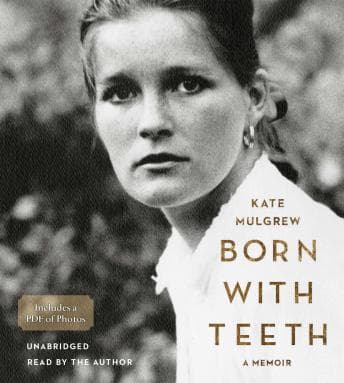

I started this one at my kitchen table, still in scrubs, folding tiny socks that absolutely do not belong to children who were just born yesterday but somehow now have opinions about breakfast. The house was quiet. Dangerous kind of quiet. And Kate Mulgrew came into my ears sounding like the kind of woman who has earned every sharp edge she has.
That voice matters here.
Because Born with Teeth is not one of those celebrity memoirs where somebody name-drops, tosses out a few set stories, and calls it vulnerability. Mulgrew goes straight for the places that still hurt - her loud Irish Catholic family, her mother's thwarted artistic life, the decision at eighteen to leave her Midwestern town for New York, and the gut-punch of giving up her daughter for adoption when her career was just beginning to catch fire. You can hear where she's still bleeding a little. Not in a messy way. In a controlled, actorly, very Kate Mulgrew way.
That Irish Catholic heat
The family material is some of the best in the whole audiobook. Not because it's cute. Because it explains her. The description of being raised by people who knew how to drink, dance, talk, and stir up the devil isn't just backstory - it's the blueprint for that voice, that force, that refusal to shrink. She sounds like she grew up in a house where everybody was arguing, laughing, reciting something dramatic, and slamming a pot down for emphasis.
And her mother hangs over the whole memoir in a way that feels very real. A would-be artist buried under babies. A cautionary tale for a daughter who decides she will not go under quietly. That tension gives the book its spine. My mom would love this (she still thinks I should've been a doctor), because beneath all the career stuff, this is really about what daughters inherit from women who didn't get the life they wanted.
Mulgrew also gives Stella Adler her due, and the "Use it" lesson lands hard. That advice becomes the organizing principle for everything that follows - ambition, regret, rage, grief, work. You can hear Mulgrew applying that instruction even in the reading itself. Her sentences are measured, theatrical without tipping into nonsense, and paced like someone who knows exactly when to tighten the throat and when to let a line breathe.
The adoption wound never really closes
As someone who spends a lot of time around family trauma - different kind, hospital kind, but still - I have a low tolerance for performative pain. So I was listening carefully when the book moved into the pregnancy, the adoption, and the decades-long shadow cast by that choice.
This is where your mileage may vary.
For me, the material about signing the adoption papers and being allowed only that brief glimpse of her daughter before losing her hit hard. So did the eventual meeting with her birth daughter. Carlos asked why I was crying in the kitchen. I blamed allergies. The emotional architecture of those sections works because Mulgrew doesn't present herself as noble or tidy. She presents herself as a woman who made a brutal choice in a brutal moment and then kept living with it because there was no other option.
I can see why some listeners bounced off those reunion sections and felt a little distance, though. Mulgrew is an actress down to the bone, and sometimes her control makes the emotion feel shaped rather than spilled. If you like memoirs that sound raw and messy and almost embarrassingly unfiltered, this may strike you as too composed. I didn't hear dishonesty, exactly. I heard a woman using craft to survive her own story. There's a difference. But it is noticeable.
When the performer is the point
The audiobook absolutely benefits from being author-narrated. No question.
The Irish lilt in her voice isn't heavy, but it colors the whole performance. It gives warmth to the family stories and extra steel to the career sections. When she talks about working, clawing her way forward, and building the life she wanted, she sounds like she's back on stage proving something. Which, honestly, she probably still is.
And if you came here hoping for acting-world texture, you'll get it. Not in a gossipy, cheap way. More in a bone-crunching work, this-is-the-job kind of way. The Star Trek: Voyager material is there, but it doesn't swallow the memoir, which I appreciated. Same with her rise as an actress more broadly. This book is less interested in celebrity than in cost. What ambition takes. What motherhood takes. What survival takes.
Production-wise, clean audio, no gimmicks, no weird music cues trying to tell you when to feel something. Thank God. Just Mulgrew, a microphone, and very disciplined delivery. Night shift approved.
At 9 hours and 28 minutes, it's also the right length for this kind of life story. Long enough to dig in, not so long that it starts sounding like deleted scenes from a career retrospective.
Who Should Listen (And Who Should Skip)
Pick this up if you like memoirs with actual substance, if you care about acting as labor and not just glamour, or if stories about mothers and daughters tend to get you right in the sternum. Also if you're already a Kate Mulgrew fan - hearing her tell her own story adds a lot.
Maybe skip it if you need your memoirists to sound completely unguarded. Mulgrew is frank, but she is never sloppy. She knows where the light is. She knows how to land a line. If that kind of self-awareness reads as performance to you, parts of this won't fully click.
For me? Worth a credit. Not because every section knocked me flat, but because when it works, it really works. Smart, bruised, funny in spots, and sharp enough to leave a mark.
Some books are confessions. This one feels more like testimony. The only other audiobook I've finished recently where I felt that same sense of a life being argued rather than simply recounted was Midnight Line — completely different world, but that same quality of a narrator who sounds like they've earned the right to say exactly what they're saying.
And Kate Mulgrew knows exactly how to give it.