
"To be out after dark is to invite danger and almost certain death."
That line hooked me somewhere around the forty-minute mark, and I spent the next nineteen hours trying to figure out what kind of book I was actually listening to. I'm still not entirely sure. And honestly? That's both the most fascinating and most frustrating thing about Book of Sand.
Here's what you need to know going in: Theo Clare is Mo Hayder. The Mo Hayder—Birdman, The Treatment, the woman who wrote crime fiction so visceral it made your teeth hurt. She passed away in 2021, and this was her pivot into speculative fiction under a pen name. Knowing that context changes everything about how you receive this book, because you can feel her thriller instincts wrestling with epic fantasy worldbuilding the entire time. Sometimes that tension produces something genuinely electric. Sometimes it produces confusion.
Two Worlds That Don't Want to Share a Book
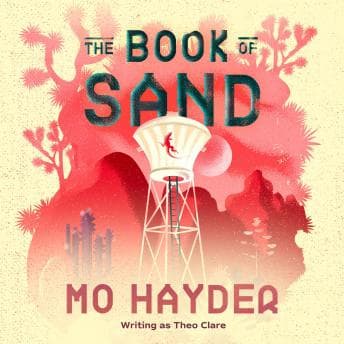
The dual-narrative structure is ambitious. You've got this scorched, post-apocalyptic sand world where a found family is desperately searching for a mysterious object near water—racing other families who'll kill for it—and then you've got McKenzie Strathie in Fairfax County, Virginia, finding a sand-lizard in her bed and slowly realizing her suburban reality might be a lie. The sand world sections are where Hayder's horror instincts shine. The dread of nightfall in that landscape, the way the family talks about darkness like it's a living predator—this understands that horror isn't about gore, it's about dread. Orb of Binding works that same nerve—the darkness as antagonist rather than backdrop—and I spent a lot of that listen with my lights on for the same reason. The ticking clock of sunlight running out gave me genuine anxiety.
But the Virginia sections feel like a different book. Not bad, just... disconnected for long stretches. I was shelving returns at the library during some of the McKenzie chapters, and I realized I'd zoned out for a solid five minutes without missing anything that felt urgent. The pacing whiplashes between these two timelines, and in audio format specifically, keeping track of which world you're in requires real concentration. I've seen other listeners say the story is hard to follow in audio, and yeah—I get it. This is not a multitasking book. This is a sit-down-and-focus book.
Kristin Atherton's News Anchor Problem
Kristin Atherton does solid work with the character voices. The family members in the sand world each get distinct vocal identities, and her dialogue delivery carries real weight during the tense confrontation scenes between rival families. When characters are talking, she commits. That's rare.
But here's the thing that kept pulling me out: the descriptive passages. Atherton reads the world-building prose—and there's a lot of it—in this flat, news-broadcast register. Measured. Even. Like she's reporting on the apocalypse rather than living in it. For a world this alien and hostile, I needed more texture in the narration of the landscape itself. The sand should feel oppressive. The heat should warp the words. Instead, the descriptions land like weather reports between the character scenes that actually breathe. It's not a dealbreaker, but across nineteen and a half hours, you notice the pattern.
The Ghost of Mo Hayder
What kept me listening—what genuinely surprised me—is how Hayder smuggles her thriller DNA into fantasy. There are scenes in the sand world that read like survival horror, not epic quest. The family dynamics carry a psychological edge that most fantasy authors wouldn't think to include. People lie to each other. They withhold information not for plot convenience but because they're scared and human and broken. That's pure Hayder.
But she's also building a mythology from scratch here, and at nineteen-plus hours, the first-in-a-series setup weight is real. There are stretches where you can feel the scaffolding. Rules being established. Lore being laid. It's necessary work, but it reads (listens?) like necessary work rather than story. Shirley Jackson walked so this author could run—but Hayder's still finding her footing in this new terrain, and you can tell.
I listened to the final three hours in the dark. (My apartment, 11 PM, Shirley curled on the radiator doing her gargoyle impression.) The convergence of the two narratives in the last act almost justifies the slow build. Almost. There's a revelation that recontextualizes McKenzie's story in a way that made me physically sit up. But the book ends on a cliffhanger that felt less like a promise and more like the story simply... stopped. White Noise left me with that same unsettled, unresolved feeling—like the floor had shifted but nobody told you where the new center of gravity was.
Who Walks Into the Sand
If you're a Mo Hayder fan curious about her range—yes, listen to this. Her voice is unmistakable even in a completely different genre. If you love survival horror with speculative elements (The Road meets Annihilation by way of Dark Tower), the sand world sections alone are worth your time. If you need tight pacing and narrative clarity in your audio, this might test your patience. This is a book that demands you meet it more than halfway.
My podcast listeners are going to have opinions about this one. I can already hear the emails.
The Candle Burns, But It Flickers
I wanted to love this more than I did. The bones are extraordinary—Hayder building dread in a fantasy landscape is exactly the kind of genre-blending that gets my heart rate up. But the execution across two timelines, in audio, with a narrator who excels at dialogue but flattens description, creates an uneven experience. It's a three-and-a-half-star book with five-star moments trapped inside it. I'll be back for book two. But I might read it next time.