
"Some of these very powerful people don't see the rift as a problem. They intend to use it as an opportunity."
That line — somewhere around the two-hour mark — is when I sat up straighter at my kitchen table, pushed my cold coffee aside, and thought: okay, B.T. Narro, you have my attention. Because that's the thing about fantasy that actually works. It's never really about the magical apocalypse. It's about the people who'd rather ride the apocalypse to power than stop it.
The Rift Between What's Said and What's Meant
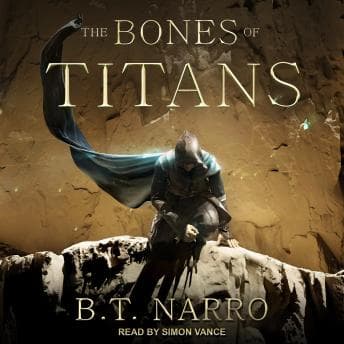
Let me be upfront: Bones of Titans is a mid-series entry in Narro's Mortal Mage world, and it carries that weight — both good and bad. If you've been following Leo, Andar, and Rygen through the earlier books, there's a payoff rhythm here that rewards your investment. The political maneuvering around the rift feels earned because you already know these factions, their grudges, their buried agendas. The mysterious mage who hasn't aged in twenty-three years? That's a hook that lands harder when you've lived in this world long enough to understand what should and shouldn't be possible within its magic system.
But if you're walking in cold — and I'll be honest, I came in with only surface-level familiarity with the series — there's a learning curve. Not a brutal one, but the kind where you're piecing together relationships and political alignments through context clues for the first hour or so. Narro doesn't hold your hand with exposition dumps, which I respect, but it does mean this isn't the entry point. Don't start here. You'll be lost by the time Leo arrives with half the human army and you're supposed to care about which leaders are genuine and which are playing angles.
What works: the trust problem at the center of the plot. Leo doesn't know if this reappeared mage created the rift or is the only one who can destroy it. That ambiguity drives nearly every decision, and Narro keeps the tension alive by never letting you fully settle on an answer. It's the kind of political fantasy that understands paranoia is more interesting than certainty. That same slow-burn suspicion of everyone in the room is something If It Bleeds does with a completely different genre toolkit — and it stuck with me for similar reasons.
What's less convincing: some of the obstacles Leo faces feel like they exist to extend the plot rather than deepen it. There's a middle stretch — maybe hours five through seven — where the story cycles through "new problem, partial solution, new problem" without the escalation you'd want. The pacing isn't bad, exactly, but it plateaus when it should be climbing.
Simon Vance Makes You Forget He's One Person
Here's where this audiobook earns its keep. Simon Vance is — look, you know the name. The man has narrated approximately ten thousand books (slight exaggeration, but barely), and there's a reason. His approach to multi-character dialogue is almost sneaky. He doesn't do big theatrical voice shifts for every character. Instead, it's subtle tone changes, slight adjustments in cadence, the way one character clips their consonants while another lets sentences trail with a kind of aristocratic laziness. You stop tracking "who's talking" because your brain just knows.
The mage character particularly benefits from this. Vance gives him this measured, slightly detached quality — like someone who's seen enough that urgency doesn't quite register the way it should. It fits perfectly for a man who's been missing for over two decades and returned apparently unchanged. There's something unsettling about how calm he sounds when everyone else is panicking about a world-ending rift, and I don't think that lands nearly as well on the page as it does in Vance's delivery.
The narrator commits. That's rare.
I will say: if you're coming from Vance's work on denser, more literary fantasy (his Patrick Rothfuss narration, for example), this is a lighter lift. The prose doesn't demand the same vocal gymnastics. But that's a book issue, not a narrator issue. Vance gives exactly what the material asks for and then some.
Who Needs This in Their Ears (and Who Doesn't)
If you're already invested in the Mortal Mage series — and the listener reviews suggest most people picking this up are — this is a solid continuation. The political intrigue around the rift is genuinely engaging, the trust dynamics keep you guessing, and Vance's narration elevates what could be standard fantasy fare into something you actually want to sit with. My podcast listeners who love magic-system-driven fantasy with political teeth? You'll dig this.
If you've never read Narro before, start at the beginning. This book assumes you care about these characters, and it's right to assume that — but only if you've earned that care through the earlier entries.
If you scare easily — wrong genre, wrong reviewer, wrong podcast. But this one's not really horror adjacent anyway. It's the quieter dread of not knowing who's lying to you while the world splits open.
Shelved Next to the Series, Not on Its Own
I listened to most of this while reorganizing the back stacks at the library — those quiet late afternoons when the building's almost empty and Oregon rain is doing its thing against the windows. Good context for a book about people trying to hold a crumbling world together. Shirley (my cat, not Jackson) was unimpressed when I got home and wanted to talk about unreliable mages. She's heard it all before.
Bones of Titans isn't going to convert anyone who isn't already on board with Narro's world. But for those who are? It does what a mid-series book should do: deepen the stakes, complicate the alliances, and leave you reaching for the next one. Vance makes sure the journey there sounds damn good.