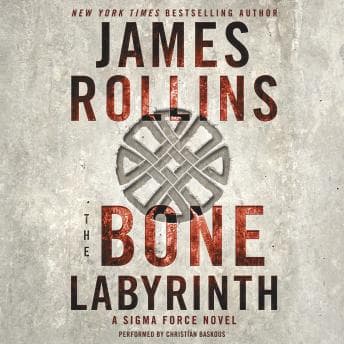

Look, I'll be honest - James Rollins is not what I typically reach for. My students would probably be shocked to see me listening to something with "action-packed" in the description instead of, say, another Faulkner deep dive. But here's the thing: sometimes you need a palate cleanser. And sometimes that palate cleanser turns out to be a 15-hour odyssey spanning 50,000 years of human evolution, Neanderthal bones in Croatian caves, and a signing gorilla named Baako who genuinely made me tear up during a faculty meeting. (Principal Martinez, if you're reading this, those were allergy tears. Definitely allergies.)
The Bone Labyrinth is the kind of book that shouldn't work. It throws everything at the wall - Atlantis, moon landing conspiracies, primate intelligence research, ancient cave paintings, genetic manipulation - and somehow Rollins makes it cohere into something genuinely propulsive. Is it literary fiction? No. Does it have the kind of prose that deserves to be savored at 1.0x speed? Honestly, not really. But it does something else entirely: it makes you forget you're grading papers at 11 PM.
Christian Baskous Earned That AudioFile Award
I couldn't find much about Baskous online beyond his Earphones Award, but based on this performance? I get it. The man juggles an international cast - Croatian archaeologists, Chinese villains, American special ops, and a remarkably expressive gorilla - without ever losing the thread. His accents aren't showy; they're functional. You always know who's speaking, which in a book with this many characters across this many locations is no small feat.
What really struck me was his handling of the emotional beats. There's a relationship between one of the researchers and Baako the gorilla that could've felt ridiculous in lesser hands. Instead, Baskous plays it completely straight, finding the genuine pathos in their bond. When things go sideways - and they go very sideways - you feel it. That's craft.
The action sequences, too. Rollins writes them breathlessly, and Baskous matches that energy without tipping into melodrama. He knows when to push and when to pull back. At 15 hours, that restraint is genuinely impressive.
Where the Science Meets the Thriller
This is where I have to put on my teacher hat for a second. (I know, I know.) Rollins does something interesting here that reminds me of what the best historical fiction does - he uses real science and real history as scaffolding for his imagination. The Neanderthal cognitive research is grounded in actual paleoanthropology. The primate language studies draw from legitimate work with great apes. He's not just making stuff up; he's extrapolating from the edge of what we know.
Is it accurate? Probably not entirely. But it's plausible enough that you don't get knocked out of the story by obvious nonsense. And there's something genuinely thought-provoking about his central question: what made us human? What cognitive leap separated us from our Neanderthal cousins? These are questions I've discussed with students reading everything from Sapiens to Frankenstein. Song of Achilles explores similar territory about what makes us human, just through the lens of Greek mythology instead of paleoanthropology. Rollins just wraps them in explosions and ancient conspiracies.
The Atlantis stuff... okay, that's where he loses me a bit. It's a lot. But even that connects to legitimate archaeological mysteries about lost civilizations and ancient knowledge. He's playing in the same sandbox as Graham Hancock, just with more gunfights.
The Gut-Punch Moments
Without spoiling anything, there are sequences in this book that genuinely surprised me. Not with twists - thriller twists are a dime a dozen - but with emotional weight. The scenes in the primate research facility are harrowing. The climactic revelations about human origins are legitimately unsettling. And that ending? Rollins wasn't kidding when he said Sigma would falter.
I found myself listening through my lakefront walk with Denise, then sneaking in another chapter during lunch, then finishing the last three hours in a single grading session. My students' essays on The Great Gatsby suffered. Worth it.
Who's This For (And Who Should Skip It)
If you loved Michael Crichton's science thrillers or Dan Brown's historical puzzles but wished they had more emotional depth and better character work, this is your book. Skip it if you need literary prose or can't tolerate some Atlantis-adjacent speculation - Rollins goes big, and not everyone wants that.
Mr. Williams's Final Grade
Probably not a re-listen - it's not that kind of book. But would I recommend it to someone who needs a break from literary fiction without feeling like they're rotting their brain? Absolutely. It's smart enough to respect your intelligence while being propulsive enough to keep you hooked through 15 hours.
My students would probably love this, actually. Maybe I should add it to the summer reading list. (I won't. But I should.)
Baskous's narration elevates it from beach read to genuine audiobook experience. Just maybe don't listen during important meetings. The gorilla scenes hit different when you're supposed to be paying attention to budget presentations.