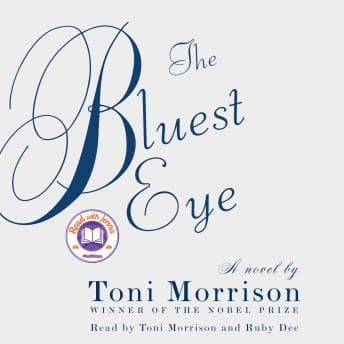

I was up at 2 AM finishing a logo that was due yesterday, Frida curled on my lap and Diego perched on the monitor like a gargoyle, and I put this on thinking — three hours, I can finish work and listen to something short before bed. I did not go to bed. I sat in the dark for twenty minutes after it ended, staring at my screen saver, trying to remember how to be a person.
This book felt like swallowing a stone.
The Weight Ruby Dee Carries in Every Syllable
Let me tell you about Ruby Dee's voice in this. It's not warm. It's not comforting. It's something older and harder than that — like your tía who's seen too much and doesn't soften the truth for you anymore. When she voices Pecola's mother Pauline, there's this specific brittleness, this clipped exhaustion of a woman who's traded her own tenderness for survival and doesn't even remember making the deal. And then when she shifts to the community voices — the gossiping women, the Maginot Line, the children narrating — she pulls back into something almost sing-song, almost folkloric, like she's telling you a story that's already been told a hundred times and still nobody's listened.
The abridged format is worth mentioning because it's only three hours, and honestly? I felt every single minute. Not because it drags — it doesn't — but because the density per sentence is absurd. Morrison packs more devastation into a paragraph than most authors manage in a chapter. Ruby Dee knows this. She doesn't rush. She lets the silences breathe. There's a passage about the marigolds not growing that season, and Dee reads it with this quiet flatness that hit me harder than any dramatic performance could have.
Toni Morrison herself does the introduction, and hearing her voice — knowing she's gone now — that's its own kind of grief. Her speaking voice has this measured authority, like every word has been weighed on a scale before she offers it to you.
Pecola Breedlove and the Ugliest Thing America Ever Did
I've read Beloved. I've read Song of Solomon. But The Bluest Eye wrecked me differently because Pecola is eleven. She's eleven and she's already internalized that the Shirley Temple cup matters, that the Mary Jane candy wrapper with the blond girl's face is the closest she'll get to being seen as beautiful. Morrison doesn't let you look away from what that does to a child's interior world. She just — holds your face to it.
And here's what gets me: this isn't just a Black American story, though it is absolutely, specifically, unflinchingly that. It's also a story about what happens when a culture decides whose face is the default setting for "beautiful" and whose face is the error message. That quiet violence of being told you're wrong just by existing — None of This is True circles a similar darkness about the stories we build around identity, and it wrecked me in its own way. Growing up brown in San Antonio, watching my abuela bleach her arm hair before church, watching my cousins straighten their hair until it broke — I felt the echo of Pecola's prayer in places Morrison probably never intended it to reach. That's not me claiming this story. It's me saying it radiated outward and burned.
Abuela would have clutched her rosary at the Cholly chapters. She would have cried. She would have said "esa pobre niña" and meant it with her whole chest.
Three Hours That Will Sit in Your Bones
I ugly-cried. Not the pretty kind. The kind where Diego actually got down from the monitor and sat next to me, which he never does because he's emotionally unavailable.
Compared to Beloved — which is Morrison's most famous audiobook, and which I listened to last year — The Bluest Eye is smaller, quieter, and in some ways crueler. Beloved is a haunting. The Bluest Eye is a wound that never gets dramatic enough for anyone to treat. Ruby Dee's performance doesn't have the theatrical range of a Toni Morrison full-cast production, but that almost works better here. One voice telling you this story feels like testimony. Like a witness.
The abridged format is the one thing that gives me pause. At three hours, I know I'm missing Morrison's prose — some of the Breedlove family backstory, some of the seasonal structure that gives the novel its rhythm. If you're a Morrison devotee, you might feel the gaps. But as a listening experience on its own, this recording is a gut punch delivered with devastating precision.
Who Needs This (and Who Should Brace Themselves)
If you want comfort, this is not it. If you want to feel something so deep it rearranges your understanding of what fiction can do — three hours. That's all it asks. Content warnings are real: abuse, sexual violence against a child, and the kind of systemic cruelty that doesn't come with a villain because the villain is everything. Go in knowing that.
If you've only read Morrison on the page, hearing Ruby Dee interpret her is a completely different animal. The dialect work alone — the way she shifts between the children's voices and the adults' worn-down cadences — gives you something the page can't.
The Book That Made Diego Sit Next to Me
My heart. MY HEART. This is a sit-in-the-dark-after book. A stare-at-the-ceiling book. A call-someone-you-love book. It's only three hours long and it'll live in you for years. Morrison wrote this when she was in her thirties and already understood something about America that most writers never get close to. Ruby Dee knew it too. You can hear it in every breath she takes between sentences.
Put it on. Just — be ready.