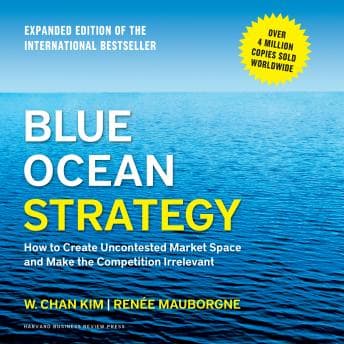

"Make the competition irrelevant."
That line hit me somewhere around hour two, wedged between a guy manspreading into my seat and the Caltrain's aggressive braking near Millbrae. And honestly? It's the entire thesis distilled into five words. If you've ever worked at a company where everyone's obsessing over what competitors are doing instead of, you know, actually innovating—this book will feel like vindication.
The Framework That Actually Ships
Look, I've listened to a lot of business audiobooks. Most of them could've been blog posts. (I'm looking at you, every startup founder memoir ever.) Blue Ocean Strategy is different. It's got the kind of research rigor you'd expect from Principles of Economics, but actually applicable to real-world strategy. Kim and Mauborgne did the work—150 strategic moves across 30 industries over 100 years. That's not a TED talk stretched into a book. That's a legit study.
The core idea is pretty simple: stop competing in "red oceans" where everyone's fighting over the same shrinking pie. Instead, create "blue oceans"—new market spaces where competition doesn't exist yet. Think Cirque du Soleil reinventing the circus, or Southwest Airlines making flying accessible to people who would've driven instead.
What I appreciate as an engineer is the systematic approach. They give you actual tools—the Strategy Canvas, the Four Actions Framework, the Six Paths Framework. It's not just "think different, bro." It's "here's how to map your industry, identify what to eliminate, reduce, raise, and create, and then execute." The ROI on this audiobook is genuinely high if you're in any kind of product or strategy role.
The expanded edition adds some useful stuff too—chapters on alignment and renewal, plus a section on "red ocean traps" that basically calls out all the ways companies think they're innovating but are actually just... not. I found myself mentally auditing my own company's strategy during my commute. (We're definitely in a red ocean. That kind of self-reflection hit harder than anything in Awaken the Giant Within, which tried for introspection but felt more like a pep rally. Don't tell my manager I said that.)
Roger Wayne's Voice Runs Out of Steam
Okay, here's where I have to be honest. Roger Wayne's narration is... fine. It's clear. The audio quality is clean. But around chapter 8, something happens. His voice starts sounding tired. Like, genuinely fatigued. I don't know if it was recorded over multiple sessions or what, but the enthusiasm just drains out.
At 6 AM on a packed Caltrain, I need a narrator who's going to keep me engaged. Wayne does the job in the early chapters, but by the back half, I found myself having to actively focus instead of absorbing passively. For a business book, that's not ideal. I ended up bumping to 1.5x speed, which helped with the pacing but made his already somewhat monotone delivery feel even more robotic.
This isn't a dealbreaker—the content is valuable enough that I pushed through. But if you need dynamic narration to stay engaged, you might struggle. Ray Porter this is not.
Queue It or Skip It?
Perfect for: your commute, especially if you're in product, strategy, or leadership roles. The frameworks are practical enough that you can actually apply them, and the case studies are interesting enough to keep you awake (mostly).
Skip if: you need background audio for deep work sessions. The narration isn't quite engaging enough for passive listening, but the content is too dense to be true background noise. It's in this weird middle zone.
Also skip if: you've already read the original edition and are wondering if the expanded content is worth a re-listen. The new chapters are good but not essential. Maybe skim the Audible preview and decide.
The Commit Message
Yeah, I'd recommend it. Despite the narration issues, the content holds up. This is basically competitive strategy 101, but for people who want to stop playing defense and start creating new games entirely. I finished it in about 4 commutes (at 1.5x), and I've already referenced the Strategy Canvas framework in two meetings.
Is it groundbreaking? Meh. Is it useful? Absolutely. Sometimes that's what you need from a business book—not inspiration, just tools that work.
Bottom Line: The strategy framework is legit. The narration gets tired. Worth your commute anyway.