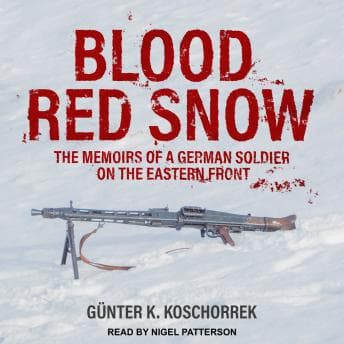

Look, I need to talk about the British accent thing because it's going to bother you and we should just get it out of the way. Nigel Patterson narrates a German machine-gunner's memoir of the Eastern Front in what can only be described as a very proper English voice. It's like watching a documentary about Korean street food narrated by someone from Yorkshire. Your brain spends the first hour going "wait, what?" before it finally gives up and lets you absorb the actual content. And the content - the content is worth that adjustment period.
I was up at 1 AM finishing this one. Jenny was asleep, I was in the kitchen with my earbuds in, and I realized I'd been standing at the counter for twenty minutes just... listening. Not multitasking. Not checking email. Standing there like an idiot while Koschorrek described his unit's escape across the frozen Don River under Soviet fire. That doesn't happen to me. I listen to books at 2.0x while doing three other things. This one made me slow down to 1.25x by hour three.
A Diary Sewn Into a Winter Coat - Literally
Here's what gets me about this book's origin story. Koschorrek kept an illegal diary during the war, scribbled on scraps of paper, and sewed the pages into the lining of his winter coat. Deposited them with his mother during rare home leaves. Then the diary went missing for forty years until his daughter found it in America. Forty years. My parents kept every receipt from their dry cleaning business in Koreatown in shoeboxes under the bed. Different stakes, obviously, but that immigrant instinct to document, to preserve, to make sure someone remembers - I felt that in my chest.
The man went from excited recruit to hollow-eyed survivor over the course of about nine hours of audio. You hear it in how the writing changes. Early entries have this almost naive energy about encountering the enemy on the Russian Steppe. By the time he's fighting street-to-street in Stalingrad, describing how different soldiers in his unit developed their own techniques for surviving the squalor and death, the prose is stripped bare. No heroics. No ideology. Just: this is what happened, this is who died, this is how the snow turned red.
What McKinsey Can't Teach You About Survival
I spent eight years at McKinsey analyzing organizational behavior under stress. Fortune 500 companies facing disruption, startups burning through runway, boards making existential decisions. I thought I understood pressure. This book is a corrective. Koschorrek's descriptions of combat decision-making - who freezes, who moves, who breaks - are more honest than any leadership case study I've ever read. There's no framework. There's no "key takeaway." There's just a 19-year-old kid behind a machine gun trying not to die.
The sections in Romania and Italy hit differently because Koschorrek himself remembers them fondly compared to the Eastern Front. You can hear the relief in the writing. It's like he exhales. And then you remember what he's comparing it to, and "fondly" takes on a whole different weight.
This is what my parents did instinctively - they never complained about the 14-hour days because they'd survived worse. They had their own scale of suffering that made everything in America manageable by comparison. Koschorrek has that same recalibration. Romania isn't objectively pleasant. It's just not Stalingrad.
The Accent Problem (And Why It Stops Mattering)
Back to Patterson. He's an AudioFile Earphones Award winner and his acting background shows - there's genuine emotional weight behind the delivery that a lesser narrator would've flattened. But some listeners will never get past the British voice reading a German soldier's words. I get it. It's like casting Hugh Grant as my dad. The cognitive dissonance is real.
Here's where I landed: by hour four, I stopped hearing "British" and started hearing "soldier." Patterson finds something in the material that transcends the accent mismatch. His voice gets quieter during the worst passages, like he's reading them to himself. That restraint works. A German-accented narrator might have been more authentic, but Patterson's slight distance from the material almost mirrors how Koschorrek himself writes - observing his own horror from a place of stunned remove.
Narrator rating takes a hit because the mismatch IS distracting early on. But it doesn't break the experience.
Who Gets the Most From This
WWII history readers, obviously. But also anyone who's tired of business books telling you about "resilience" without knowing what the word actually costs. If you've ever sat through a leadership seminar where someone quoted Sun Tzu, hand them this instead. It's 9 hours and 43 minutes and not a single one is wasted - which is more than I can say for 90% of what's in my Audible library.
Skip it if you need a polished narrative arc. This is a diary. It's messy and raw and sometimes the timeline lurches. That's the point.
Bottom Line: The ROI on Remembering
Koschorrek wrote this to honor the dead. He waited fifty years to publish it. That's not a content strategy. That's a man settling a debt. The closest parallel I've encountered is The Empire of Russia from the Remotest Periods to the Present Time - a very different kind of document, but one that carries the same weight of someone feeling obligated to make sure the record exists. My 2.0x speed couldn't save this one - not because it's bad, but because slowing down was the whole point. Jenny found me in the kitchen at 1:30 AM staring at the wall. She didn't ask. She just made tea. Some books do that to you.






![Steve Jobs [unabridged audiobook] audiobook cover](/_next/image?url=https%3A%2F%2Fcovers.audiobooks.com%2Fimages%2Fcovers%2Ffull%2F9788499923406.jpg&w=1920&q=75)