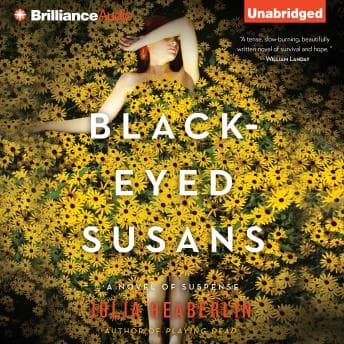

"I am the star of screaming headlines and campfire ghost stories. I am one of the four Black-Eyed Susans. The lucky one."
That opening grabbed me by the collar somewhere around hour zero, and I thought I was locked in for a ten-hour sprint. I was wrong about the sprint part. But let me cut to the chase before I get into the weeds.
A Cold Case With Warm Promise
I picked this one up on a Tuesday night when Linda was out at book club and I was cleaning Ranger's muddy paws after a long walk in the rain. Started it on the back porch with a bourbon, which felt right for a book set in Texas with bones in the dirt. The premise is strong - a teenage girl found barely alive in a field of wildflowers alongside skeletal remains, her testimony sending a man to death row, and now two decades later someone's planting black-eyed susans outside her bedroom window in February. In Texas, those bloom in summer. Somebody's sending a message.
Heaberlin's a journalist, and it shows in the best possible way. The forensic details around the bone identification, the legal mechanics of death row appeals, the way evidence gets reexamined with modern technology - she clearly did her homework. This isn't one of those thrillers where the cops do things no actual law enforcement professional would recognize. The investigation feels grounded, methodical. That same grounded procedural instinct is what made Hound of the Baskervilles hold up for me across a century of distance - Holmes works a scene the way a real investigator would, and you feel the difference. I've worked with forensic teams in theater and the procedural elements rang true enough that I wasn't throwing my phone across the truck cab.
The book toggles between two timelines - Tessa as a traumatized teenager in the aftermath of her ordeal and Tessa as an adult artist and single mother trying to protect her daughter while confronting the possibility she helped convict an innocent man. That structure works well for about the first five hours.
Where the Convoy Stalls
And then the pacing falls off a cliff. Not a gentle slope - a cliff. The first half builds genuine dread. Someone is watching Tessa. The flowers are a threat or a taunt or both. You've got a man on death row and a ticking clock. All the ingredients for sustained tension. But somewhere around the midpoint, the book gets lost in repetitive cycles of Tessa doubting herself, Tessa having fragmented memories, Tessa circling the same questions without making progress. I found myself bumping the speed to 1.5x during a long drive to San Antonio, which is my version of skimming.
The memory loss angle - look, I get it. Trauma does that to people. I've seen it firsthand with soldiers who genuinely cannot reconstruct what happened during an ambush. It's real. But as a narrative device, having your protagonist unable to remember the central event until the very end is a gamble. Heaberlin doesn't quite stick the landing. The revelations, when they come, felt like they should've hit harder than they did. The ending is going to divide people. Some will find it satisfying. I found it a bit rushed after all that slow middle, like the author suddenly realized she needed to wrap things up in the last forty-five minutes.
Three Voices, Uneven Impact
The three-narrator setup - Eric G. Dove, Karen Peakes, and Whitney Dykhouse - is smart in theory. You've got different voices handling different timelines and perspectives, which keeps the timeline shifts from getting confusing. Peakes handles adult Tessa with a quiet intensity that works well for a woman holding herself together by sheer force of will. Dykhouse takes on teenage Tessa, and the contrast between the two voices sells the idea that trauma fundamentally changed this person. Dove covers the male characters and third-person sections.
Here's the thing though - none of them blew me away. Competent. Professional. They create atmosphere and you can picture the Texas heat, the cold February ground, the claustrophobia of Tessa's fear. But I've listened to multi-narrator productions that made me forget I was listening to actors (the full cast of "World War Z" comes to mind). This one stays solidly in "good enough" territory. No audio issues, clean production, no complaints on the technical side.
Who Should Saddle Up - And Who Should Ride On
If you're a Gillian Flynn fan who doesn't need the pace set at combat speed, you'll probably enjoy this. It's got the unreliable narrator, the dark subject matter, the "did she send the wrong man to die" moral weight. Women-in-jeopardy thriller with actual substance underneath. If you need your thrillers moving at all times - if a stalled middle section is a dealbreaker for you - this might test your patience. I'd say it's about sixty percent of a great book, which is frustrating because the premise deserved better follow-through.
Ranger fell asleep during the slow stretch. Make of that what you will.
Worth the Windshield Time?
Solid premise, authentic Texas setting, decent narration, but that sagging middle and a landing that doesn't quite stick keep this from earning top marks. Good for a long drive where you've got miles to burn and don't mind the lulls. Not the book I'd spend my last credit on, but if you catch it on sale or through your library app, it's worth the ten hours. Mostly.