
"But as for you, go your way till the end; for you shall rest, and shall stand in your allotted place at the end of the days."
That's how Daniel closes — not with a bang, not with a dramatic curtain call, but with an instruction to go on living. I was sitting on the back porch last Sunday morning, coffee going cold, Denise still asleep, and Sam Stinson's voice just... landed that final verse on me like a hand on the shoulder. And I thought: twenty years of teaching literature, and I still underestimate this book.
The Strange Two-Headed Beast of Daniel
Here's what I always tell my students about structure (before they stop listening): form is meaning. And Daniel is one of the strangest structural animals in the entire biblical canon. You get six chapters of court narrative — lions' dens, fiery furnaces, mysterious handwriting on walls — and then the book just... pivots. Hard. Into four chapters of apocalyptic fever dream that would make William Blake reach for his sketchpad.
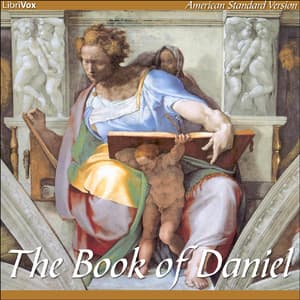
At 1 hour and 13 minutes, this ASV recording doesn't give you time to get comfortable in either mode. The first half plays almost like historical fiction. Daniel and his friends refusing the king's food, Shadrach, Meshach, and Abednego walking through fire, Nebuchadnezzar going mad and eating grass like an ox for seven years — these are genuinely great stories. Tight, dramatic, with clear stakes. My students would actually pay attention to these parts. (I know because I've tested it. Chapter 5, the writing on the wall at Belshazzar's feast? That's the one that gets them every time. "MENE, MENE, TEKEL, UPHARSIN." Try saying that out loud and not feeling something.)
But then chapter 7 hits, and suddenly you're neck-deep in beasts with iron teeth and ten horns and "one like a son of man" coming on clouds. The shift is jarring even on the page. In audio, at 1.0x, it's like switching from a John le Carré novel to Revelation mid-listen. And that's not a flaw — that's the point. Daniel is a book about a man navigating earthly power in the first half and then receiving visions about what earthly power actually amounts to in the second. The structure IS the argument.
Sam Stinson and the Challenge of Reading God's Word Aloud
Let me be honest: I don't have a lot of data on Stinson's performance history, and this is a LibriVox recording, so you're getting volunteer narration, not a studio production with a $200/hour voice actor. Set your expectations accordingly.
What I can say is this: reading Scripture aloud — really reading it, not performing it — is harder than most people think. You're dealing with the American Standard Version here, which is more literal and formal than the NIV or the Message. The ASV doesn't hold your hand. It preserves Hebrew syntax in ways that can sound stiff in English, with those long genealogical constructions and repeated "and it came to pass" phrasings that a narrator has to navigate without turning them into white noise.
Stinson keeps a steady, reverent pace. He's not trying to dramatize Nebuchadnezzar's madness or voice the angel Gabriel in chapter 9. It's a straight reading. And honestly? For a 73-minute listen through a text this dense, that restraint works better than overperformance would. The ASV's language is already doing heavy lifting — "His dominion is an everlasting dominion, which shall not pass away" doesn't need vocal fireworks. The narrator understands that pause is punctuation. He lets the text breathe where it needs to, particularly in those apocalyptic chapters where the imagery is already overwhelming.
But — and this matters — if you're looking for a performance that differentiates between Daniel's voice, the king's voice, and angelic messengers, this isn't that recording. It's a reading, not an interpretation. For study purposes, that's fine. For someone wanting to be swept into the narrative drama of the fiery furnace, you might want a different production.
Who This Is Actually For
If you're doing a read-through-the-Bible project and you need Daniel in audio form, this is perfectly functional. It's free (LibriVox), it's clear, and it's faithful to the ASV text. If you're a student of apocalyptic literature — and honestly, if you love fantasy world-building, you owe it to yourself to understand where the genre's DNA comes from — this is essential source material. The four kingdoms vision in chapter 2, the Ancient of Days in chapter 7? This is why we still read the classics. Because Tolkien read Daniel. Because C.S. Lewis read Daniel. Because every writer who's ever built a cosmic struggle between empires was, whether they knew it or not, downstream of this book. That downstream current shows up in unexpected places — God's Smuggler is a very different kind of book, but it carries the same conviction that earthly power has a ceiling, and it hit me with something close to what Daniel chapter 7 does.
But if you want a rich, produced, multi-voice biblical audio experience, this isn't it. This is the text, read clearly, for free. Value your expectations accordingly.
The Lesson Plan on This One
Daniel is 73 minutes that contain court intrigue, political resistance, dream interpretation, and full-blown apocalyptic prophecy. It's absurdly dense for its length. Stinson delivers it clean and straight. I wouldn't call it inspired narration, but I'd call it honest — and for Scripture, honest is worth more than flashy. Worth pausing the faculty meeting for. (Sorry again, Principal Martinez.)