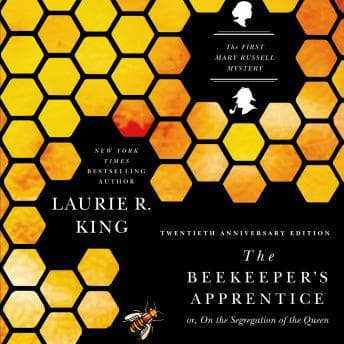

I was walking the lakefront with Denise last Saturday morning - one of those rare Chicago days where the wind off the lake isn't actively hostile - when I realized I'd been standing still for about three minutes, just staring at the water while Jenny Sterlin narrated a fifteen-year-old girl intellectually dismantling Sherlock Holmes on the Sussex Downs. Denise had to double back for me. She asked if I was okay. I said, "A teenage girl just out-deduced Holmes and I think I'm in love with this book."
So. Let's talk about what Laurie R. King is really doing here.
The Audacity of Making Holmes the Supporting Character
I've taught Conan Doyle. I've listened to more Holmes adaptations than I care to count. My review of Hound of the Baskervilles gets into why the original formula is so hard to escape - Watson as narrative furniture is essentially load-bearing. And the fundamental problem with every Holmes continuation is the same: Watson exists to be impressed, and we exist to watch Watson be impressed. It's a closed loop. King breaks it open by giving Holmes something he's never really had - an intellectual equal who also happens to be a gangly, grieving, fiercely feminist fifteen-year-old in 1915.
Mary Russell isn't Watson 2.0. She's argumentative. She's a theologian. She corrects Holmes on Hebrew translation. And King has the nerve to make this feel earned rather than gimmicky. The early Sussex scenes where Holmes and Russell spar over observation techniques - testing each other with increasing respect - reminded me of the best student-teacher relationships I've witnessed in twenty years of teaching. That electric moment when you realize the kid across from you doesn't just understand the material, they're about to push past you. It's terrifying and wonderful.
The kidnapping case in Wales is almost secondary to watching these two minds orbit each other. Almost. King still delivers proper mystery architecture - the clues about the senator's daughter connect back to Holmes's past in ways that reward close attention. But the real puzzle is the relationship itself. How do you partner with someone forty years your senior without it becoming patronizing? King threads that needle for thirteen and a half hours, and I never once felt it wobble.
Jenny Sterlin Knows That Silence Is a Sentence
Here's where I get specific, because the narration deserves it. Sterlin's Holmes isn't the baritone caricature you're probably imagining. She plays him with this sharp, clipped British diction - precise rather than theatrical - and then drops in these tiny pauses when Russell says something that surprises him. Those pauses. The narrator understands that pause is punctuation. You can hear Holmes recalibrating, and Sterlin never rushes past those beats to get to his response.
Her Russell is younger-sounding without being girlish, which is a tightrope act. There's an edge to her voice when Russell gets stubborn, a slight tightening that's different from how she voices Russell in reflective moments. And her differentiation between the supporting cast - the Welsh locals versus the London establishment types versus the quiet menace of characters connected to the kidnapping - it's all handled through accent and cadence shifts rather than vocal gymnastics. Nothing cartoonish. Just specificity.
The preface read by King herself is a nice touch. Brief, warm, and it contextualizes the twentieth-anniversary edition without overstaying its welcome.
Who Belongs on the Sussex Downs
If you loved the original Conan Doyle stories, this is their spiritual successor - but with a conscience about the things Doyle never bothered examining. Gender. Power. The loneliness of extraordinary intelligence. My students would hate this - too slow, too talky, too much Victorian atmosphere. I love it. But I'll say this: if you need a body by chapter three and a twist every twenty minutes, you'll get restless. This is a slow-burn character study wrapped in a mystery wrapper, and it asks you to care about intellectual chemistry the way thrillers ask you to care about car chases.
This is emphatically not background listening. I tried grading papers to it one evening around hour seven and realized I'd written "good analysis" on a paper that was clearly plagiarized because I was too absorbed in Russell and Holmes fleeing across a rooftop. (I caught it the next morning. The plagiarism, not the rooftop.)
Period piece lovers, Holmes devotees who want something fresh, and anyone who's ever had a mentor who changed the shape of their thinking - this one's for you. Listen at 1.0x. The prose deserves to be savored, and Sterlin's pacing is calibrated for patience.
Worth Pausing the Faculty Meeting For
Twenty years of reading Doyle with students, and Laurie R. King managed to make me hear Holmes differently. Not younger, not softer - just finally capable of being surprised by someone. And Jenny Sterlin's performance makes that surprise land every single time. Thirteen hours well spent. I've already started the second book.