
"The very purpose of our life is to seek happiness."
That line hit me around the forty-minute mark, while I was chopping onions for a dal that would take way too long to make. And I just... stopped. Knife in hand, eyes already watering (the onions, obviously), thinking: okay, but what does that actually mean when you break it down psychologically?
This is the thing about the Dalai Lama's work that gets me every time. He says something that sounds almost too simple, and then you realize he's basically summarizing what took Western psychology decades to articulate. The pursuit of happiness as a fundamental human drive? That's literally Maslow. That's positive psychology. That's the entire self-help industry in one sentence - except he got there through 2,500 years of Buddhist contemplative practice instead of lab studies. (Though honestly, Girl, Stop Apologizing takes a much more direct approach to goal-setting without the metaphysical framework.)
The Mind as a Case Study
What makes this audiobook genuinely useful - and I mean useful in a way my therapist would actually approve of - is the step-by-step structure. The Dalai Lama isn't just philosophizing here. He's laying out a progression: here's where you start, here's how you know you're making progress, here's what comes next. As someone who studies how people change, this is fascinating. He's essentially providing a roadmap for cognitive restructuring, but framed through Buddhist tradition.
The exercises for replacing negative feelings with positive attitudes? That's basically cognitive behavioral therapy wrapped in different language. The research shows that these kinds of contemplative practices produce measurable changes in brain structure and emotional regulation. (I wrote a paper on this. Still waiting for someone outside my committee to read it.)
But here's where I got a little stuck. The book assumes you're already bought into the Buddhist framework - karma, rebirth, the whole metaphysical package. If you're approaching this purely from a secular psychology angle, some sections require mental translation work. Not a dealbreaker, but worth knowing.
A Scholar Behind the Microphone
Jeffrey Hopkins is a Tibetan Buddhism scholar, not a professional voice actor, and honestly? It works. His voice is calm, measured, almost meditative - which suits material that's literally about meditation. I found myself slowing down while listening, matching his pace. Whether that's a feature or a bug depends on what you're looking for.
Some people find his delivery a bit dry. I get that. There were stretches during my morning jogs where I had to really focus to stay engaged. This isn't the kind of audiobook that grabs you by the collar. It's more like... it invites you to sit down. Repeatedly. Until you actually do.
The production quality is clean and professional, no complaints there. But I'll be honest - at nearly ten hours, there are moments where the pacing drags. I found myself speeding up to 1.25x during some of the more repetitive philosophical explanations, then slowing back down for the practical exercises.
Who Should Listen (And Who Should Start Elsewhere)
If you're new to Buddhism or meditation, this might not be your starting point. The Dalai Lama assumes a baseline familiarity with concepts like emptiness, dependent origination, the bodhisattva path. He explains them, but quickly. I'd recommend "The Art of Happiness" first - it's more accessible, more conversational, and honestly a better entry point. Same reason I'd point someone toward Millionaire Next Door only after they've grasped basic financial literacy - you need the foundation first.
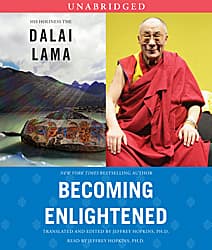
But if you've already done some reading in this space? If you're ready to move from "understanding" to "practicing"? This is where "Becoming Enlightened" shines. The contemplative exercises are specific and actionable. The milestones for progress give you something concrete to work toward. It's not just philosophy - it's a training manual.
What I found most compelling is how the Dalai Lama weaves in personal anecdotes from his own practice. Here's this Nobel Laureate, this revered spiritual leader, and he's talking about his own struggles with anger, his own ongoing work on compassion. That vulnerability? Psychologically, it's incredibly effective. It models the growth mindset he's teaching.
The Fifteen-Minute Meditator's Take
Parts of it, I'll absolutely revisit. The sections on developing compassion and the practical meditation instructions are worth returning to. The more abstract philosophical material? Once was enough for me.
My therapist, by the way, would probably love that I'm finally taking meditation seriously. (Don't tell her I still can't sit still for more than fifteen minutes. We're working on it.)
If you want to understand the psychological mechanisms behind Buddhist practice - why these techniques work, what they're actually doing to your mind - this is a solid listen. Just know what you're getting into. It's dense. It's slow. It rewards patience.
Which, I suppose, is kind of the point.