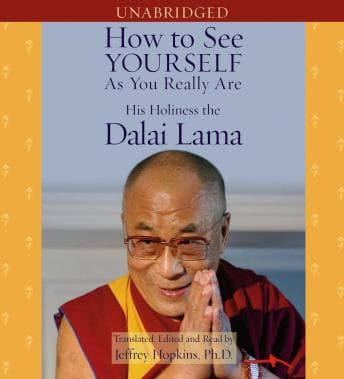

Most self-help books treat the self like a fixer-upper — here's your broken kitchen, here's your leaky roof, now go renovate. The Dalai Lama does something radically different in How to See Yourself As You Really Are. He asks you to question whether the house exists at all.
I was chopping onions for a chana masala at 9 PM on a Tuesday — the kind of elaborate weeknight cooking my mother would call unnecessary and my therapist would call coping — when this book genuinely made me set down the knife and stare at my cutting board. Not because of some emotional gut-punch, but because His Holiness walked me through an exercise in examining whether the "I" that feels insulted when someone cuts me off in traffic is the same "I" that existed five minutes before. And my brain short-circuited in the best possible way.
When a Nobel Laureate Becomes Your Therapist (Sort Of)
Here's what separates this from your average mindfulness audiobook: the Dalai Lama structures this like a philosophical argument, not a wellness seminar. He's not telling you to "just be present" or "let go of attachment" like those are things you can simply decide to do on a Sunday afternoon. Instead, he builds a case — step by step — for why our perception of self is fundamentally distorted, and then gives you meditative exercises to actually experience that distortion dissolving.
The book breaks into three sections: understanding reality, practicing insight, and harnessing that insight for compassion. The research actually shows that this structure mirrors cognitive behavioral approaches — identifying cognitive distortions, then replacing them with more accurate perceptions. Except the Dalai Lama got there about 2,500 years before Aaron Beck. (My dissertation committee would want me to caveat that comparison. I won't.)
What makes this book psychologically fascinating rather than just spiritually interesting is the concept of "dependent arising" — the idea that nothing, including you, exists independently. The protagonist exhibits classic — wait, there's no protagonist here, but there IS a character under examination: you, the listener. And the Dalai Lama treats your sense of self like a case study. He asks you to look for the "I" in your body, in your mind, in your consciousness, and he's patient when you can't find it. Because that's the point.
I found myself asking: why does Western psychology spend so much energy building up the self — self-esteem, self-actualization, self-compassion — while Buddhist psychology questions whether there's a stable self to build up in the first place? This book sits right at that intersection, and it's genuinely uncomfortable if you've spent years in therapy doing the former. My therapist would have thoughts about this.
Jeffrey Hopkins Reads Like a Man Who Has Meditated on Every Syllable
Jeffrey Hopkins served as the Dalai Lama's interpreter for a decade, and you can hear it. His narration isn't performative — he doesn't try to sound "spiritual" with that breathy, hushed quality some narrators adopt for Buddhist texts. He reads with the clarity of someone who has translated these ideas hundreds of times and understands where Western listeners typically get lost. There's a steadiness to his delivery that actually mimics meditative pacing. Which, for a book about meditation, is either perfect design or happy accident.
The flip side: at 6 hours and 30 minutes, with Hopkins' measured pace, some sections on Buddhist philosophical distinctions — particularly around "inherent existence" versus "conventional existence" — can feel dense. Not boring, but the kind of dense where you realize you've been running on autopilot for three minutes and need to rewind. Multiple listeners recommend following along with the physical book, and honestly? They're right. This isn't a podcast-brain listen. It demands your prefrontal cortex.
No sound effects, no music, no production gimmicks. Just Hopkins and the text. Clean as a meditation bell.
Who This Is For (and Who Should Run)
If you want a self-help book that tells you you're great and just need to unlock your potential — skip this. How to Win Friends and Influence People sits at the opposite end of that spectrum — it's entirely invested in shaping the self as a social instrument, which is exactly the kind of assumption this book will quietly dismantle. The Dalai Lama is not interested in your potential. He's interested in dismantling the illusion that the "you" chasing that potential is a fixed thing.
But if you've read enough pop psychology to feel like you understand cognitive distortions and you're ready for someone to tell you the distortion goes deeper than you thought — way deeper — this is a fascinating case study in what happens when Eastern contemplative practice meets rigorous philosophical inquiry. Spiritual seekers, sure, but also anyone who's ever sat in a therapist's office and wondered whether they're working on the right version of themselves.
Compared to The Art of Happiness, which reads more like a conversation, this is the Dalai Lama in professor mode. More structured, more demanding, less anecdotal. If that book was the introductory lecture, this is the graduate seminar.
The Prescription I'm Writing Myself
I'm not Buddhist. I'm a psychology researcher who grew up watching my grandmother do puja every morning and reading Poirot novels under the covers. But this book did something few self-help books manage — it made me question an assumption I didn't know I was making. Not about the world, but about the thing looking at the world. That's rare enough to be worth your time. Just don't listen while chopping onions.