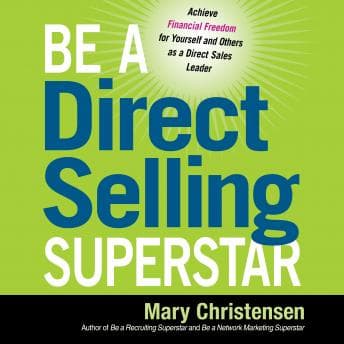

Look, I'll be honest - I started this one at 5:47AM on a Tuesday morning because I'd run out of my usual queue and this had been sitting in my library since Kevin's mom casually mentioned she was "exploring direct selling opportunities." I figured I should at least understand the landscape before Thanksgiving dinner turns into a recruitment pitch.
Could've Been a Blog Post (But Which Blog Post Exactly?)
TL;DR: Worth your commute only if you're genuinely considering direct selling and have zero background in it.
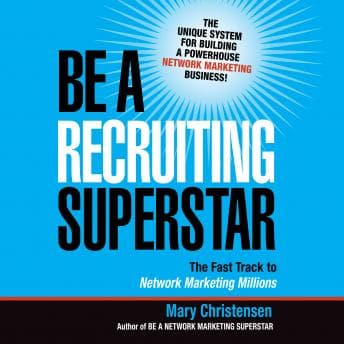
Mary Christensen clearly knows her stuff - she ran two multinational direct selling corporations and was president of the Direct Selling Association. That credibility shows. But here's the thing: at 6 hours and 45 minutes, this book commits the cardinal sin of business audiobooks. It's a 2-hour book wearing a 7-hour trench coat. The goal-setting chapters, the time management advice, the "believe in yourself" segments - these are generic self-help filler you've heard in literally any business book published after 2005. Strip those out and you've got maybe 2.5 hours of actually specific, useful direct selling strategy.
The parts that ARE specific? Pretty solid. Christensen's framework for building a seller network reads like someone who's actually done the work, not just theorized about it. Her approach to recruiting feels less like the usual MLM hype and more like - okay this is going to sound weird - distributed systems architecture. You're building nodes, ensuring each one can operate independently, creating redundancy. She thinks about org structure the way I think about microservices. That part genuinely clicked for me.
But then she'll pivot back to "eliminate self-sabotaging behaviors" for an entire chapter and I'm like... I could be listening to Bobiverse for the fourth time right now.
The Narration Problem Nobody's Talking About (Actually Everyone Is)
Lesley Parkin has a British accent - Cambridge-educated, very precise, very professional. And for a business book, that should work fine. The problem is pacing. I listen at 1.75x for business books by default (because most business books could've been blog posts, see above), and even at that speed, Parkin's delivery felt... measured. Like she was reading terms and conditions for a financial product. One reviewer literally said it sounded like "a computer voice" and while that's harsh, I get where they're coming from.
Compare this to, say, the narrator energy you get in something like Chris Voss's "Never Split the Difference" where the narrator matches the urgency of the content. Parkin's delivery is technically clean - no audio issues, no weird production artifacts - but it flattens the parts where Christensen is apparently being "witty" according to print readers. The wit just... doesn't land in audio format. It's like watching a standup special on mute with subtitles. The words are funny, the delivery is a quarterly earnings call.
I bumped it to 2x for the last two hours. First time I've ever done that for a full audiobook. Even then it felt like wading through syrup.
Who This Is Actually For (Be Honest With Yourself)
If you're brand new to direct selling - like, you just signed up for your first company and you don't know what a "downline" even means - this is genuinely a decent starting framework. Christensen's structural advice about building teams and managing different personality types has real substance. The ROI on this audiobook is positive if you're in your first 90 days of direct selling and need someone to hold your hand through the fundamentals.
If you've been in the game for even a year? You'll be bored by hour two. The basics are basic. This isn't the advanced playbook.
And if you're like me - a tech worker just trying to understand the industry so you can have an informed conversation at Thanksgiving? Honestly, you could read a few solid articles and get 80% of the value in 20 minutes. The Pareto principle this book teaches but doesn't practice. Though if you want a genuinely sharp look at how numbers and frameworks get dressed up to sound more authoritative than they are, How To Lie With Statistics is a 45-minute commute that actually earns every minute.
Perfect for: background listening while doing dishes, maybe. Skip for: your actual commute (you'll zone out and miss your stop, and not in the good way).
The Commit Message: "fix: expectations vs reality"
I wanted to like this more than I did. Christensen's expertise is real and her frameworks have merit. But the combination of padded content and a narrator whose pacing actively works against engagement makes this a hard sell as an audiobook specifically. If the print version is a 3.5, the audio version drops a full point because Parkin's delivery removes the personality that apparently exists on the page. Kevin's mom is getting a paperback copy for Christmas instead.