
"You don't get it, do you? I'm a djinni. I've been summoned by magicians for five thousand years. I've built the walls of Uruk, I've—" And then Bartimaeus gets cut off by some footnote about how he also once got stuck in a jar for three centuries. That's the energy of this entire book, and I was absolutely cackling at my desk at 1 AM while my thesis proposal document stared at me, unopened, from the other monitor.
Kitty Jones Is the Character I Didn't Know I Needed
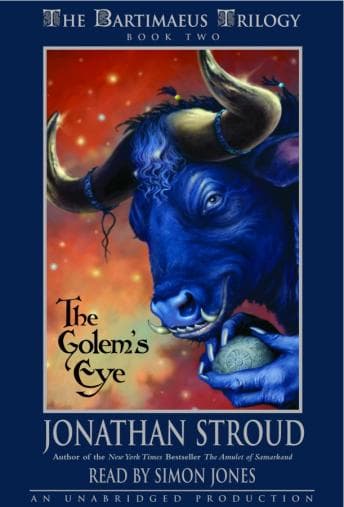
Okay, so here's the thing about The Golem's Eye that elevates it above the first book—Kitty's POV chapters. In The Amulet of Samarkand, we got Nathaniel and Bartimaeus trading perspectives, and that was great. But Stroud adding a commoner's viewpoint into this magician-ruled London? This is Sanderson-level world-building, except aimed at a younger audience and somehow even more politically sharp. Kitty's backstory—her encounter with a magician as a kid, the casual cruelty of it, the way she discovers her resilience to magic—it's the kind of origin story that actually earns the rebel archetype instead of just slapping it on a character. Her Resistance cell planning to rob Gladstone's tomb in Westminster Abbey is legitimately one of the best heist setups I've encountered in YA fantasy, and I say that as someone who has opinions about heist setups.
Nathaniel, meanwhile, is becoming exactly the kind of person Bartimaeus warned us about. He's climbing the magician government ladder, getting more ruthless, more self-important. Stroud doesn't do a sudden heel turn—it's gradual, uncomfortable, and honestly kind of painful to watch. The kid from book one who was sympathetic is now ordering the Night Police around. My D&D group would love debating his alignment shift. He's not evil. He's just... choosing power over principle, one small decision at a time. That slow moral compromise reminded me a lot of what makes The Count of Monte Cristo so gut-wrenching—watching someone rationalize each step further from who they used to be, except Dantès goes way harder and has way more centuries of prose to do it in.
Simon Jones and the Footnote Problem (That Isn't a Problem)
Let's talk about the audiobook-specific magic here. Bartimaeus' footnotes are a signature feature of the print books—snarky asides from a five-thousand-year-old djinni who cannot help himself. In print, you glance down at the bottom of the page. In audio, Simon Jones has to read them inline, and somehow it works better. His timing on the footnote transitions—dropping into a slightly different register, a parenthetical tone—makes them feel like Bartimaeus is literally muttering under his breath while the main story happens. It's comedy gold. The footnote where Bartimaeus claims credit for some historical event and then immediately undercuts himself? Jones lands it perfectly every time.
His Bartimaeus voice carries this specific sardonic weariness that I can only describe as "ancient being who is so tired of magicians but also kind of loves the drama." It's distinct from Nathaniel's increasingly clipped, bureaucratic tone and from Kitty's more grounded delivery. Jones isn't doing wild accent gymnastics—it's more about cadence and attitude shifts between characters. And for a 16-and-a-half-hour listen, that consistency matters. I never once lost track of whose chapter I was in.
The Golem Itself Is Genuinely Creepy
Stroud does something smart with the golem—it's not a villain with motives. It's a weapon. An unstoppable clay construct smashing through London with no apparent purpose, and the magician government can't stop it or even explain it. The scenes where it attacks are genuinely unsettling because there's no reasoning with it, no dramatic monologue, just destruction. The Prague sequences where Nathaniel and Bartimaeus investigate the golem's origins add this great layer of magical history that feels lived-in rather than exposition-dumped. (If you don't like info-dumps, this isn't for you—but you're wrong. The Prague lore is fascinating.)
And then you've got the dancing skeleton chase across London's skyline, which is exactly as unhinged as it sounds. Stroud balances genuine menace with absurdist humor in a way that shouldn't work but absolutely does. The Night Police sequences are dark—like, notably dark for a series shelved in the kids' section. There's a real edge to this world.
Who's Rolling Initiative on This One
If you loved the first Bartimaeus book, this is the payoff book where the world expands and the stakes actually feel real. If you're into fantasy with sharp political commentary disguised as a YA adventure—think Mistborn's class warfare but with more jokes—you'll eat this up. It's also a fantastic gateway for younger listeners who are ready for something with more moral complexity than your standard chosen-one narrative.
Skip it if you need fast pacing from page one. The three-POV structure means it takes a few hours to get all the plates spinning. And if you haven't read book one, don't start here—you'll be lost.
I Read This Instead of Writing My Thesis (Again)
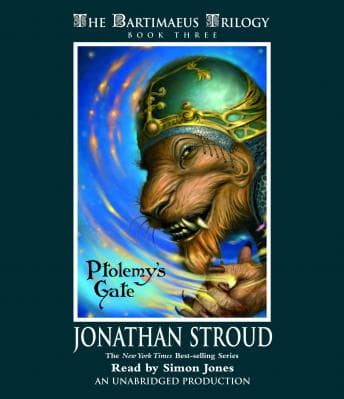
Sixteen and a half hours. Did I listen to it in three days? Yes. Did Dr. Patel email me about my progress during that time? Also yes. Do I regret it? Not even slightly. The progression is satisfying—the world gets bigger, the characters get more complicated, and Bartimaeus remains one of the best-written fantasy narrators (in-universe narrator, not Simon Jones, though he's also excellent) I've ever encountered. Jones' performance is the definitive way to experience this series. I'm already queuing up Ptolemy's Gate and my thesis can wait another week.