
I almost missed my stop at Mountain View this morning.
There I was, wedged between a guy coding in Go and someone sleeping on my shoulder, absolutely blasting through the last hour of The Bands of Mourning. This isn't just a fantasy novel; it's API documentation for a magic system that actually makes sense, wrapped in a steampunk western.
If you've survived the first two eras of Mistborn, you know the drill. But this one feels different. Less "doom and gloom ash falling from the sky" and more "Indiana Jones finds a magical nuke."
When Magic Systems Scale Like Distributed Databases
Let's be real—I read Sanderson because I like rules. I like systems with hard constraints. The magic in this series (Allomancy and Feruchemy) is basically physics with a cheat code.
In Bands of Mourning, we finally leave the city of Elendel. It's a road trip book. A heist. Wax and Wayne are heading south to find the Lord Ruler's lost metalminds (basically magical external hard drives).
The pacing here is way tighter than Shadows of Self. It moves. You get trains, shootouts, and some serious expansion on the tech tree of this world.
(Side note: The way Sanderson integrates the magic into the emerging technology—like using steelpushing for movement or weight-storing for flight mechanics—is the kind of system design I wish we had at work. It just works. No bugs.)
But the real MVP here isn't the magic. It's Steris.
I spent the last book thinking she was just an annoying NPC added for political friction. I was wrong. Sanderson does this kind of slow-burn character work in Elantris too, though the magic system there is more broken-code-that-needs-debugging than elegant API. Her arc in this book? Top tier. She's the project manager of the group—prepared for every edge case, totally unappreciated, and essential for deployment. I felt seen.
The Kramer Variable (Or: Why You Need 1.5x Speed)
Okay, let's talk about Michael Kramer.
If you check Reddit, half the people say he's the god of audiobooks, and the other half say he sounds like he's reading a user manual for a toaster.
Here's my take: They're both right.
Kramer has this deep, resonant, gravelly voice that can feel a bit... hypnotic. If you listen at 1.0x speed, you might fall asleep on the Caltrain and wake up in San Jose.
The Fix: Crank it to 1.25x or 1.5x.
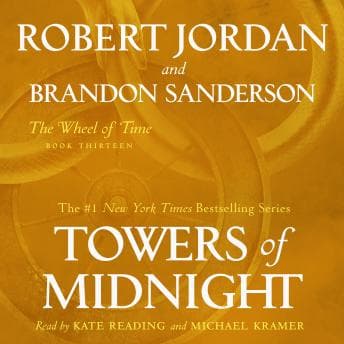
At that speed, the "monotone" vanishes and you just get the efficiency. Plus, his character work is undeniable. His voice for Wayne? Incredible. He manages to do accents-within-accents (since Wayne is a master of disguise) without it becoming a mess. Kramer's range is even more impressive in Towers of Midnight, where he juggles like thirty POV characters without breaking a sweat. He gives distinct vocal textures to Wax (gruff, tired) vs. Wayne (bouncy, chaotic) vs. Steris (precise, flat).
He sells the humor, too. There's a scene in a hotel involving a shotgun and some very bad negotiations that had me laughing out loud in the quiet car. (Got some dirty looks. Worth it.)
The Cosmere ROI
If you're just here for a cowboy wizard story, this book delivers. But if you're a Cosmere nerd (like me, unfortunately), the last 10% of this book is going to melt your brain.
I won't spoil it, but the implications for the wider universe are massive. It connects dots I didn't even know were on the page. It's like finding a comment in legacy code that explains why the entire platform was built that way.
Who's This For?
Listen if: You liked Alloy of Law, you want hard magic systems with actual internal logic, or you bounced off the first Mistborn trilogy because it was too depressing—this era's got way more soul and way more explosions.
Skip if: You need a standalone (this is book three of a series) or you hate adjusting playback speed.
Deploying to Production
It's fun. It's fast (once you adjust the speed). It expands the world without bogging down in exposition. Steris alone is worth the listen.