What does it cost to condense 150% casualties into five hours?
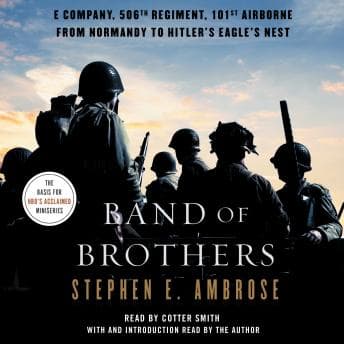
I was up late, couldn't sleep - one of those nights where the house is quiet and Ranger's snoring on the couch and your brain just won't shut off. Pulled up Band of Brothers on a whim because sometimes you need to sit with something real instead of whatever thriller's next in the queue. And here's the thing that kept nagging me the entire listen: this is the abridged version. Five hours. Ambrose wrote a book that covers Easy Company from Toccoa to Berchtesgaden, and someone took a machete to it.
Let me cut to the chase - the source material is sacred ground for anyone who's worn the uniform. But this particular audio edition? It's complicated.
The Ghost of What's Missing
Ambrose did something rare with this book. He didn't write top-down history where generals move pins on maps. He wrote it from the foxhole up. The assault on Brécourt Manor - where Winters led a handful of men against those four 105mm guns overlooking Utah Beach - that's one of the most studied small-unit actions in military history. It's still taught at West Point. And you get it here, but you get the CliffsNotes version. The full text has the kind of tactical detail that makes you understand why it worked - the flanking, the covering fire, the improvisation when half your guys aren't even there because they scattered across Normandy in the jump. In five hours, you're getting the highlight reel.
The Bastogne section hit me hardest, and I could feel the cuts most acutely there. These guys sat in frozen foxholes with no winter gear, no ammo resupply, eating snow. Ambrose captured individual moments - guys sharing a single blanket, the sound of tree bursts, the specific horror of watching a friend get hit when there's no medic close enough. Some of that granularity survives the abridgment. A lot doesn't. If you've read the full book, you'll feel the absence like a phantom limb.
Cotter Smith Behind the Mic
Smith's narration is... interesting. He reads this material the way a good NCO delivers a briefing - clear, measured, no drama. And honestly, for Ambrose's prose, that mostly works. The writing doesn't need someone hamming it up. When Ambrose describes the men of Easy discovering the concentration camps, Smith's restraint communicates something that theatrical delivery would've cheapened. There's a poignancy in the flatness.
But - and this is where it gets tricky - that same restraint sometimes crosses into monotone. During the Holland jump, during Market Garden when everything's going sideways, you want to feel the chaos ratcheting up. Smith stays at the same emotional altitude throughout. I've seen this scenario play out in real life: the calm, steady voice works great when things are calm and steady. When rounds are cracking overhead, you need a different register. He doesn't find it.
I bumped him up to 1.25x (my standard) and it actually helped. Gave the narration a bit more urgency it was lacking at normal speed. Not a fix, but an improvement.
The Sobel Problem (And Why It Matters)
One thing the audiobook does preserve well is the Herbert Sobel arc. Here's a guy who was, by all accounts, a terrible combat leader but a brilliant trainer. He made Easy Company miserable at Camp Toccoa - the runs up Currahee, the petty punishment, the impossible standards. The men hated him. And Ambrose is honest about the fact that Sobel's brutality is part of why they survived. That tension - despising the man who saved your life by making it hell beforehand - that's something I've lived adjacent to. Not the same unit, not the same war, but the dynamic? Universal. The audiobook gets this right because it's baked into the structure of the story itself. It's harder to edit out.
Winters, on the other hand, gets slightly shortchanged by the abridgment. You get the broad strokes of why men would follow him anywhere. You don't get all the small moments that built that trust. The difference between a good leader and a great one is usually invisible from the outside - it's in decisions nobody else notices. Ambrose captured those. Not all of them made the cut here.
Worth Your Time? Here's the Debrief
If you've never read Band of Brothers and want the story while you drive - it works. Five hours is digestible, Ambrose's research is impeccable, and the men of Easy Company deserve to be remembered. The author clearly did their homework - he interviewed the survivors extensively, and their voices come through even in abbreviated form.
But if you're serious about this history, the abridged version is like eating MRE crackers when there's a full meal available. You're getting nutrition. You're not getting the experience.
Who should listen: Anyone new to Easy Company's story who wants an accessible entry point. Veterans and military history buffs who want a refresher for a long drive. Skip it if you've already read the full text - you'll spend the whole time thinking about what's been cut. And if you loved the HBO series (which, let's be honest, is incredible), know that this audiobook covers the same ground in a fraction of the time with a fraction of the detail.
Ranger slept through most of it. Not his fault - it was 2 AM. But I stayed up. Some stories earn that. The last time a book kept me up like this was Lords of the North - different war, different century, but the same feeling of men doing impossible things in impossible conditions while someone finally bothered to write it down right.



![Steve Jobs [unabridged audiobook] audiobook cover](/_next/image?url=https%3A%2F%2Fcovers.audiobooks.com%2Fimages%2Fcovers%2Ffull%2F9788499923406.jpg&w=1920&q=75)