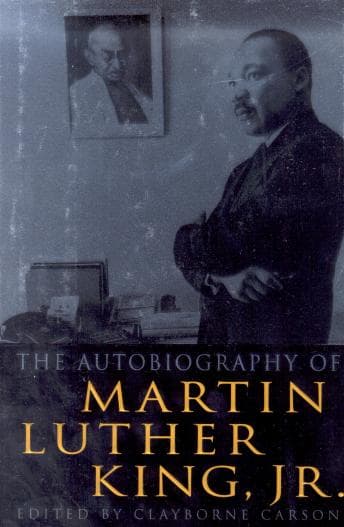

I was up at 2 AM finishing a logo rebrand for a client who keeps changing their mind about fonts, and I had this playing through my studio monitors because my headphones died somewhere around hour six. The apartment was dark except for my screen glow, Frida curled on the desk, Diego somewhere judging me from the shadows. And there's LeVar Burton reading Martin Luther King Jr.'s own words about the Montgomery Bus Boycott, about the phone calls threatening his family, about sitting in his kitchen at midnight wondering if he had the strength to keep going - and I just stopped working. Sat there. Hands off the keyboard.
My heart. MY HEART.
The Weight of a Man's Own Words
So here's the thing about this book that caught me off guard: it's not technically written by King himself. Clayborne Carson, who runs the King Papers Project at Stanford, assembled it from King's letters, sermons, speeches, and journal entries into a cohesive first-person narrative. And somehow that editorial construction doesn't feel stitched together - it feels like sitting across from someone at a kitchen table while they tell you their life story. You get King as a kid in Atlanta, irritated by segregation but not yet on fire about it. You get King the theology student wrestling with Niebuhr and Gandhi's philosophy of nonviolence, genuinely uncertain about his own calling. You get King the husband apologizing to Coretta for the danger he's dragged their family into.
That kitchen scene - King alone at night after receiving death threats, praying out loud, admitting he's afraid - that broke me open. Ugly-cried. Full stop. Because he wasn't a monument yet. He was a 27-year-old pastor who didn't know if he'd survive the week.
And then you hear the actual recordings. The production team spliced in real MLK audio clips throughout, and when his actual voice hits after Burton's narration, it's like thunder rolling through after a quiet conversation. The "I Have a Dream" segments, the sermon recordings - goosebumps on top of goosebumps. The production also weaves in period-appropriate music that grounds you in the era without being heavy-handed.
LeVar, Baby, I Love You, But...
Okay. This is where it gets complicated. I grew up watching Reading Rainbow. LeVar Burton's voice is genuinely special to me - warm, inviting, the kind of voice that makes you lean in. And for the intimate, reflective passages? He's beautiful. When King is writing letters from Birmingham Jail, Burton's measured delivery lets the intellectual precision of those arguments just land. You feel the patience of a man explaining, for the thousandth time, why freedom can't wait.
But - and this is a real but - there are moments where Burton's voice carries that Reading Rainbow brightness, that eager uplift, and it sits wrong against material about bombings, about children being hit with fire hoses, about King's growing exhaustion in the last years of his life. The contrast between Burton's narration and King's actual recorded speeches is sometimes jarring. King's baritone carried this rolling, almost gravitational authority. Burton's voice is lighter, more inviting than commanding. It's not bad narration - he won a Grammy for this, and you can hear why. It's just that the subject demanded a different frequency sometimes.
(I kept imagining what this would sound like with a narrator who could match King's vocal weight. And then feeling guilty about it because Burton clearly cares so deeply about this material.)
What Abuela Would Say
Abuela would have loved this one. Not because she knew much about the civil rights movement - she grew up in a different world, different struggles - but because she understood what it means to keep going when the powerful people want you to sit down and shut up. King's descriptions of ordinary people in Montgomery refusing to ride the bus, walking miles to work in the Alabama heat, choosing their dignity over their comfort - Abuela knew those people. Different names, different fights, same spine.
The book also gives you King's candid assessments of the presidents he dealt with. His complicated respect for JFK (admiration mixed with frustration at the political calculus), his surprisingly warm but wary relationship with LBJ, his sharp critique of Nixon. These aren't soundbites. They're the private thoughts of someone navigating impossible power dynamics. That same sense of being inside the machinery of power - watching people maneuver around each other with enormous stakes - is what made Russian Roulette hit me so hard, though the villains there are considerably less conflicted. At 9 hours and 36 minutes, there's room for that kind of depth.
Who Needs This in Their Ears
If you want a history textbook read aloud, this isn't that. If you want to understand what it felt like to be inside the movement - the fear, the faith, the arguments, the exhaustion, the weird bureaucratic battles within the SCLC - this is extraordinary. Listen when you can actually pay attention. This isn't a background-while-you-do-dishes book. This is a sit-down-and-be-changed book.
Skip it if flat narration ruins everything for you - Burton is skilled but occasionally mismatched to the material's intensity. But honestly? The real King audio clips alone are worth the listen. When his actual voice comes through those speakers at 2 AM in your dark apartment, you understand why people followed him into danger.
This book felt like being handed someone's diary and realizing the personal cost of history we treat as inevitable.



![Steve Jobs [unabridged audiobook] audiobook cover](/_next/image?url=https%3A%2F%2Fcovers.audiobooks.com%2Fimages%2Fcovers%2Ffull%2F9788499923406.jpg&w=1920&q=75)