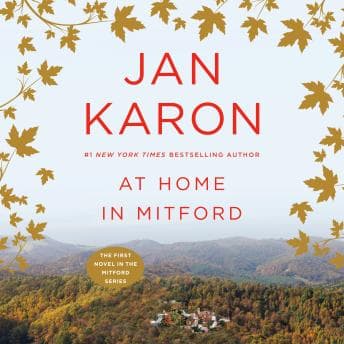

Look, I need to start with a confession that might get my design credentials revoked: I almost didn't finish this book. Not because it's bad—it's genuinely lovely—but because John McDonough's narration pace in the first two hours had me checking if my Audible app was broken. It wasn't. The man just... savors every syllable like he's being paid by the minute.
But here's the thing. By hour five, curled up on my couch with Diego purring on my chest and Frida judging me from the windowsill, I realized the slow pace wasn't a bug. It was the whole point.
A Small Town That Feels Like Your Abuela's Kitchen
Mitford, North Carolina is the kind of place where nothing happens and everything matters. Father Tim is a sixty-something Episcopal priest who's basically accepted that his life will be quiet sermons and church potlucks until he dies. Then a massive dog named Barnabas literally crashes into his life—we're talking Great Dane sized, refuses to leave, eats everything—and suddenly this man who'd resigned himself to loneliness has a family forming around him whether he likes it or not.
The kid, Dooley, wrecked me. This foul-mouthed, neglected boy from the mountains shows up at Father Tim's door, and watching their relationship develop over nineteen hours? I ugly-cried at least three times. Not dramatic sobbing, but that quiet kind where tears just roll down your face while you're supposed to be adjusting kerning on a logo. The way McDonough voices Dooley's country accent—rough but vulnerable, angry but desperate to be loved—my heart. MY HEART.
Abuela would have loved this one. She'd have clutched her rosary at Dooley's language but then immediately started praying for him and probably tried to mail the fictional child some tamales.
McDonough's Southern Drawl Grows On You (Give It Time)
Okay, let's talk about the narrator situation. John McDonough reads with this deliberate, almost ponderous style that initially made me want to speed up to 1.25x. I didn't—I'm a 1.0x purist, you know this—but I was tempted. His Southern drawl is authentic, not performative, and his Emma voice (Father Tim's church secretary, a delightful busybody) became my favorite thing. She sounds exactly like every church lady I've ever met: nosy, opinionated, and convinced she's doing the Lord's work by meddling in everyone's business.
The character differentiation is genuinely good once you settle in. McDonough gives each person their own rhythm—Father Tim's gentle, measured tones versus Dooley's sharp, defensive bursts. The neighbor Cynthia gets this warm, slightly teasing quality that makes you understand why Father Tim starts noticing when she wears that path through the hedge between their houses.
But I won't lie: if you need plot momentum, this isn't it. There's a jewel theft mystery that honestly feels like an afterthought. The book is about vibes. It's about community. It's about a lonely man learning to let people in. Wild Women and the Blues gave me that same sense of community wrapping around you, though with jazz clubs instead of church potlucks. The vibes are immaculate—if your vibe is "sitting on a porch swing watching fireflies while someone brings you sweet tea."
This Is a Rainy Sunday Book (Not a Gym Book)
I listened to most of this while working on a branding project for a local bakery, and the gentle pace actually helped me focus. It's background-friendly but rewards attention—you'll miss the quiet emotional beats if you're not paying attention when Father Tim admits to God that he's scared of getting attached to Dooley because the boy might leave.
The content warnings are real but handled gently: Dooley's backstory involves an alcoholic mother and implied abuse, Father Tim deals with depression and diabetes management, and there's grief woven throughout. Nothing graphic, but if you're looking for pure escapism, know that this book acknowledges life is hard sometimes.
Who Should Move to Mitford (And Who Should Keep Driving)
This is for you if: you love character-driven stories where nothing explodes, you find comfort in faith-based fiction that isn't preachy, you want a book that feels like a warm blanket, or you're working through something and need gentle company.
Skip if: slow pacing makes you anxious, you need romance with actual heat (this is the most G-rated attraction I've ever encountered), or you find small-town wholesomeness cloying. Some reviewers called it boring, and honestly? I get it. If you're not in the right headspace, Father Tim's daily routine will feel tedious instead of meditative.
A Book You'll Want to Return To
I'm giving this a solid recommendation with caveats. It's not going to change your life or make you ugly-cry the way a Sarah Addison Allen book does. But it filled something in me I didn't know was empty—that longing for community, for belonging, for a place where people actually show up for each other. Nineteen hours is a commitment, but by the end, I didn't want to leave Mitford.
Already downloaded the second book. Diego approves. Frida remains skeptical, but that's just her personality.









