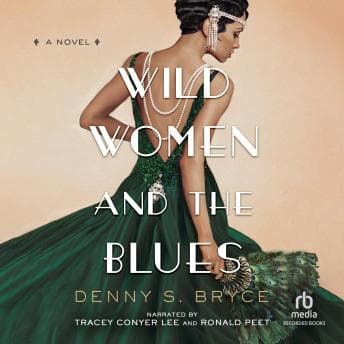

I was grading sophomore essays on The Great Gatsby - yes, again, every spring, like clockwork - when Honoree Dalcour's voice cut through my red-pen haze and made me put down the stack entirely. That never happens. Twenty years of teaching, and I've developed an almost superhuman ability to grade while listening. But this 110-year-old woman demanding to know why some film student thinks he deserves her story? I stopped mid-sentence on a kid's paper about green lights and symbolism.
Look, here's the thing about dual timeline novels: they're almost always uneven. One story carries the other like a stronger sibling. But Denny S. Bryce does something genuinely clever here - she makes the imbalance intentional. Honoree's 1925 Chicago sections are lush, dangerous, dripping with jazz and bootleg whiskey and the kind of ambition that gets young women killed. Sawyer's 2015 sections are quieter, sadder, a man trying to piece together someone else's history because he can't face his own. The contrast works.
Two Voices, Two Eras, One Conversation
Ronald Peet and Tracey Conyer Lee handle the dual narration beautifully. Peet brings Sawyer's grief and desperation without tipping into melodrama - there's restraint there, the kind of performance that trusts the listener to feel what's underneath. But honestly? Tracey Conyer Lee as Honoree is the reason to listen to this version. She captures both the young dancer hungry for the spotlight and the centenarian who's earned every sharp edge in her voice. The transition between timelines never jarred me, which is harder to pull off than it sounds.
The character differentiation is solid throughout. Louis Armstrong, Oscar Micheaux, the various gangsters and dreamers populating the Dreamland Café - they each get distinct treatment. Some reviewers mentioned the pacing drags in spots, and I won't argue. There are moments in the middle where I found myself walking an extra block along the lakefront, waiting for the story to pick back up. But the slow sections felt earned, like Bryce was letting us sit with the weight of what Honoree was revealing.
What Fitzgerald Missed (And What Bryce Gets Right)
This is the 1920s my students never read about. Same decade as Gatsby, same bootleggers and jazz, but a completely different world. The black-and-tan clubs, the Harlem Renaissance figures making their way through Chicago, the particular dangers facing a Black woman trying to build a life in a city that would chew her up and spit her out without a second thought. That same exploration of people caught between cultures and violence shows up in Three Day Road, though Xavier and Elijah's war is literal trenches instead of Chicago's underworld. If you loved Gatsby - and I do, despite grading 3,000 essays about it - this is its spiritual successor from an angle Fitzgerald never saw.
Bryce does something smart with the Oscar Micheaux thread too. For those who don't know (and I'm embarrassed to admit I had to look him up - my film knowledge stops around 1960), Micheaux was basically the first major African American feature filmmaker. Honoree's connection to him gives the novel a through-line about who gets to tell stories, whose histories get preserved, and whose get lost. Heavy stuff, but Bryce doesn't hit you over the head with it. She trusts you to catch the parallels between Sawyer desperately trying to complete his thesis and Honoree finally deciding her story is worth telling.
The Gut-Punch Moments
I won't spoil the revelations - both Honoree's secrets and Sawyer's - but there are moments in the final third that genuinely surprised me. The narrators handle these turns with the gravity they deserve. Conyer Lee, in particular, delivers some lines near the end with the kind of quiet devastation that made me stop walking entirely. Just stood there on the lakefront like an idiot, staring at the water.
My students would hate this. Too slow, they'd say. Not enough happens. But that's because they're seventeen and haven't learned yet that sometimes the most important things happen in the spaces between action. The pauses. Both narrators understand that pause is punctuation.
The production quality is clean, no weird audio artifacts or volume issues. At 12 hours and change, it's a solid weekend listen or a week of commutes. I listened at my usual 1.0x because the prose deserves to be savored, but I could see going to 1.25x during some of the slower middle sections if you're impatient.
Who Should Listen (And Who Should Skip)
If you teach American literature, love Jazz Age history from perspectives Fitzgerald never considered, or just want dual narration done right - this one's for you. Skip it if you need constant plot momentum; my seventeen-year-olds would bail by hour three.
Worth pausing the faculty meeting for. (Sorry again, Principal Martinez.)