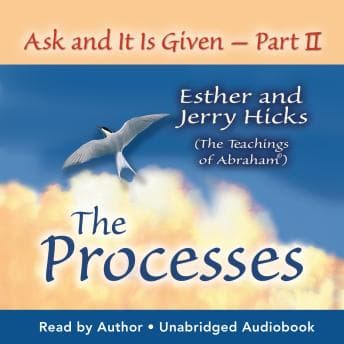

This is basically a self-help listicle stretched into a 4.5-hour audiobook.
Look, I want to be fair here. I grabbed this during a week where I'd burned through my sci-fi queue and was feeling weirdly open to something different. Kevin's been on a manifestation kick lately (his CrossFit coach recommended it, which tells you everything), and he dared me to try an Abraham-Hicks book. So there I was, Saturday morning, cleaning the apartment with my AirPods in, listening to Jerry Hicks walk me through 22 "processes" for reconnecting with the Non-Physical.
22 Processes That Could've Been a Notion Template
Here's the thing - this isn't even the full book. It's Part II of Ask and It is Given, carved out as a standalone audio product. So you're getting the practical exercises without the theoretical foundation. If you haven't read Part I or aren't already familiar with the Abraham-Hicks framework (Law of Attraction, emotional guidance scale, vibrational alignment), you're going to feel like you walked into a meeting 45 minutes late and everyone's using acronyms you don't know.
The 22 processes themselves range from genuinely useful cognitive reframing techniques - the "Rampage of Appreciation" is basically gratitude journaling with more enthusiasm, and the "Focus Wheel" is a structured way to shift your thinking that honestly reminded me of debugging logic chains - to stuff that made the engineer in me cringe. There's a "Segment Intending" process where you're supposed to mentally pre-pave every segment of your day with positive expectations. I tried it during my Monday commute. The Caltrain was 12 minutes late and a guy sneezed directly onto my neck. Vibrational alignment: compromised.
But I'll give credit where it's due. A few of these exercises are genuinely practical mental models. The "Emotional Guidance Scale" - ranking emotions from joy/knowledge down to fear/grief/despair - is actually a decent framework for checking in with yourself. It's not that different from the mood-tracking techniques my therapist has suggested, just wrapped in metaphysical language. The closest thing I've read to this kind of science-meets-self-examination framing is This is Your Brain on Birth Control, which also does the work of translating fuzzy internal experience into something you can actually examine — and at least cites its sources.
Jerry Hicks: The Narrator Debate
Jerry's delivery is... polarizing. His cadence is steady, measured, almost meditative. If you're in the right headspace - quiet room, Sunday afternoon, genuinely trying to absorb the exercises - it works. He reads like someone who deeply believes what he's saying and wants you to follow along carefully.
But at 6AM on a packed Caltrain? No. Absolutely not. His tone is so even and unhurried that my brain kept drifting. I'd zone out for 10 minutes and come back to a completely different process with zero idea how we got there. No vocal variation to signal "hey, new section" or "this is the important part." I bumped it to 1.5x and it helped marginally, but the fundamental issue is that Jerry narrates like he's reading instructions for assembling IKEA furniture - competent, clear, but not exactly gripping.
Honest comparison: if you've watched Esther and Jerry's live workshop recordings on YouTube, those have way more energy. The call-and-response format, audience reactions, Esther channeling Abraham in real-time - it's genuinely more engaging than Jerry solo-reading exercises from a book. The ROI on this audiobook is questionable when the free YouTube content is arguably better.
The Woo-Woo Tolerance Test
Let me be direct. Your enjoyment of this depends entirely on your tolerance for phrases like "vibrational frequency," "Non-Physical energy," and "the Universe is responding to your signal." If you can translate that into "mindset affects outcomes and cognitive patterns matter" - which is, stripped of the metaphysics, roughly what's being said - there's usable stuff here. If hearing "Abraham" referred to as a non-physical entity makes you want to throw your phone into the San Francisco Bay, save yourself 4.5 hours.
I landed somewhere in the middle. Some processes felt like solid CBT-adjacent techniques dressed up in spiritual clothing. Others felt like circular logic - "feel better so good things happen so you feel better." The lack of any empirical grounding or acknowledgment of, you know, systemic factors that might affect someone's life beyond their vibrational frequency... that bugged me.
Perfect for: quiet moments, bedtime wind-down, a weekend where you're open to woo. Skip for: commute, gym, anyone who needs evidence-based frameworks.
Commit, Stash, or Discard?
At 4.5 hours, the time investment is small. But so is the payoff if you're not already bought into the Abraham-Hicks worldview. If you're curious about Law of Attraction stuff, start with the full Ask and It is Given book instead - at least you'll get the context. If you just want practical mental exercises for shifting your mood, pick up Feeling Good by David Burns. It's doing similar work with actual science behind it.
Kevin said it changed his perspective. I said his perspective needed more than 22 processes. We're still together. Barely.