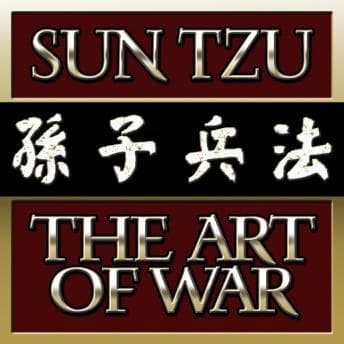

Sun Tzu's Art of War is not a book. It's a psychological profile of power — written 2,500 years ago by someone who understood human behavior better than most modern leadership gurus with TED talks and podcast deals.
I was cooking biryani on a Sunday afternoon — the kind of elaborate, three-hour production where you're layering rice and checking saffron milk and pretending you're not going to eat the entire pot alone — when I decided to put this on. Military strategy and slow-cooked rice felt thematically appropriate somehow. Patience as a weapon. Timing as everything.
A 2,500-Year-Old Case Study in Human Nature
Here's what struck me, listening to this as a psychologist rather than a business bro looking for LinkedIn caption material: Sun Tzu's core insight isn't about war. It's about reading people. "Know your enemy and know yourself and in a hundred battles you will never be in peril." That's not military advice. That's the foundation of every psychological assessment I've ever administered.
The thirteen chapters move through deception, terrain, espionage, and the management of armies, but underneath all of it is a single obsession — understanding what motivates human beings under pressure. The protagonist here, if you can call Sun Tzu that, exhibits classic systems thinking. He doesn't see battles as isolated events. He sees them as psychological ecosystems. I found myself asking: why does this still feel so relevant? Because the patterns of fear, ambition, overconfidence, and self-deception haven't changed. Not even a little.
The research actually shows that humans default to the same cognitive biases under stress that Sun Tzu was exploiting in the 6th century BC. It's almost embarrassing. Bill Bryson traces a similar kind of humbling arc in Short History of Nearly Everything — the recurring shock of realizing that everything we think we've newly discovered, nature or human or otherwise, was already operating perfectly well without our awareness of it.
The Two-Narrator Experiment (Mixed Results)
This particular audiobook version uses Don Hagen and Victoria Gordon in what appears to be a tag-team arrangement — Hagen reads the original text, and Gordon provides explanatory commentary between sections. In theory, this is a smart choice. The Art of War in its raw form reads like bullet points. Numbered maxims. Sparse, declarative, sometimes cryptic. Having someone contextualize is genuinely useful.
But here's the problem: Hagen's delivery gets droll. Not bad, exactly, but flat in a way that makes the sixth chapter of military aphorisms feel indistinguishable from the twelfth. When you're listening to a text that's already structured like a numbered list — "First... Second... Third..." — you need a narrator who brings some tonal variation, some gravity to the shifts between chapters on, say, espionage versus terrain. Instead, the pacing stays remarkably even, which sounds like a compliment but isn't. It becomes almost meditative in a way that made me lose focus somewhere around chapter nine while I was stirring the rice.
Gordon's explanatory sections were genuinely the better listening experience. She provides context that transforms cryptic ancient maxims into something you can actually apply. Her presence breaks up what would otherwise be a pretty monotonous six-and-a-half hours. But she doesn't appear often enough to fully rescue the pacing issue.
At 6 hours and 30 minutes, this feels padded for what is, let's be honest, a fairly short original text. I'd strongly recommend bumping the speed to 1.25x. It tightens everything up and — counterintuitively — made the content easier to absorb because my mind had less time to wander.
Psychologically, This Tracks (Even When the Format Doesn't)
What I kept coming back to is how much Sun Tzu understood about self-deception — the way leaders convince themselves they're winning when they're bleeding resources, the way emotional reactivity masquerades as decisiveness. My therapist would have thoughts about several of these chapters, particularly the ones on knowing when NOT to fight. That's not strategy. That's emotional regulation.
The business application angle that gets pushed in every description of this book? It's... fine. It's not wrong. But it flattens something more interesting. This is a fascinating case study in how a pre-modern thinker arrived at psychological truths that we've spent centuries rediscovering with fMRI machines and randomized controlled trials. The chapter on the use of spies is essentially a primer on social engineering and information asymmetry. The chapter on terrain is about environmental psychology before we had a name for it.
But — and this is important — the audiobook format fights the text. The Art of War wants to be read, paused over, re-read. Aphorisms don't flow well in audio. They stack up and blur together. You'll catch a line that makes you want to stop and think, but the narration has already moved three maxims ahead. This is a text that demands active engagement, and passive listening works against it.
Who Gets the Most From This (And Who Should Grab the Paperback Instead)
If you've never encountered the Art of War and want a general sense of its ideas while you're doing something else — cooking, commuting, existing — this audiobook version will give you that. Gordon's commentary genuinely helps contextualize a text that can feel opaque without historical framing.
But if you want to actually study this, to sit with the psychological insights and apply them? Buy the book. The physical one. With margins you can write in. The audio format and this particular narration don't serve the material's density well enough to justify 6.5 hours of your life.
Psychologically brilliant source material, somewhat undermined by a format and narration style that smooth out its edges when they should be sharpening them.