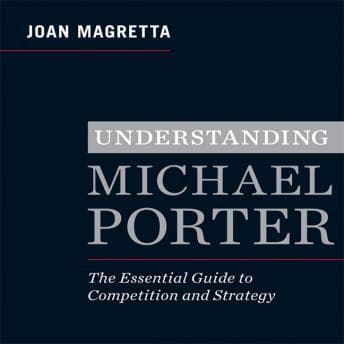

Look, I have a confession. I've been recommending Porter's frameworks to clients for years while secretly dreading the question: "Have you actually read all his original work?" The honest answer was always a mumbled "enough of it." Porter's publications are scattered across decades of HBR articles, dense academic papers, and books that could double as doorstops. So when I found this audiobook—basically a cheat code written by his former editor—I felt both relieved and slightly called out.
Here's the thing about Joan Magretta: she spent years at McKinsey before becoming an editor at Harvard Business Review. She's one of us. She knows what it's like to sit in a client meeting and need the core insight, not the academic hedging. And that's exactly what she delivers here.
The Porter Decoder Ring
Magretta does something I've never seen done well before—she connects the dots between Porter's concepts in a way that makes you feel slightly dumb for not seeing it yourself. Five forces, value chain, competitive advantage. I'd been treating these as separate tools in a toolkit. Turns out they're more like pieces of the same machine.
The section on "competing to be unique" versus "competing to be the best" alone is worth the listen. That distinction between differentiation and operational excellence shows up in negotiation too—Never Split the Difference makes a similar point about creating unique value rather than just haggling over price. I've watched three companies crater because leadership bought into the "best" mentality. Race to the bottom, every time. My parents never read Porter, but they understood this instinctively—their dry cleaning shop didn't try to be the cheapest or the fanciest. They carved out their niche in Koreatown and owned it. Now that instinct has academic backing. (Jenny says I relate everything to my parents' business. Jenny is correct.)
Why This Works at 2.0x Speed
Six hours. That's it. Magretta respects your time in a way most business authors don't. I wish more productivity books followed this model instead of the bloated approach in something like Get Sh*t Done, which could've been half the length. No padding with case studies you'll forget, no meandering anecdotes about Southwest Airlines for the hundredth time. Just the frameworks, explained clearly, with enough context to actually apply them.
Don Hagen and Erik Synnestvedt split narration duties, and honestly? It works better than I expected. The dual-narrator approach keeps things from getting monotonous—which matters when you're absorbing strategic frameworks on your morning commute. Neither tries to make it more exciting than it is. Clean, professional, no vocal theatrics. This is business content, not a thriller. They read the room.
I cranked it to 2.0x and had zero comprehension issues. The pacing is already tight enough that faster speeds don't break the flow. If anything, 1.5x might be the sweet spot for first-time listeners who want to take notes.
The Misconception Cleanup
Magretta spends serious time on how Porter gets misapplied. This is where her practitioner background shines. She's clearly sat in the same rooms I have, watching executives butcher the five forces framework or treat "competitive advantage" as a buzzword rather than a precise concept.
The bit about operational effectiveness versus strategy? I'm stealing that for my next client deck. So many founders confuse the two. They think being better at execution IS strategy. It's not. Magretta makes this distinction crystal clear without being condescending about it.
One thing I couldn't verify—I looked for more background on the narrators and came up mostly empty. Based on this performance, though, they're solid choices for business content. No complaints about audio quality either. Clean production throughout.
Who This Is (and Isn't) For
If you've actually read Porter's complete body of work—like, really read it, not just skimmed the HBR articles—you probably don't need this. It's synthesis, not new thinking. But let's be honest: most of us haven't done that homework. We've been faking it with secondhand summaries and Wikipedia entries.
Also skip if you're looking for entertainment. This isn't a business narrative or founder memoir. It's a textbook that happens to be well-written and well-narrated. Nothing wrong with that, but know what you're getting.
My Parents Called It Instinct. Porter Calls It Strategy.
Magretta took decades of Porter's thinking and made it digestible without dumbing it down. Six hours, no fluff, immediately applicable.
I've already recommended it to three clients this month. That's the real review right there.