
I literally listened to this entire thing while my thesis document sat open and mocking me. Forty-two minutes. That's it. I could've written like... a paragraph of my methodology section in that time. But no, I chose robot cop on Mars instead.
No regrets.
When Classic Sci-Fi Gets Weird (In the Best Way)
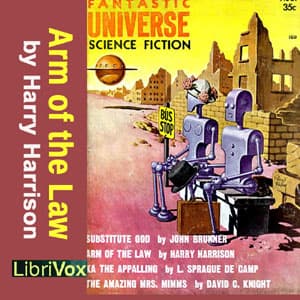
Harry Harrison wrote this back in 1958, and honestly? It feels like someone pitched "RoboCop meets small-town sheriff comedy" sixty years before anyone should've thought of that. The premise is beautifully simple: a backwater Martian outpost gets a prototype robot police officer shipped to them in a crate. Like a piece of furniture. And then things get... complicated. That fish-out-of-water setup—outsider arrives, locals have to adapt—is basically the whole premise of Barbarian Alien, just with more ice planets and significantly more romance.
What I love about Harrison's approach here is that he's not trying to build some massive world with elaborate political systems and seventeen magic types. (Not that I don't love that stuff—you know I do.) This is tight, focused, almost like a D&D one-shot where the DM had one really good idea and just ran with it. The robot, Rod, isn't some philosophical exploration of consciousness or whatever. He's just this weird, slightly terrifying presence that the local cops have to figure out how to work with.
And it gets dark. Like, not grimdark, but there's this undercurrent of "wait, should we be laughing at this?" that Harrison does super well. The robot is efficient. Maybe too efficient. The story plays with that tension between "this is hilarious" and "this is actually kind of scary" in a way that reminded me of some of the better Black Mirror episodes. Wolves of the Calla does something similar with its robot antagonists—that unsettling blend of familiar Western tropes and deeply wrong technology. Except, you know, written when my grandparents were in high school.
Phil Chenevert Does the Heavy Lifting
Here's the thing about short fiction audiobooks—the narrator basically IS the experience. Forty-two minutes doesn't give you time to settle in. Either the voice works or it doesn't.
Chenevert works. Mostly.
His tone is pretty neutral, which honestly fits the dry humor Harrison's going for. The pacing is solid—he doesn't rush through the setup, which is good because the setup is half the fun. But I gotta be honest, some of the character voices blend together a bit. When you've got multiple Mars colonists talking, it can get a little "wait, who said that?"
(This is where I'd normally say "Steven Pacey would've given each character a distinct voice and accent," but that's not really fair. Pacey is a god among narrators. Most mortals can't compete.)
The production quality is clean, though. No weird audio artifacts or anything. It's a LibriVox-style recording, so manage your expectations accordingly, but Chenevert is clearly a pro who knows what he's doing.
Who's This For (And Who Should Skip It)
If you're a Harrison fan, this is a fun little piece of his catalog that you might've missed. If you're new to classic sci-fi short fiction, it's a pretty good entry point—not too long, not too dense, just weird enough to be memorable. Skip it if you need deep character work or a fully resolved ending; the story wraps up faster than the buildup deserves. Classic short fiction problems—you've got limited real estate.
Would I listen again? Probably not—it's the kind of story that hits hardest the first time when you don't know where it's going. But would I recommend it to my D&D group who likes old-school sci-fi? Absolutely. It's got that pulpy, Asimov-era energy that's just fun to experience, even if it's not trying to reinvent the genre.
Back to Chapter 3 (Eventually)
At forty-two minutes, you could knock this out during a lunch break. Or while pretending to work on your thesis. Not that I would know anything about that.
(Dr. Patel, if you're somehow reading this: I'm working on Chapter 3. I promise.)