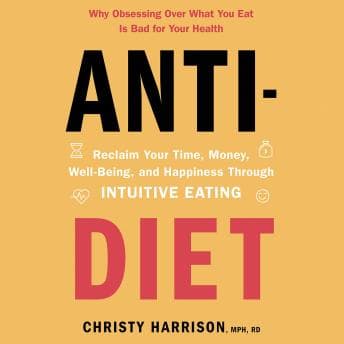

Diet culture is a belief system. And like most belief systems, it's stickier and more insidious than anyone wants to admit.
That's essentially Christy Harrison's thesis in Anti-Diet, and as someone who studies how narratives shape identity — how the stories we tell ourselves literally construct who we think we are — I found myself nodding through about 80% of this book while chopping onions for a chana masala I was absolutely going to eat without guilt, thank you very much.
The Psychology Harrison Gets Right (and Why It Matters)
What makes this book genuinely interesting from a behavioral science standpoint is Harrison's argument that diet culture operates like what psychologists call an internalized schema — a deep cognitive framework that filters how we interpret everything from a restaurant menu to a doctor's visit. She traces diet culture's roots back through history, connecting the dots between Puritan morality, the rise of BMI as a flawed metric, and the rebranding of dieting as "wellness." The protagonist of this story — and yes, diet culture IS the protagonist, the thing with agency driving the plot — exhibits classic features of systemic manipulation: it shape-shifts, co-opts the language of health, and makes you think resistance is the pathological response.
Harrison's breakdown of how the wellness industry absorbed diet culture's DNA without changing its core message? That's the section I rewound twice. She names specific examples — clean eating, detoxes, elimination diets dressed up as "healing protocols" — and walks through how each one smuggles in the same old weight-loss imperative under a shinier label. The research actually shows that weight cycling (the lose-gain-lose pattern most dieters experience) carries its own health risks, and Harrison presents this data clearly without dumbing it down.
I found myself asking: why does this particular repackaging work so well on smart, skeptical people? Harrison's answer — that diet culture exploits our desire for control and moral superiority — tracks with what we know about cognitive dissonance and identity-protective cognition. People don't just diet to lose weight. They diet because thinness has been coded as discipline, virtue, worthiness. That's an identity story. That's my entire research area. The way inherited cultural scripts quietly become self-concept — I traced a version of that same process in Brown Girl Dreaming, where identity formation under external pressure does something remarkably similar, just in a very different arena.
Where the Argument Gets Wobbly
Okay, but. And this is the part where my academic brain starts twitching.
Harrison is a registered dietitian and journalist, and she's clearly done her homework. But there are moments where the book leans heavily on a particular interpretation of the evidence — especially around the Health at Every Size framework — without fully grappling with the complexity of the research landscape. Some of the studies she cites are solid. Others are... let's say selectively presented. A Red Pen Reviews analysis flagged some of this, and I think that's fair criticism. The book sometimes reads like advocacy first, science second. Which doesn't make it wrong, but it does mean you should read it as one perspective in an ongoing conversation, not as the final word.
Psychologically, though, here's what I think she absolutely nails: the emotional and cognitive toll of chronic dieting is real and measurable. The anxiety, the food obsession, the way it colonizes mental bandwidth that could go toward literally anything else — Harrison captures this with a clarity that feels both clinical and deeply personal. She draws on her own history with disordered eating, and those sections have a rawness that the more academic chapters lack.
Harrison Reading Harrison
She narrates her own book, which is a gamble that pays off about 70% of the way. Her delivery is warm, clear, and compassionate — you can hear the podcast host in her cadence, that practiced ability to explain complex ideas conversationally. But nearly ten hours is a long time, and there are stretches in the middle (particularly the historical deep-dives) where the pacing flattens. Not because the content isn't interesting, but because Harrison's vocal range doesn't shift much between "here's a devastating personal story" and "here's an 18th-century timeline of fad diets." A little more tonal variation would've helped. At 1.25x speed, though, the pacing tightens up nicely.
(My therapist would have thoughts about why I listened to a book about diet culture while stress-cooking at 10 PM on a Tuesday. I'm choosing not to explore that right now.)
Who This Is Actually For
If you've ever felt like your relationship with food takes up way too much cognitive real estate — or if you work in healthcare and want to understand why your patients flinch when you mention weight — this is worth your time. If you want a purely objective, dispassionate review of the nutritional science, look elsewhere. Harrison has a point of view and she's not hiding it.
People who'll be frustrated: anyone wanting a prescriptive "here's exactly what to eat" plan (that's the whole point — she's not giving you one), or readers who need every claim backed by a randomized controlled trial before they'll engage with an argument.
The Case File, Closed
This is a fascinating case study in how cultural narratives become personal pathology. Harrison's best contribution isn't the science — it's the framework. She gives you language for something many people feel but can't articulate: that the problem isn't your willpower. It's the story you've been handed about what your body is supposed to be. And from someone who studies how stories build and break identity? That's a framework worth sitting with.