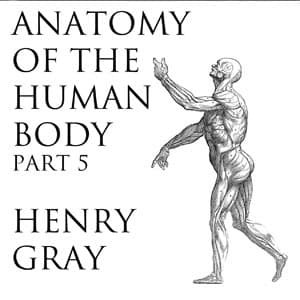

"The internal surface of the stomach is covered at all times with a thick, viscid mucus..."
That's roughly where I was at hour 3 when I realized two things: one, I was learning about gastric mucosa at 6:17 AM on a packed Caltrain, and two, I had accidentally become the kind of person who listens to a 160-year-old anatomy textbook for fun. Look, I have an explanation. I'd just finished a sci-fi binge where the alien biology was so hand-wavy it physically pained me, and I thought, you know what, let me go back to the source material on actual human biology. Funnily enough, the last thing I'd listened to before that binge was Man-Eaters of Tsavo, which at least had the decency to make biology feel viscerally, immediately relevant. Gray's Anatomy - the real one, not the show Kevin keeps telling me I'd like.
Thirteen Hours of Organs and You Can't Skip Around
So here's the deal. Part 5 covers splanchnology (that's your viscera - digestive, respiratory, urogenital systems) and surface anatomy. This is the 1918 US edition, which means you're getting pre-modern anatomical description that reads like Victorian technical writing, because that's literally what it is. The language is precise, dense, and completely uninterested in your engagement. There's no narrative arc. There's no character development unless you count the detailed journey of the common bile duct as a protagonist moment (I do not).
The ROI on this audiobook is... complicated. If you're a med student or anatomy nerd, the information is genuinely interesting, but also outdated enough that you shouldn't be using it to study for boards. If you're a casual science listener, this is roughly equivalent to having someone read you a textbook index entry by index entry for thirteen and a half hours. Which is, quite literally, what it is.
The real problem: this book was written to be read alongside illustrations. Gray's Anatomy is famous for its diagrams. The LibriVox recording acknowledges this - they point you to bartleby.com for the images. But on audio? You're listening to someone describe spatial relationships between organs, attachment points of ligaments, and the branching patterns of arteries... with no visual reference. It's like trying to debug a distributed system by having someone read the architecture diagram aloud over the phone. You can kind of follow it, but you're missing 60% of the information.
The LibriVox Volunteer Situation
This is a multi-volunteer LibriVox recording, and that means exactly what you think it means. Different chapters have different readers with different audio setups, different reading speeds, different comfort levels with medical Latin. Some volunteers are clear and steady - genuinely pleasant to listen to. Others sound like they're recording in a closet with a USB mic from 2008 (which, honestly, they probably are). The transitions between readers are jarring. You'll go from someone with a warm, measured tone to someone who sounds like they're speed-reading a legal document.
No shade to the volunteers - they're doing this for free, and reading anatomical Latin aloud without stumbling is genuinely hard. But the inconsistency kills any chance of a smooth listening experience. I found myself adjusting volume constantly, and my usual 1.5x speed worked for some readers but made others unintelligible.
Compare this to, say, a professionally narrated science book - like anything Ray Porter touches - and the gap is massive. But that's not really a fair comparison. This is free. It's public domain. It exists because volunteers cared enough to record a century-old textbook. That has its own kind of value.
Who Actually Needs This in Their Ears
Perfect for: absolutely nobody's commute. Sorry. This is not commute-worthy by any definition I use. You cannot follow descriptions of the peritoneal cavity while half-asleep on a train, and I tried. Twice.
Maybe useful for: someone studying anatomy who wants passive background exposure to terminology. Or a writer doing research on historical medicine who wants to absorb the cadence of early 20th-century scientific writing. Or an insomniac - and I mean this genuinely, not as an insult. The steady, factual drone of organ descriptions is weirdly soothing at 1AM when your brain won't stop replaying a production incident.
Skip if: you want to actually learn anatomy (get a modern textbook with pictures), you want entertainment (get literally anything else), or you have strong feelings about audio quality consistency.
The Debug Report
TL;DR: This is a free LibriVox recording of a 1918 anatomy textbook that was designed to be read with illustrations you don't have. It's a noble effort by volunteers, and there's something genuinely cool about listening to the same text that trained doctors over a century ago. But as an audiobook experience? It's like reading API documentation as a bedtime story. Technically informative, practically brutal, occasionally accidentally soothing. I finished it because I'm stubborn, not because it was good.






![Steve Jobs [unabridged audiobook] audiobook cover](/_next/image?url=https%3A%2F%2Fcovers.audiobooks.com%2Fimages%2Fcovers%2Ffull%2F9788499923406.jpg&w=1920&q=75)