
The Original "Move Fast and Break Things"
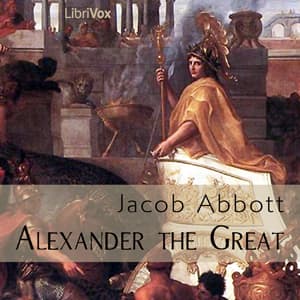
I picked this up on a Tuesday night after a strategy session that went three hours over time. I needed to listen to someone who actually got things done. Alexander the Great? The guy conquered the known world before he turned 33. Meanwhile, my client can't decide on a font for their Q3 deck.
So, I see this audiobook. Under 6 hours. Jacob Abbott. It's an older text—19th century—originally written for "young people." Perfect. I don't need a 40-hour academic deep dive into pottery shards. I need the executive summary of the conquest. I need the hustle.
(Jenny saw the title and asked if I was planning to invade a neighboring homeowner's association. I declined to comment.)
The "Uptalk" Problem
Here's the thing about efficiency—it requires a smooth delivery vehicle. And this is where we hit a snag.
Lizzie Driver narrates this. Her enunciation? Crystal clear. You won't miss a word. But—and this is a big but—she has this specific cadence. A sing-song rhythm with an upward inflection at the end of sentences.
If you've ever interviewed a nervous junior analyst, you know the sound. Everything sounds like a question? Even when they're stating a fact?
"Alexander marched to Tyre? And then he built a causeway?"
It's jarring. We're talking about one of the most ruthless military commanders in history. The man razed cities. The narration sounds like a librarian reading a bedtime story to a particularly sensitive toddler.
I had to crank the speed up. Usually, I'm a steady 2.0x guy. For this, I went to 2.5x just to flatten out the pitch variation. At that speed, the sing-song quality mostly disappears, and you just get the data stream. If you listen at 1.0x, you have more patience than I do. And I sat through a three-year digital transformation project that went nowhere.
CEO Lessons from 1849
Despite the audio quirks, the content holds up. Abbott wrote this in the 1800s, so the language is a bit formal, but it respects your intelligence while keeping it simple.
It's basically a case study on rapid scaling and the failure of succession planning. Alexander built a massive conglomerate (the Empire) but failed to institutionalize his processes. He died, and the whole thing fractured into competing spin-offs.
Abbott captures the energy of it. He doesn't get bogged down in the boring stuff. He focuses on the action, the decisions, the character flaws. It's "Great Man" history—which is out of fashion in universities but still pretty relevant if you're trying to understand leadership psychology. Abbott's approach here—straightforward biographical narrative—reminded me of Life of P.T. Barnum, another 19th-century biography that cuts through the mythology to show you the actual person.
My parents would have liked Alexander's work ethic. They wouldn't have liked the drinking. Abbott doesn't shy away from the violence, but he frames it in that moralizing 19th-century way. Kind of charming, actually. Like getting business advice from your great-grandfather.
The Bottom Line
This isn't the definitive scholarly work on Alexander. If you want that, go find something 30 hours long. This is a primer. The Wikipedia Deep Dive version, but written with better prose.
Is it perfect? No. The narration is a hurdle. But if you treat it like a briefing document—get in, get the info, get out—it works. Don't expect a cinematic performance.
Who should listen: Busy professionals who want the leadership highlights without the academic slog. History-curious folks who appreciate efficient storytelling. Who should skip: Anyone who needs a polished, dramatic narration—the uptalk will drive you nuts at normal speed.
(And seriously, use the speed controls. It's the only way to survive the uptalk.)








![Steve Jobs [unabridged audiobook] audiobook cover](/_next/image?url=https%3A%2F%2Fcovers.audiobooks.com%2Fimages%2Fcovers%2Ffull%2F9788499923406.jpg&w=1920&q=75)