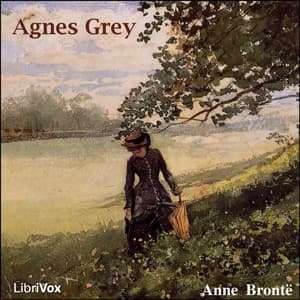

Look, I need to start with a complaint. The metadata for this audiobook lists the description for Aesop's Fables Volume 12. Aesop's Fables. For Agnes Grey. Somewhere, Anne Brontë — the most overlooked Brontë sister, the one who already gets treated like a literary afterthought — just rolled over in her grave in Scarborough. Even in the digital age of free audiobooks, she can't catch a break. This is why we still read the classics, people. Someone has to remember them correctly.
But I'm not here to rant about metadata. I'm here because I spent a quiet Saturday walking the lakefront with Denise, and instead of our usual comfortable silence punctuated by her pointing out dogs she wants to pet, I had one earbud in listening to Agnes Grey. And something about Anne Brontë's quiet fury paired with the gray November water off Lake Michigan just... worked.
The Brontë Sister Who Told the Truth Instead of a Gothic Romance
Here's what my students don't understand about Agnes Grey, and honestly what most readers miss: this isn't Charlotte's fire or Emily's fever dream on the moors. Anne wrote the governess novel that's basically a 19th-century teacher's memoir. Agnes gets hired by wealthy families who treat her like furniture with a pulse. The children she's supposed to educate are feral. The parents undermine her at every turn. The pay is insulting.
I've been teaching for twenty years. I felt this book in my bones.
Anne Brontë wasn't interested in making her protagonist's suffering romantic. When Agnes watches young Tom Bloomfield torture birds and his mother laughs it off, there's no gothic veil softening it. It's just ugly. It's a kid being cruel and adults enabling it because they have money and Agnes doesn't. That kind of clear-eyed social observation — Hemingway would've approved. Strip the sentiment, show the thing, let the reader do the work.
And then there's Mr. Weston. The love interest who wins Agnes over not through brooding mystery or dramatic declarations, but by being... kind. Decent. Interested in what she thinks. My students would hate this. I love it. The prose deserves to be savored precisely because it refuses to perform passion — it just presents it, plainly, and trusts you to recognize it.
What Happens When Volunteers Love a Book More Than the Algorithm Does
So here's the thing about LibriVox recordings — you're getting volunteer narrators, which means you're getting people who chose to spend their free time reading Anne Brontë aloud for strangers. That counts for something. The emotional investment is real even when the production polish isn't.
The multi-reader approach means each chapter can feel slightly different in tone and energy. Some readers lean into Agnes's dry wit, catching the way Brontë slips in these devastating little observations about class and gender disguised as polite narration. Others read it more straightforwardly, which sometimes works — Agnes is restrained, so restraint in the reading makes sense — and sometimes flattens moments that need a sharper edge.
There's an inherent unevenness you have to accept. Recording quality shifts. Pacing varies. One reader might sit comfortably in the drawing room scenes while another rushes through them. It's not a professional Audible production and it doesn't pretend to be. But there's something almost appropriate about a collaborative, imperfect, freely-given reading of a novel about a woman whose labor is consistently undervalued. The narrator understands that pause is punctuation — at least some of them do, some of the time.
At six hours and forty-two minutes, it's a modest commitment. Worth pausing the faculty meeting for. (Principal Martinez, I promise I was paying attention to the new attendance software training. I wasn't. I was in Chapter 14 with Agnes finally finding a shred of happiness.)
Who Needs This and Who Should Keep Walking
If you loved Jane Eyre but wished it had less attic wife and more honest reckoning with what it actually felt like to be a working woman in Victorian England, this is its spiritual successor — or really, its quieter predecessor. Anne published Agnes Grey the same year Emily published Wuthering Heights. Guess which one people remember. The same thing happens with quieter, more grounded novels getting buried under flashier company — I noticed it reading Here on Earth, where Alice Munro's territory gets claimed by a novel that has ambitions but not quite the staying power.
If you need polished narration with consistent production values, this isn't your version. Try a professionally produced edition. But if you're okay with the LibriVox charm — free, earnest, occasionally uneven — and you want to finally give Anne Brontë the afternoon she deserves, plug in and walk.
The Annotation Anne Earned
Let's talk about what the author is really saying. Agnes Grey is a protest novel wearing a governess's modest dress. Anne Brontë wrote from experience — she was a governess, she knew the small humiliations — and she refused to romanticize any of it. The book is short, sharp, and honest in a way that her more famous sisters sometimes aren't. This LibriVox version delivers it imperfectly but sincerely, which might be the most Agnes Grey way to encounter it. Denise asked me why I was so quiet on our walk. I told her I was thinking about a woman who deserved better. She thought I meant someone at school. I meant Anne.