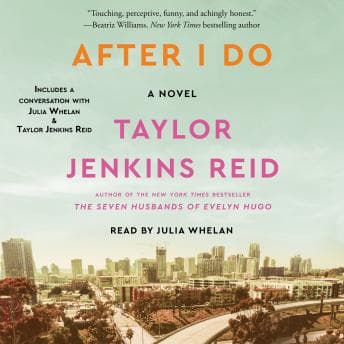

Do we ever really stop auditioning for our spouses, or do we just get lazy with the script? That's the uncomfortable question that kept me up past my bedtime—and past the pile of C- essays on Romeo and Juliet sitting on my desk. My sophomores think love is dying for someone in a crypt; Taylor Jenkins Reid argues it's the much harder work of living with them when the spark has turned into a mortgage payment.
I picked this up primarily because Julia Whelan is the narrator, and honestly, she could read the Chicago Public Schools lunch menu and make it sound like a Greek tragedy. She brought that same gravitational pull to Great Alone: A Novel, where her narration turned an already brutal story into something I had to pull over for. I usually listen to audiobooks to escape the reality of grading, but this one pinned me to the chair. Whelan understands that in a domestic drama, the volume doesn't need to be loud to be deafening. She adopts this specific, weary cadence for Lauren that hits a little too close to home for anyone who's been married longer than a week. It's not the breathy "romance novel" voice; it's the voice of a woman who is exhausted by her own life.
The Anatomy of a Break
The premise is risky—Lauren and Ryan decide that the only way to save their marriage is to take a year off. No contact. My students would call this "toxic," and frankly, part of me wanted to yell at the audio, "Just go to therapy!" But literature—and yes, I'm counting this as literature—isn't about people making good decisions. It's about people making human ones.
Whelan navigates the year of separation without turning it into a melodrama. She gives distinct textures to the secondary characters—Lauren's family has this chaotic, intrusive warmth that sounds exactly like Thanksgiving at my in-laws' place. But the real magic is in the internal monologue. There are moments where Lauren is questioning her entire identity, and Whelan drops her pitch just slightly, turning a rhetorical question into a confession. It feels less like a performance and more like eavesdropping.
Why It Works (And Why It Hurts)
I'll be honest: this isn't a "feel-good" listen for the first half. It's an autopsy of a dying relationship. If you're looking for escapism, go back to Daisy Jones. This is for when you want to sit with the messy, unglamorous reality of commitment. Taylor Jenkins Reid seems constitutionally incapable of letting her characters off easy—Atmosfera puts a different kind of couple through a different kind of wringer, and it left me with the same low-grade emotional hangover. The pacing can feel slow, but so is a year of waiting. The narrative demands patience, much like marriage itself.
The bonus conversation between the author and narrator at the end? Worth sticking around for. It's like the DVD commentary tracks we used to get, giving you a peek behind the curtain of how they constructed this emotional wringer.
Who's Getting an A, Who's Getting Excused
This one's for married folks willing to look at their own relationship with uncomfortable honesty—or anyone who's wondered if love is supposed to feel this hard. Skip it if you want your romance novels to stay in the fantasy lane; this is homework, not recess.
My mom would probably find the premise scandalous—she thinks a "break" is just a polite word for divorce—but I think she'd appreciate the honesty. It's a love story, sure, but it's one that earns its ending. Now, if only I could get my students to understand that "happily ever after" is a verb, not a destination.