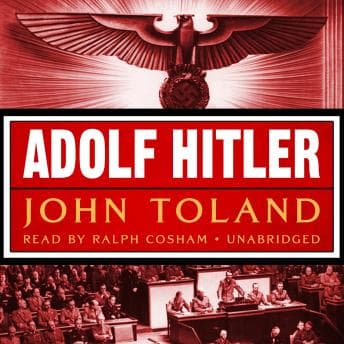

Forty-four hours and forty-nine minutes. That's not a book. That's a deployment.
I started Toland's Adolf Hitler during a week-long stretch of overnight security audits for a client in Houston - the kind of gig where you're sitting in a rental car at 2 AM watching a loading dock and questioning your life choices. Ranger wasn't with me on this one, but I had Geoffrey Howard in my earbuds, and let me tell you, nearly 45 hours with one narrator is an intimacy you don't ask for but can't avoid.
The Kind of Intel Brief That Actually Changes Your Thinking
Let me cut to the chase: this is the single most thorough biography of Hitler I've encountered, and I've read my share. Toland published this in 1976, which matters - he was still able to interview people who'd been in the room. Hitler's personal adjutants, secretaries, associates who were alive and willing to talk. That access is gone now, permanently. What you get is a biography built on primary sources that simply cannot be replicated.
What surprised me - and I don't surprise easy - is how much time Toland spends on the years before power. The failed artist in Vienna, the WWI dispatch runner who was genuinely brave under fire (Iron Cross, First Class, which was unusual for an enlisted man), the flophouse years. Toland doesn't psychoanalyze the way later biographers do. He just lays out what happened, what people around Hitler observed, and lets you sit with the discomfort of a human being becoming a monster through a series of choices that each made sense to him at the time. That restraint is more disturbing than any editorial hand-wringing would be.
The military chapters are where I was watching closest, and the author clearly did their homework. Toland gets the command dynamics right - the tension between Hitler and the General Staff, the way he'd override professional military judgment with intuition that occasionally worked (Ardennes 1940) and catastrophically didn't (Stalingrad, obviously). I've seen this scenario play out in real life - not at that scale, thank God - where a senior leader starts believing his gut is better than everyone's analysis. It never ends well.
Howard Holds the Line - Mostly
Geoffrey Howard - who many listeners know as Ralph Cosham - was a seriously talented narrator. The man won Audies, and you can hear why. His German pronunciations are clean and confident, not the butchered approximations you usually get. French names, Polish places, Italian references - he handles the multilingual demands of a WWII biography the way a good interpreter handles a coalition briefing. Professional, accurate, no showing off.
But here's the honest assessment: 45 hours is a brutal ask for any single narrator, and Howard's energy does flag. He starts strong - the early chapters have real presence and authority - but somewhere around the middle third, you can feel the fatigue creeping in. Certain passages go flat when they shouldn't. It's not bad narration by any stretch. It's more like a marathoner who started at a pace they couldn't quite sustain. At 1.25x speed (my standard), this smoothed out somewhat - the slightly faster pace actually masked some of the energy dips and kept the momentum going through the denser political maneuvering sections.
One thing Howard does well throughout: he keeps an appropriate distance. This isn't a narrator trying to do dramatic voices for Hitler's speeches or create a theatrical experience. It's measured, urbane, controlled. For this subject matter, that's exactly right. You don't want someone chewing scenery while describing the Holocaust.
Who Should Strap In and Who Should Stand Down
Worth your time? Here's the debrief: if you're serious about understanding the 20th century's worst chapter, this is essential. But you need to know what you're signing up for. This isn't a weekend listen. At 1.25x, you're still looking at roughly 36 hours. That's weeks of commute time or several very long road trips.
This book demands dedicated attention. I tried it as background during some routine paperwork and realized I'd missed critical context about the Beer Hall Putsch while reviewing access control logs. Don't make that mistake. This is a sit-down-and-focus listen.
If you want a shorter, more interpretive take on Hitler, go read Ian Kershaw. If you want the primary-source deep dive from someone who actually talked to the people who were there - and you've got the stamina for it - Toland is irreplaceable. Some listeners complain about pacing, and they're not wrong that it's slow in spots. But I'd argue that's the book being thorough, not the book being lazy. There's a difference.
The one structural oddity worth noting: some of the photo arrangements in the original text apparently don't follow chronological order, which is a minor irritation that obviously matters less in audio format.
Mission Debrief
I finished this one at 4:30 AM in a hotel parking lot in Katy, Texas, engine idling, coffee long cold. Sat there for a minute after the last chapter ended. Forty-five hours with the most documented evil of the modern era will do that to you. Toland doesn't tell you how to feel about any of it. He just makes sure you can't look away. That's harder to do than it sounds, and it's why this biography still matters almost fifty years after publication. The cold-case researchers behind Betrayal of Anne Frank are working that same ground - trying to reconstruct what happened and who was responsible when most of the witnesses are long gone - though I came away from that one with more questions than answers. Mission accomplished - but it's a long march to get there.




![Steve Jobs [unabridged audiobook] audiobook cover](/_next/image?url=https%3A%2F%2Fcovers.audiobooks.com%2Fimages%2Fcovers%2Ffull%2F9788499923406.jpg&w=1920&q=75)