"Talk to her."
That line hit me somewhere around hour two, riding the light rail through the Rainier Valley tunnel with my hearing aids cranked, captions scrolling on my phone screen in sync with the full cast audio. Cas is sitting beside Poppy while she's in stasis, and he's told to just... talk. Tell her their story. And something about that premise - the idea that voice alone can anchor someone, pull them back - as a hard-of-hearing listener, that hit different.
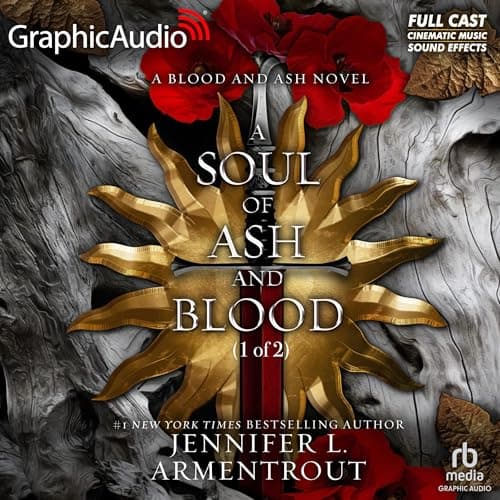
So here's the thing. A Soul of Ash and Blood is basically a retelling. You've read From Blood and Ash. You know how Poppy and Cas meet, how the deception unfolds, how it all spirals. Armentrout is asking you to walk the same path again, but now you're inside Hawke's head instead of Poppy's. And whether that's worth nine and a half hours of your life depends entirely on whether the production earns that retread.
This one does. Mostly.
GraphicAudio Turned This Into a Different Animal
Let me be blunt: I avoided the Tim Campbell solo narration of this book. Multiple listeners called his voice for Cas flat-out wrong, and I trust crowd consensus on voice casting. Voice casting can make or break a romantic fantasy — I watched the same dynamic play out in Archangel's Kiss, where the lead narration either sells the brooding immortal or kills the whole atmosphere. The GraphicAudio dramatized version is a completely different product. Stewart Crank as Cas/narrator carries the weight of the POV shift - his delivery during the framing scenes where Cas talks to unconscious Poppy has this raw, stripped-back quality that distinguishes present-Cas from past-Hawke. Katie Boothe's Poppy doesn't just sound young; she sounds guarded in exactly the right way, which matters because we're now seeing her naivety through Cas's eyes and it needs to read as strength, not weakness.
Torian Brackett as Kieran is the real surprise. The Cas-Kieran dynamic gets more room to breathe in this version, and Brackett plays the loyalty with an edge - like Kieran knows the plan is going to hurt people and he's already bracing for it. That tension doesn't exist in a solo narration. Full cast makes it textual.
The sound design is genuinely cinematic. Sword clashes have spatial placement, crowd scenes have depth, and the score knows when to pull back. During the quieter Cas-Poppy moments, the music drops to near silence, and that restraint is what sells the emotional beats. The performance is layered enough to feel - I caught emotional shifts through the production design even in sections where my aids were struggling with background subway noise.
The Retelling Problem (And Why It Almost Works)
Here's where I have to be honest. If you haven't read From Blood and Ash, this is a weird entry point. The framing device - Cas narrating to comatose Poppy while gods awaken and war looms - sets up stakes that this Part 1 never pays off. It's a setup book inside a retelling, and that's a lot of narrative trust to ask for.
The pacing drags in the middle third. Scenes you remember from Poppy's POV play out again with Cas's internal monologue layered on top, and some of those reveals (his guilt about the deception, his growing attraction) land with less impact because we already knew. The dramatized format helps - the full cast keeps scenes from feeling like a lecture - but there are stretches where I caught myself checking the chapter progress bar.
What saves it are the genuinely new moments. The things only Kieran knows. Cas's private calculations about whether the mission is worth what it'll cost Poppy. Those sections feel like finding deleted scenes from a movie you love, and they're distributed well enough to pull you through the familiar territory. Scared Sexy gave me a similar feeling — moments tucked into familiar genre beats that reward you for staying with them.
Caption Sync and the Accessibility Question
Caption sync was perfect on this one - which matters more than people realize for a dramatized production where multiple voices overlap. The transitions between speakers are clean, sound effects are captioned accurately, and the score never drowns out dialogue. Accessibility done right. GraphicAudio clearly built this with the understanding that not everyone processes audio the same way.
One small gripe: some of the battle sequences stack so many sound layers that clarity suffers. I had to rewind twice during a fight scene in the latter half because overlapping effects blurred the dialogue. Clarity over speed - always. A little more restraint in those moments would've helped.
Who Gets the Credit, Who Saves It
If you're deep in the Blood and Ash series and want Cas's internal world rendered by actual actors with cinematic production, this is the version. Period. If you bounced off Tim Campbell's solo narration, this GraphicAudio adaptation is a completely different experience worth trying.
But if you need new plot momentum - if retracing familiar ground for nine hours sounds like a chore even with a fresh POV - wait for a sale. And if you haven't read From Blood and Ash at all, start there. This retelling assumes you already care.
My Hearing Aids Caught What Mattered
The premise of this book is that a voice can hold someone in place. That talking to someone who might not hear you is still worth doing. As someone who's spent a lifetime calibrating what I hear against what I miss, that premise isn't just fantasy romance framing. It's real. And this production - imperfect pacing and all - earns that emotional core because the cast actually performs it rather than just reading it.