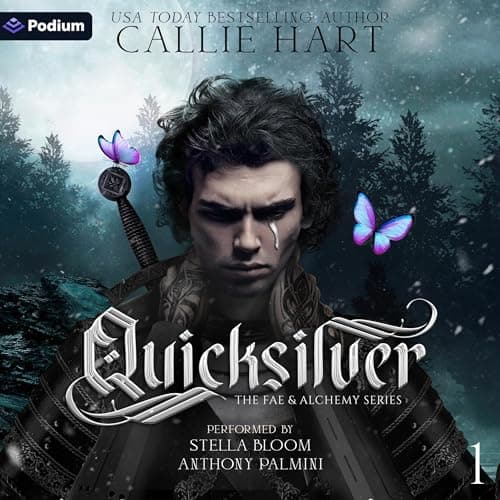

A lot of romantasy gets sold on chemistry first, world second, and logic whenever convenient. Quicksilver actually made me work for the buy-in - and I mean that as a compliment, mostly. I started this while reorganizing one of my apartment shelves, the one where fairy lore keeps trying to invade the gothic section (rude but predictable), and by the time Saeris had gone from stealing water in a brutal desert to getting thrown into the frozen nightmare-land of Yvelia, I was in.
Not instantly. But decisively.
Because this book knows its hook. A woman in a water-starved land, secretly skimming from the Undying Queen's reservoirs. A warning that sounds like a curse - do not touch the sword, do not turn the key, do not open the gate. Then a realm shift into ice and Fae politics and an accidental binding to a warrior literally associated with Death. That's not subtle. It's not trying to be. It is trying to get its claws into your throat and drag you through 20 hours of enemies-to-lovers chaos. And, honestly, it gets there.
The desert-to-snowfield contrast does a lot of heavy lifting here. Saeris begins in survival mode, and that matters; she's not just "sassy heroine with a secret power" pasted into a fantasy template. Her theft of water and concealment of her Alchemist magic give her desperation that feels material, bodily, immediate. Then the book yanks her into a place where the threat changes shape but not intensity. That's smart. Same danger, different weather.
When the frost bites back
What kept me listening wasn't just the romance - though yes, the Kingfisher situation will absolutely work for the target audience. It's that the setup has an actual engine. Saeris doesn't simply meet a hot, dangerous Fae man and get swept into destiny. She reopens a gateway, lands in the middle of a centuries-long conflict, and binds herself to someone whose entire deal is basically: haunted, deadly, withholding, and probably a terrible idea. My podcast listeners are going to love this.
Kingfisher, as written, is operating in a lane romantasy readers know well, but Callie Hart gives him enough jaggedness to keep him from feeling prefab. His "Death has a name" framing could've been eye-roll territory. Instead, because the book leans into his murky past and his not-entirely-trustworthy motives, it lands with more menace than melodrama. He doesn't feel safe. Important distinction. Daughter of The Blood does something similar with its dangerous male leads — that same quality of genuine threat underneath the magnetism, where you're never fully sure the protagonist is going to make it out intact.
And Saeris helps. She pushes back. She doesn't dissolve into passivity the second the plot hands her a dangerous man with cheekbones. Some listeners clearly bounced off the banter - I get it. If bratty, antagonistic flirting isn't your thing, parts of this are going to feel like a long evening trapped beside the hottest, most exhausting couple at a party. But when it works, it really works. The tension has teeth. The longing is bruised around the edges. This understands that fantasy romance lives or dies on whether the emotional friction feels costly.
Still - this is not a lean book. At 20 hours and 41 minutes, Quicksilver asks for patience. There are stretches where the pacing loosens and you can feel the story indulging its own atmosphere, its own push-pull, its own "just one more charged exchange before we move the plot" instincts. I didn't mind as much as some listeners did because the worldbuilding kept giving me enough texture to chew on. But if you need relentless forward motion, you may start checking the progress bar.
The duet does the seduction for you
This was my first real thought once I settled into the audio rhythm: okay, the narrator commits. That's rare.
Quicksilver is done in duet style, and that matters. Not dual POV where each narrator handles whole chapters - actual duet performance, where voices trade off by character. Some people need a minute to adjust to that format, and I did too. The first stretch can feel slightly disorienting if you're expecting standard alternating narration. Then your ear locks in, and suddenly the charged scenes have more snap, more immediacy, more danger.
Stella Bloom gives Saeris the exact kind of force this role needs. Not just strength - lots of narrators can do "tough." Bloom gives her defiance with a dry edge, like she's aware fear is in the room and is choosing insolence anyway. That makes Saeris feel less like an archetype and more like a person making bad-but-understandable choices under pressure.
Anthony Palmini is the bigger weapon here. His Kingfisher isn't played as nonstop growl-and-smirk nonsense. There's quiet intensity in it, restraint, a dark charm that lets the threats land without turning cartoonish. When the book wants haunted longing, he goes there. When it wants danger, he doesn't oversell it. That's why the chemistry works in audio. Not because the lines are always natural - some of them aren't - but because both performers treat the emotional stakes as real.
The minor characters don't vanish into mush, either. Even side voices have enough vitality that the world feels populated rather than wallpapered.
No sound effects, no gimmicks, no overproduced nonsense. Just clean editing and performers who understand where the voltage is.
Who should open this gate (and who should bolt it shut)
If you loved the parts of Fourth Wing that were more about tension than dragons, if The Serpent and the Wings of Night worked for you, if "icy Fae warrior with secrets" sounds less like a warning and more like a personal invitation - yeah, this is probably for you.
If you scare easily, skip. If you don't, you need this. Though to be clear, this isn't horror in the blood-soaked sense. It's adjacent. More dread-fantasy than outright nightmare fuel. The menace is romanticized, but it's still menace.
Skip or sample first if you hate prolonged banter, slow-burn buildup, or books where chemistry sometimes hogs the spotlight from momentum. Also: mature listeners only. Sexual content, violence, drug and alcohol use - none of that is hidden.
I listened to the last stretch during a rain-heavy insomnia spiral, with Shirley (my cat) asleep like she wasn't living in a home full of cursed-book energy, and that felt right. Quicksilver is indulgent, dramatic, sharp in the places that count, and elevated by a duet performance that gives the central relationship real auditory electricity.
Not flawless. But absolutely worth the credit if this flavor of romantasy already has your number.