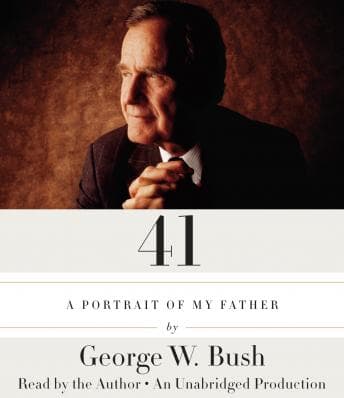

What does it cost a person to stand up in front of the world and say, out loud, I love my dad?
I was not expecting this book to wreck me. Let me be real - I didn't pick this one up for political reasons. I'm a first-gen Mexican-American woman from San Antonio who didn't exactly grow up in Bush country. But my abuela? She respected the office, every single time, no matter who held it. She'd iron her good blouse to watch inaugurations. And two years after losing her, I've been on this weird kick of listening to books about family - specifically about the mess and beauty of parent-child relationships across generations. So when I saw a son writing about his father, narrated by the son himself, something pulled me in.
I started this on a Wednesday afternoon, deep into a brand identity project for a local mezcalería, cats draped across every warm surface in my apartment. Diego was asleep on my keyboard. Frida was judging me from the bookshelf. And George W. Bush was in my ears, talking about his dad learning to fly a torpedo bomber at eighteen years old.
A Son's Voice Cracks Where a Historian's Wouldn't
Here's the thing about Bush narrating this himself - it's imperfect. And I mean genuinely, technically imperfect. There are moments where his words blur together, where that Texas drawl swallows a syllable or two, and you have to rewind five seconds to catch what he said. At 1.0x speed, I still missed things. That bothered me at first.
But then something shifted around hour two. I stopped hearing a former president reading a book and started hearing a son. There's this quality in his voice when he talks about his father's letters home during WWII - this reverence that no professional narrator could manufacture. You can hear when he's proud. You can hear when he's trying not to get emotional. Julia Whelan, I love you forever, but she couldn't give me this. This is a man processing his own father through the act of reading aloud, and the rawness of that hit me somewhere I wasn't prepared for. Ross Gay does something adjacent in Book of Delights - that quality of a person thinking out loud on the page, catching themselves mid-feeling, where the imperfection of the voice becomes the whole point.
Did I ugly-cry? Not the full four-session Beach Read experience. But my eyes got hot and blurry during the passages about Bush 41's relationship with his own mother, Dorothy Walker Bush, and her fierce competitive streak that shaped everything about who he became. The way 43 describes her - you can feel the generational echo. How a grandmother's fire becomes a father's quiet discipline becomes a son's... whatever George W. became. That lineage of personality. It reminded me so much of how my abuela's stubbornness lives in my mom lives in me.
Abuela would have loved this one. Not for the politics - for the family.
When the Mirror Gets in the Way
Okay, but I have to be honest about the frustrating parts, because this book has a real structural problem. Bush cannot stop making it about himself. And look - I get it. The whole premise is "my father through my eyes," so of course his own presidency comes up. But there are stretches, especially in the later hours, where it feels less like a portrait of 41 and more like 43 relitigating his own decisions using his dad as a backdrop. The Iraq sections in particular felt like he was working through something personal that maybe belonged in a different book - or a therapist's office.
Some listeners found this self-centering irritating, and I understand that. For me, it was more... complicated. Because isn't that what children do? We can't talk about our parents without talking about ourselves. We see them through our own damage and our own hunger. So the narcissism (and yeah, it's there) is also kind of the point? It's the most honest thing about the book, even if it's not intentional.
The pacing is uneven too. The WWII and early Texas oil chapters move with real energy and specificity. But the political career sections - Congress, CIA, UN Ambassador - sometimes feel like they're skimming a Wikipedia timeline with personal anecdotes dropped in. At 7 hours 42 minutes, it's not a huge time commitment, but there were moments I drifted back to my design work and realized I hadn't actually been listening for several minutes.
Who This Is Actually For
If you want a rigorous presidential biography, this isn't it. If you want political analysis, definitely not. But if you've ever lost a parent, or if you're watching a parent age and trying to understand who they were before they were yours - this book felt like sitting in someone else's living room while they flip through photo albums and tell you stories that matter more to them than they probably should to you. Rules Do Not Apply lives in that same emotional territory - a daughter reckoning with who her parents were as full, complicated people before she came along and needed them to be something simpler. And somehow that's enough.
People who love family memoirs and don't mind imperfect narration will find something warm here. If enunciation issues drive you up the wall, maybe grab the print version instead.
The Last Brushstroke
I finished this at 11 PM on a Thursday, Diego purring on my chest, a half-finished logo on my screen. And I sat there thinking about my own dad - how I'd describe him to strangers, what I'd leave out, what I'd accidentally reveal about myself in the telling. This book is flawed and self-serving and sometimes mumbled beyond comprehension. But the love in it is real. You can hear it in every slurred syllable. My heart didn't shatter, but it ached in that good, quiet way - the kind that makes you text your parents at midnight just to say hey.






![Steve Jobs [unabridged audiobook] audiobook cover](/_next/image?url=https%3A%2F%2Fcovers.audiobooks.com%2Fimages%2Fcovers%2Ffull%2F9788499923406.jpg&w=1920&q=75)