
I have a problem with leadership books. Most of them are written by people who have never actually been stuck in the middle of an organizational hierarchy, desperately trying to influence a boss who doesn't listen while simultaneously managing a team that thinks you have more power than you do.
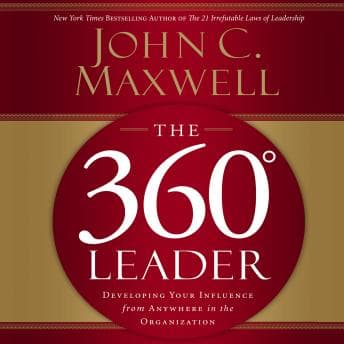
I was cooking biryani at 10 PM on a Tuesday—one of those elaborate stress-cooking sessions where the rice has to be perfect or the whole thing falls apart—when Maxwell started talking about the "seven myths of leading from the middle." And I found myself nodding along like he'd been reading my research notes on organizational psychology.
The Psychology of the Squeezed Middle
What makes this book compelling is that Maxwell actually understands the unique psychological pressure of middle management. The research shows that middle managers experience higher rates of anxiety and depression than either their superiors or subordinates—they're caught in what psychologists call a "role conflict" position. Maxwell doesn't use that terminology (this is a practical guide, not an academic text), but he clearly gets it.
He identifies what he calls the "360 Degree Challenge"—the reality that you're simultaneously leading down, across, and up. Most leadership books focus exclusively on the downward direction, as if influence only flows one way. Maxwell's framework acknowledges something my dissertation committee would appreciate: power dynamics are relational and multidirectional.
The protagonist of this book—and yes, I'm treating Maxwell's ideal middle leader as a character study—exhibits classic growth mindset patterns. But what I found myself asking: why does Maxwell assume everyone has the emotional resources to implement these strategies? He doesn't really account for the depleted manager, the one running on empty. That's a gap.
Henry O. Arnold Does the Heavy Lifting
Arnold's narration is polished and clear, which is exactly what you need for this type of content. No dramatic flourishes, no attempt to make leadership principles sound like a thriller. He delivers Maxwell's insights with the kind of measured authority that makes you actually believe you could implement this stuff on Monday morning.
Maxwell himself shows up occasionally, and there's something useful about hearing the author's own voice on certain sections—it adds authenticity to the anecdotes. But Arnold carries the bulk of the nine hours, and his pacing keeps things moving even when Maxwell gets repetitive. (And he does get repetitive. More on that in a moment.)
Where the Framework Gets Wobbly
Psychologically, some of this doesn't track. Maxwell presents leading up—influencing your boss—as if it's primarily a matter of technique and attitude. But the research actually shows that upward influence is heavily constrained by organizational culture and your boss's individual receptivity to feedback. You can be the most skilled "360 degree leader" in the world, and if your boss is a narcissist or the culture punishes initiative, you're going to hit walls Maxwell doesn't really acknowledge. What a Time to be Alone actually addresses this gap—the reality that sometimes the healthiest response to a toxic system is to focus on yourself, not on optimizing your influence within it.
Also, the stories. Maxwell loves his illustrative stories. Some of them are genuinely illuminating case studies in human behavior—the kind I'd use in my own teaching. Others feel like they've been polished into motivational poster territory, losing the messy complexity that makes real leadership situations so difficult.
At around the five-hour mark, I noticed a pattern: Maxwell introduces a concept, tells a story, gives three to five principles, moves on. Rinse, repeat. It's effective pedagogy, but it also means you could probably listen at 1.25x without missing anything crucial.
When Expertise Meets Context
This is a fascinating case study in what happens when someone with genuine expertise tries to systematize something that's fundamentally contextual. Maxwell's thirty years of experience are real. His observations about middle leadership are often astute. But leadership—like personality—is situational. He understands human nature in broad strokes, but sometimes those strokes are too broad.
The workbook component (referenced in the description) isn't really an audiobook feature, which is a limitation. If you're serious about applying this material, you'll want the physical book too.
Who Gets Value Here (And Who Won't)
This book is for you if: you're genuinely stuck in middle management and feel like you have no influence; you've never thought systematically about leading in multiple directions; you need practical frameworks more than psychological depth.
Skip it if: you've already read extensively on leadership and influence (this covers familiar ground); you're looking for research-backed approaches with citations (Maxwell operates on wisdom, not data); you're already at the top and just want validation.
Questions Maxwell Doesn't Ask
Maxwell's underlying assumption is that you should want to maximize your influence at every level of your organization. My therapist would probably ask: why? Is this about genuine contribution, or is it about control? Is the "360 degree leader" psychologically healthy, or are they just really good at managing their anxiety through action?
These aren't questions Maxwell asks. But they're the questions I kept asking while stirring my biryani.
Solid framework. Clear narration. Real insights mixed with some oversimplification. If you're in the middle and feeling stuck, this is worth your time—just don't expect it to solve the structural problems Maxwell can't see.