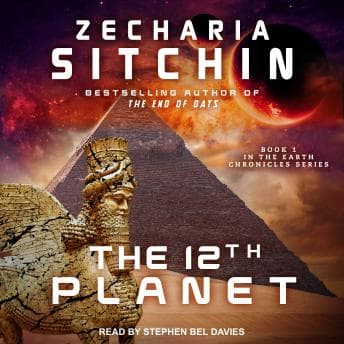

This is not a science book. I need to say that upfront because the genre tag says "Self-Help" and the description says "indisputable documentary proof" and neither of those things is accurate. The 12th Planet is Zecharia Sitchin's 1976 interpretation of Sumerian and Akkadian texts arguing that ancient astronauts from a planet called Nibiru genetically engineered humanity. It's ancient aliens theory before Ancient Aliens was a History Channel show. And I listened to all 13 hours and 35 minutes of it.
Let me explain how that happened.
How I Ended Up Spending 9 Commutes on Ancient Astronaut Theory
Kevin left this in my Audible library. He went through a phase last year where he was binge-watching conspiracy documentaries at 2AM and apparently bought this alongside some UAP books. I found it while scrolling for something to queue up during a particularly brutal Monday morning - the kind where the 6:07 Caltrain is already standing room only and you just need something in your ears that isn't the guy next to you mouth-breathing. I figured, why not? I'd never actually read Sitchin despite hearing him referenced in every "ancient aliens" conversation ever.
Here's what surprised me: for the first 4-5 hours, this is genuinely interesting Sumerian scholarship. Sitchin's knowledge of ancient Near Eastern languages was real. The guy could read cuneiform. He walks you through the Enuma Elish (Babylonian creation epic), Sumerian king lists, cylinder seal imagery, and the cosmological texts with a level of detail that feels like sitting in a graduate seminar. His breakdown of the Sumerian numerical system and how it maps to astronomical observations? Actually fascinating. The description of how the Anunnaki social hierarchy mirrors Sumerian temple bureaucracy? I was taking mental notes.
Then around hour 5, the logic starts doing that thing where you're watching someone build an elaborate house of cards on a table that's already tilting. Sitchin takes legitimate ancient texts, translates them in ways that mainstream Assyriologists dispute, and then stacks inference on inference until "the Sumerians described planetary orbits" becomes "aliens from a 12th planet with a 3,600-year elliptical orbit bioengineered homo sapiens as a slave labor force for gold mining." The leaps in reasoning are - and I say this as someone who debugs distributed systems for a living - like reading a postmortem where someone concludes the root cause was aliens because the logs had the word 'ET' in an error code.
The Sitchin Stack Trace: Where the Logic Faults
The core argument structure is basically: (1) Sumerians knew things about the solar system they shouldn't have known, (2) their myths describe beings from the sky, (3) therefore those beings were literal extraterrestrials from a planet we haven't discovered. Steps 1 and 2 have some interesting supporting evidence. Step 3 is a leap you could drive Nibiru through.
What's wild is how confident Sitchin is. There's zero hedging. Every translation choice that supports his thesis is presented as the only possible reading. Every ambiguous cylinder seal is "clearly depicting" rocket ships or DNA helixes. He never once says "this could also mean..." - and if you've spent any time reading actual academic translations of these same texts, you know there's a LOT of "this could also mean." The scholarly consensus is that Sitchin's translations are, let's say, creative.
But I'll give him this: the man did his homework on the source material. Wrong conclusions built on a foundation of real research is way more interesting than wrong conclusions built on nothing.
Stephen Bel Davies Does His Job
The narration is competent. Davies reads this like what it is - a dense, reference-heavy nonfiction work. He handles the constant Sumerian and Akkadian terminology (Anu, Enlil, Enki, Ninmah, on and on) with consistent pronunciation, which matters when you're half-conscious on a train and trying to keep track of which alien god is which. No dramatic flair, no weird vocal choices - just steady, clear delivery. For 13+ hours of what is essentially one man's obsessive thesis, that's the right call. You don't need theatrical energy here; you need clarity.
I bumped it to 1.5x by hour 3 because Sitchin has a tendency to restate his evidence multiple times from slightly different angles. At 1.5x, the pacing felt right. At normal speed, there's a lot of "as we have already established" energy that drags.
Who Should Queue This (And Who Absolutely Shouldn't)
If you're into the history of fringe theories, or you want to understand why the ancient astronaut hypothesis has the specific shape it does in pop culture, this is the source text. It's the origin repo that everything else forks from. Worth knowing even if you think the central thesis is wrong (I do).
If you're looking for actual Sumerian history, read a real Assyriologist. If you're looking for self-help... I have no idea why this is categorized as self-help. The self-help shelf is a strange place — I reviewed Gift: 14 Lessons to Save Your Life a while back, which is actually about survival and trauma and earns its genre tag, so the contrast here is almost funny.Unless "you were genetically engineered by aliens" counts as a self-help revelation.
Perfect for: train, roadtrip with someone who'll argue about it with you. Skip for: anything requiring you to take it at face value.
The ROI Calculation
The ROI on this audiobook is weird. I don't believe a word of the central thesis, but I'm genuinely glad I listened. It scratched the same itch as reading a really well-constructed wrong answer on Stack Overflow - you learn something about the problem space even when the solution is bonkers. Nine commutes. No regrets. Kevin is now insufferable about it because he thinks I've "come around" on ancient aliens. I have not. But I can now explain exactly why Sitchin's translation of 'nephilim' is disputed, and that's worth something.