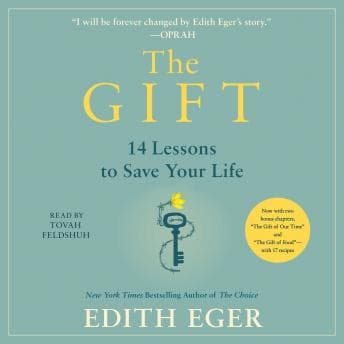

"The worst prison is the one we create for ourselves."
I was grading sophomore essays on The Great Gatsby at 11:47 PM—my eyes burning, red pen bleeding dry—when Edith Eger said that line. I stopped mid-correction. Put down the pen. Let the stack of papers sit there judging me while I actually listened.
This is what great literature does. It interrupts you.
When a 93-Year-Old Tells You to Stop Whining
Look, I assign Elie Wiesel's Night every year. I've taught Holocaust literature for two decades. I thought I understood survival narratives. But Eger does something different here. She's not asking you to bear witness—she's asking you to stop using your past as an excuse.
The audacity of it. A woman who danced for Mengele, who survived Auschwitz, who watched her parents walk to the gas chambers, telling readers that their mental prisons are just as real and just as escapable. My students would bristle at this. I love it.
Eger structures the book around what she calls "the twelve imprisoning beliefs"—fear, guilt, shame, avoidance, the usual suspects. But she doesn't approach them like a self-help guru with a whiteboard. She approaches them like a grandmother who's seen too much to tolerate your nonsense. Each chapter weaves between her own story, her decades of clinical work, and practical exercises. The prose deserves to be savored. She writes the way Hemingway talked about writing—clean, direct, every word earning its place.
Tovah Feldshuh Understands That Pause Is Punctuation
Here's where the audiobook becomes essential rather than optional. Feldshuh's narration has this lilting quality—not quite an accent, more like a musical phrasing that rises and falls with Eger's emotional terrain. When Eger describes returning to Auschwitz as an elderly woman, Feldshuh slows down. Not dramatically. Just enough that you feel the weight of footsteps on that ground.
She doesn't perform the book. She inhabits it. There's a warmth in her delivery that makes Eger's harder truths land softer. When Eger writes about shame—specifically, the shame she carried for decades about surviving when her parents didn't—Feldshuh's voice carries both the confession and the absolution. It's the kind of narration that makes you forget someone is reading to you.
At just under six hours, this is a focused listen. No padding. No repetition of concepts for the slow learners in back. (I say this with love. I teach high schoolers. I know padding.)
The Recipe Chapters Are Weird and Perfect
The revised edition includes new material about COVID and—I'm not making this up—recipes. Eger's chicken paprikash. Her daughter's tested versions. At first I thought this was publisher padding, the kind of thing marketing departments demand. But then Eger explains how her mother taught her to cook in their Hungarian kitchen before everything was taken, and how making those dishes now is an act of remembrance and defiance.
This reminds me of what Hemingway said about the iceberg theory. The recipes aren't really about food. They're about what survives.
Who Should Press Play (And Who Shouldn't)
If you loved Viktor Frankl's Man's Search for Meaning, this is its spiritual successor—same philosophical DNA, but with a therapist's practical toolkit attached. Bossypants operates in a completely different register—comedy instead of therapy—but Tina Fey has that same gift for turning personal pain into practical wisdom without making you feel lectured to. If you're looking for a gentle meditation on healing, this delivers. If you're in crisis and need immediate help, this is not that. Eger is wise, not urgent.
Skip this if you want pure memoir. The prescriptive elements are woven throughout, and some listeners might find the self-help framework intrusive. I didn't. But I also assign essays on "what the green light symbolizes" for a living, so I'm comfortable with layered meaning.
The content warning is real—Eger doesn't dwell on Holocaust horrors, but they're present. She survived. She describes how. If you're not in a place to encounter that material, wait until you are.
Class Dismissed
I finished this during Principal Martinez's quarterly budget presentation. (Sorry, Principal Martinez. The discretionary funding discussion was very important, I'm sure.) But Eger had just said something about how we choose our response to suffering, and I was thinking about my students—the ones carrying things I'll never know about, writing essays about Gatsby's green light while their own lives burn.
Maybe I'll assign this next year. The juniors could handle it.
Or maybe I'll just keep it for myself, for those 11 PM grading sessions when I need someone to remind me that the prison door was never locked.