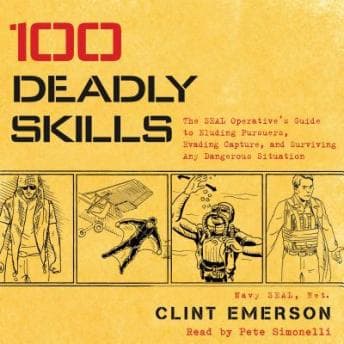

Look, I need to start with a confession: I picked up this audiobook because I was convinced I'd hate it. Not hate the content exactly, but hate how it made me feel—like some paranoid person who suddenly sees threats in every parking garage and coffee shop. And honestly? I was right. I do feel that way now. But here's the thing—I'm weirdly okay with it.
I listened to 100 Deadly Skills during my morning jogs through Cambridge, which in retrospect was a terrible idea. Nothing like learning how to escape a kidnapping while dodging undergrads on their way to 8 AM lectures. My therapist would have thoughts about this character—meaning me, the woman who now instinctively notes exit points in every room she enters. Thanks, Clint Emerson.
The Psychology of Preparedness (Or: Why We Love This Stuff)
What makes this book compelling isn't just the tactical content—it's what it reveals about human psychology. The research actually shows that people who feel prepared for danger experience significantly less anxiety than those who don't. I Am: The Power of Discovering Who You Really Are explores a similar concept—how self-knowledge creates psychological resilience, though obviously with fewer zip-tie escape techniques. There's something almost therapeutic about Emerson's matter-of-fact approach. He's not fear-mongering. He's basically saying: here's what could happen, here's exactly what you'd do, now stop worrying about it.
The protagonist here—and yes, I'm treating the author as a case study, sue me—exhibits classic traits of what psychologists call "proactive coping." He's not dwelling on threats. He's systematically dismantling them. And that mindset is... actually kind of contagious? By the end, I found myself less anxious, not more. Which I did not expect.
The skills range from genuinely useful (situational awareness, escaping zip ties) to wildly improbable for my life (making an improvised Taser, rappelling down buildings). But even the extreme stuff serves a purpose. It's a fascinating case study in how exposure to worst-case scenarios can actually reduce fear rather than amplify it. The brain likes having a plan, even if that plan involves hotwiring a car—something I will absolutely never do. Probably.
Pete Simonelli Gets the Assignment
So here's where audiobook format matters. This book is basically a list. One hundred skills, broken into chunks. That could've been deadly boring (pun intended, I'm not sorry). But Pete Simonelli's narration saves it. He's got this clear, no-nonsense delivery that sounds exactly like what you'd want from someone teaching you to survive a hostage situation. Not dramatic. Not performative. Just: here's the information, pay attention.
Some reviewers have called his tone "stiff" or "robotic" in places, and—okay, fair. There are moments where a little more variation would've helped. But for this material? The straightforward approach works. You don't want someone getting theatrical about how to escape a locked trunk. You want someone who sounds like they've actually done it and is slightly bored explaining it to you. That's the vibe.
At just under four hours, the pacing is tight. I appreciated that. Emerson doesn't pad with war stories or lengthy justifications. Skill, explanation, done. Next. My ADHD brain—which usually wanders during how-to content—stayed locked in. That's not nothing.
The Audiobook Problem (Let's Be Real)
Here's my one genuine complaint: this book was clearly designed as a visual guide. The print version has illustrations. Diagrams. Step-by-step images. And in audio format... you don't get those. Simonelli does his best to verbally describe techniques, but there were definitely moments where I thought, "I have no idea what he's talking about" because I couldn't see the diagram.
For some skills, this doesn't matter. For others—like anything involving knots or specific hand positions—it's frustrating. If you're serious about actually learning these techniques, you probably need the physical book too. The audiobook works better as a conceptual overview, a way to understand the principles and identify which skills you want to practice later.
I listened at 1.25x speed and it felt perfect. The information is dense but not complex, if that makes sense. You're not parsing philosophical arguments. You're absorbing practical steps.
Who Should Listen (And Who Should Skip)
I found myself asking: why does someone really pick up this book? And I think the answer is less about genuine survival preparation and more about psychological comfort. We live in a world that feels increasingly chaotic. Books like this offer an illusion of control—and honestly, sometimes illusions are useful. They lower cortisol. They help you sleep.
Will I ever need to know how to trick facial recognition software? Almost certainly not. But do I feel slightly more capable as a human having listened to this? Yeah. I do. And that's worth something.
Perfect for: people who enjoy tactical content, true crime fans who want to feel less like potential victims, anyone with a long commute and a taste for practical knowledge. Skip if: you need visual learning, you're already anxious about safety (this might not help), or you're looking for deep storytelling.
Me? I'm keeping this one. Right next to my Agatha Christie collection. Because apparently that's who I am now—a woman who studies both fictional murders and how to survive real ones. Maa would be so confused.