
"You think you know someone, and then you find out they've been lying for seven years."
That line hit somewhere around the two-hour mark, and I remember pausing my chopping—mid-onion, tears already streaming for unrelated reasons—because Mia Briscoe's voice carried this particular weight of betrayal that felt uncomfortably familiar. The research actually shows that we process deception from close friends as more traumatic than from strangers. Mia's entire arc is a case study in that phenomenon.
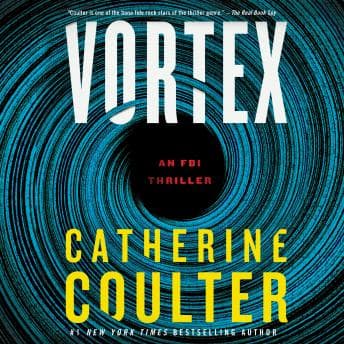
Catherine Coulter's Vortex runs parallel investigations that eventually collide: Mia's seven-year-old cold case about her missing friend Serena, and CIA operative Olivia Hildebrandt's brush with death in Iran followed by an attack on American soil. The protagonist exhibits classic trauma-response patterns—hypervigilance, trust issues, the compulsive need to control information. Psychologically, this tracks. What makes Mia compelling is that Coulter doesn't let her off easy. She has to confront that her best friend's disappearance might have been preventable if she'd been paying attention instead of enjoying a frat party.
When the FBI Meets the Couch
Sherlock and Savich are back, and honestly, after twenty-five books in this series, they function like old friends you're checking in with. Saskia Maarleveld voices Sherlock with a competence that borders on clinical—which works, because Sherlock IS clinical. She's the analytical one, the pattern-recognizer, and Maarleveld captures that without making her robotic. Pete Simonelli handles Savich and the male ensemble with genuine differentiation. You can tell the difference between a nervous witness and a confident CIA handler without checking who's speaking.
But—and my therapist would have thoughts about this—Simonelli's French accent is... problematic. When a French operative appears, it's like watching someone do an impression of someone else's impression of French. It pulls you out of the moment. Not enough to ruin the experience, but enough that I noticed. And once I noticed, I couldn't un-notice.
The dual narration creates this interesting effect where the two investigations feel genuinely separate until they don't. Maarleveld's sections have a more measured pace; Simonelli's lean into action. A fascinating case study in how vocal performance can reinforce narrative structure.
The Psychology of Powerful People Behaving Badly
What Coulter understands about human nature: people with power don't just want to keep secrets. They want to believe their own lies. The antagonists in Vortex aren't mustache-twirling villains. They're people who convinced themselves that covering up a college student's disappearance was the reasonable choice. The practical choice.
I found myself asking: why does Mia really pursue this case after seven years? The obvious answer is guilt. The more interesting answer is identity. She became an investigative journalist specifically because of Serena. Without that mystery, who is she? The book doesn't spell this out—Coulter trusts her readers—but it's there if you're looking.
Olivia's storyline is more straightforward action-thriller territory. Betrayal within intelligence agencies, missing flash drives, people trying to kill her. Standard fare for the genre. But Olivia's response to trauma is refreshingly realistic. She's not immediately back in fighting shape after a grenade nearly killed her. She's scared. She's angry. She makes decisions based on emotion and then has to deal with the consequences.
Who Should Listen (And Who Should Skip)
If you've been following the FBI Thriller series, this is comfort food. Familiar characters, reliable structure, satisfying resolution. If you're new to Coulter, Vortex works as an entry point, but you'll miss some relationship dynamics that long-time readers take for granted.
Skip this if you need constant action—the pacing might frustrate you. There are investigative lulls. Conversations that build character rather than advance plot. I appreciated them—character psychology is kind of my thing—but I can see how someone wanting a pure adrenaline rush might check their phone during the slower stretches.
The research actually shows that thriller readers fall into two camps: those who want puzzles and those who want chases. NYPD Red 7: The Murder Sorority leans harder into the chase camp, if you're trying to figure out which side you're on. Vortex tries to satisfy both, which means neither group gets everything they want.
Case Closed (For Now)
At nearly ten hours, this is a commitment. But it's the kind of commitment that rewards attention. The dual investigations interweave more cleverly than I expected. The narrators—French accent aside—deliver performances that enhance rather than distract. And Coulter's understanding of why people do terrible things to each other remains sharp after twenty-five books.
Is it the best FBI Thriller? Probably not. Is it a solid entry that respects both longtime readers and newcomers? Yes. Will I remember specific plot points in six months? Honestly, no. But I'll remember how it felt to listen while cooking alone in my apartment, piecing together clues alongside Mia, wondering what secrets the people in my own life might be keeping.
My mother still doesn't understand why I need more audiobooks when I already have so many. Maa, that's not how this works.