
So here's a question that's been rattling around my head since I finished this one: how many of our daily decisions are actually ours, and how many are just our brain running old scripts we never agreed to?
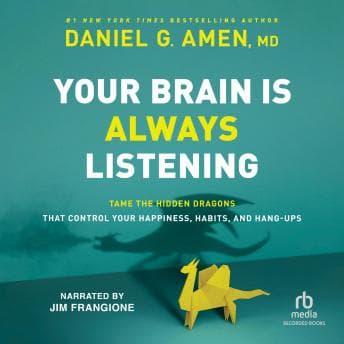
I picked up Dr. Daniel Amen's Your Brain is Always Listening during a particularly brutal on-call week. Three production incidents in five days, sleep schedule completely wrecked, and my anxiety was doing that fun thing where it convinces you every Slack notification is a disaster. The timing felt right for a book about taming the "dragons" in your brain. And honestly? It delivered about 70% of what I needed.
The Dragon Framework Actually Sticks
Look, I've listened to enough self-help books to know when something is just recycled advice with a new coat of paint. 48 Laws of Power had that same recycled feeling, honestly—useful frameworks wrapped in historical anecdotes I'd heard before. This one's different. Not revolutionary, but different. Amen uses this "dragons" metaphor to categorize the negative thought patterns that hijack your brain. You've got your "Abandoned Dragon" (fear of rejection), your "Inferior Dragon" (imposter syndrome, basically), your "Anxious Dragon"—you get the idea.
What I actually appreciated is that he ties this back to neuroscience in a way that doesn't feel like hand-wavy pseudoscience. He runs brain imaging clinics, so there's actual SPECT scan data behind some of this. Is it peer-reviewed journal-level rigorous? Probably not. But it's more grounded than most stuff in this genre, and as someone who debugs systems for a living, I appreciated the attempt at a diagnostic framework.
The practical tools are where the ROI is. He gives you specific questions to ask yourself when you're spiraling, ways to challenge automatic negative thoughts, and—this is the part I bookmarked—strategies for dealing with "dragons from your past" that are still breathing fire on your present decisions. I used one of his reframing techniques during a particularly tense code review last week. Did it work? Honestly, yeah. Same way the negotiation tactics in New Art of Negotiating actually helped me push back on unrealistic sprint commitments. I hate when these books are right. Kind of annoyingly well.
Jim Frangione Keeps You Awake at 6AM
Here's the thing about self-help audiobooks: the narrator can make or break them. You're essentially letting someone lecture you for 8+ hours, so they better not sound like a corporate training video. Jim Frangione nails it. His voice is warm without being saccharine, clear without being clinical. He reads Dr. Amen's material like he actually believes it, which—look, that matters when you're half-asleep on a packed Caltrain surrounded by other tech zombies.
The pacing is solid. Not Ray Porter levels of perfect (obviously), but Frangione knows when to slow down for the important stuff and when to keep things moving. He won an AudioFile award for mystery narration apparently, which explains why he's good at building tension even in a psychology book. The production quality is clean—no weird audio artifacts, no jarring transitions between chapters.
My one gripe? Some sections toward the end get repetitive. Like, I get it, I need to challenge my ANTs (Automatic Negative Thoughts). You've said this. Multiple times. I found myself bumping up to 1.75x during a few stretches just to push through.
Who Should Queue This Up (And Who Should Skip)
Perfect for: train, gym, long walks when you're in a weird headspace. Skip for: deep work sessions—you'll want to actually engage with some of the exercises. And if you're looking for hardcore neuroscience with citations, this isn't that. It's more accessible, which is either a feature or a bug depending on what you need.
This is basically a debugging guide for your brain's legacy code. Some of the patterns he identifies are genuinely useful for understanding why you react certain ways to certain triggers. Is it going to solve all your problems? No. Could some of this have been a blog post series? Parts of it, yeah.
But I finished this in about 6 commutes, and I came away with at least three techniques I'm still using. For a self-help audiobook, that's a pretty solid hit rate. Kevin (boyfriend, not a dragon, though sometimes I wonder) even noticed I was less snappy during my last on-call rotation.
Pushing to Production
If you're into brain optimization content and you want something more substantial than a podcast episode but less dense than an actual neuroscience textbook, this hits that sweet spot. Just... maybe don't expect every chapter to blow your mind. Some dragons are more interesting than others.