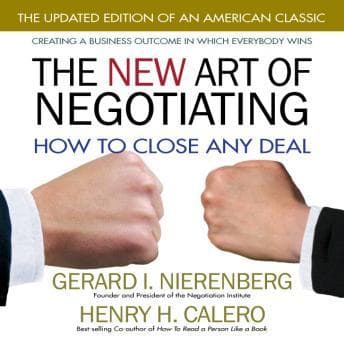

Okay, so here's my issue with most negotiation books: they treat every interaction like you're a Wall Street shark circling a bleeding competitor. Which, fine, maybe that works for some people. But the rest of us are just trying to get our landlord to fix the dishwasher without becoming mortal enemies.
Gerard Nierenberg gets this. The man literally founded the field of negotiation training back when most business books were still telling you to dominate your opponent into submission. His whole thing? Nobody has to lose. And honestly, from a psychological standpoint, this tracks. Research on cooperative versus competitive negotiation consistently shows that win-win approaches lead to better long-term outcomes, stronger relationships, and less cortisol flooding your system at 2 AM replaying that conversation with your boss.
The Psychology Behind the Framework
What makes this audiobook genuinely useful - and not just another "be confident, make eye contact" lecture - is Nierenberg's focus on motivation analysis. He wants you to understand why the other person is at the table before you start strategizing. What do they actually need? What are they afraid of? What would make them feel like they won, even if you're also winning?
This is basically applied psychology dressed up in business casual. And I'm here for it.
The body language section is interesting, though I'll admit I approached it with some skepticism. (My research brain immediately starts asking about sample sizes and cultural variations.) But Nierenberg and Calero keep it practical rather than pseudoscientific. They're not claiming you can read minds through crossed arms. They're suggesting you pay attention to the whole person you're negotiating with. Revolutionary concept, apparently.
Scott Peterson Delivers the Goods
Let's talk about the voice in my head for six hours. Scott Peterson has that clear, steady delivery that works perfectly for instructional content. He's not trying to make this dramatic - because it shouldn't be. This isn't a thriller. It's a skill-building manual, and he treats it accordingly.
I listened to most of this during my morning jogs through Cambridge, and the pacing kept me engaged without making me miss crucial points when I was dodging tourists on the sidewalk. (Boston problems.) Peterson's enunciation is crisp enough that I could follow along even when my brain was partially occupied with not tripping over uneven brick.
Is he going to win awards for vocal range? No. But that's not the job here. The job is making Nierenberg's concepts accessible, and he does exactly that.
Where This Gets Interesting
The book was originally published decades ago, and this "new" version updates the examples for contemporary business. Some of it still feels a bit dated - the landscape has shifted pretty dramatically since this revision. But here's the thing: the underlying psychology hasn't changed. Humans still want to feel heard. We still respond better to collaboration than ultimatums. We still make decisions based on emotion and rationalize them with logic afterward. If you want to explore that self-awareness angle further, I Am: The Power of Discovering Who You Really Are digs into understanding your own emotional patterns before trying to navigate anyone else's.
Nierenberg understood this before behavioral economics became trendy. The man was ahead of his time.
What I found myself thinking about - probably more than Nierenberg intended - was how these principles apply outside the boardroom. Negotiating with a teenager about homework? Win-win. Discussing division of labor with a roommate? Win-win. Convincing your dissertation committee that your methodology is sound? (Okay, maybe that one's just survival.)
The framework is genuinely transferable. Which makes the six-hour investment worth it even if you never close a corporate deal in your life.
Who Should Listen (And Who Should Skip)
If you're in sales, business development, or any role where you're regularly making deals, this is foundational stuff. Not cutting-edge, but foundational. Like reading Freud before you dive into contemporary psychology - you need to know where the field came from.
For the rest of us? It's surprisingly applicable to everyday life. I caught myself using the motivation analysis framework during a conversation with my department head last week. Did I get what I wanted? Mostly. Did she also feel good about the outcome? Seemed like it. Win-win in action.
Skip this if you want entertainment. This is education. Good education, delivered well, but education nonetheless. If you're looking for a gripping narrative to make your commute fly by, this isn't it. If you want to actually get better at a skill you use literally every day whether you realize it or not? Different story.
The production is clean, Peterson's delivery is professional, and Nierenberg's framework has stood the test of time for a reason. Not every book needs to be a revelation. Sometimes it just needs to be useful. What a Time to be Alone hits that same note for me—not flashy, just genuinely practical for navigating your own psychology.
This one's useful.