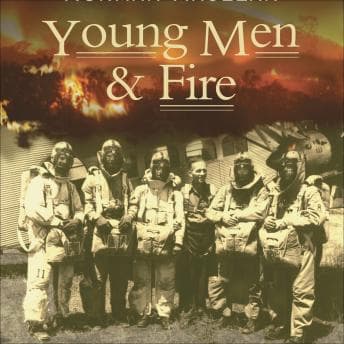

What happens when the most devastating story ever told about wildland firefighting gets narrated by someone reading it like a quarterly earnings report?
I was up at 2 AM finishing a client deck—the kind of PowerPoint that makes you question your life choices—when I decided to put this on. Six hours, I thought. Tight. Focused. A tragedy about fifteen young men who died in Montana in 1949. Norman Maclean spent fourteen years writing this thing. Won the National Book Critics Circle Award. His son John narrates it. Should be perfect, right?
Brilliant Content, Terrible Delivery
Here's the thing about this audiobook: the source material is extraordinary. Maclean wasn't just some writer who stumbled onto a tragedy. He was a woodsman, an English professor, a man who understood both the forest and the sentence. The Mann Gulch fire killed thirteen Smokejumpers in less than an hour—a 2,000-degree blowup that moved faster than men could run. Maclean spent over a decade reconstructing exactly what happened, interviewing survivors, walking the actual terrain, doing the kind of forensic analysis that would make McKinsey proud.
And his son reads it like he's going through a property insurance claim.
I've sat through a lot of bad presentations. I've watched partners drone through slides while clients' souls visibly left their bodies. John MacLean's narration gave me flashbacks. There's a hiss of white noise running through the recording—the kind of audio quality you'd expect from a 1990s cassette transfer, not a modern audiobook. And his delivery? Monotone doesn't capture it. Technically competent and emotionally absent. The man is reading about young men burning to death, about a foreman named Wag Dodge who invented an escape fire in the moment of crisis only to watch his crew ignore him and die, and it sounds like he's reading assembly instructions for IKEA furniture.
When Expertise Isn't Enough
John MacLean knows this material. He's a journalist, an author, a wildland fire expert in his own right. He's his father's son. On paper, he's the perfect narrator. But expertise and performance are different skills. I've seen this fail at three different companies—putting the subject matter expert in front of the client instead of the presenter who can actually sell the idea.
The tragedy is that Norman Maclean's prose deserves better. This isn't some dry historical account. Maclean writes about the legal proceedings, the negligence charges, the way institutions failed these young men. He writes about grief and honor and the human spirit with the precision of a scholar and the soul of a poet. At 2.0x speed, I could feel the weight of his sentences even through his son's flat delivery. The content is that good.
But an audiobook is a performance. And this performance is a missed opportunity.
Who Gets Value Here (And Who Doesn't)
If you're a wildland fire professional, a student of disaster response, or someone who needs to understand how institutional failures kill people—this book is essential reading. The content is irreplaceable. Maclean's reconstruction of the Mann Gulch tragedy is the definitive account, and his meditation on death and meaning elevates it beyond mere journalism. That same search for meaning in catastrophe shows up in Bhagavad Gita: Treatise of Self-help, though Maclean's prose has more fire in it.
But for the audiobook specifically? Skip to chapter 5. Thank me later. Or better yet, get the print version. This is one of those rare cases where the audio format actively diminishes the material. The poor production quality, the narration that lacks any enthusiasm for the subject—it's like watching a great film on a broken television with the sound cutting out.
If you're going to listen anyway—and there's something to be said for having John MacLean's voice on his father's words, a kind of literary inheritance—do it during focused time. This is not a commute book. This is not background listening. The content demands attention, and the narration won't help you stay engaged. You'll need to bring your own energy. Skip it if you need a narrator to carry you through difficult material.
Credit Allocation Recommendation
This is what my parents did instinctively—the relentless work, the documentation, the refusal to let something important be forgotten. Maclean's fourteen-year obsession with this tragedy feels familiar. The book itself? Worth every minute. The audiobook production? A case study in how to undermine excellent content.
Jenny would say I'm being harsh. Jenny is right. But I'm also right. Maclean's insights on how men die, how institutions fail, how we reconstruct meaning from tragedy—that's worth the listen. The delivery? My 2.0x speed couldn't save this one.
Get the print version. Or accept that you're paying for content, not performance.