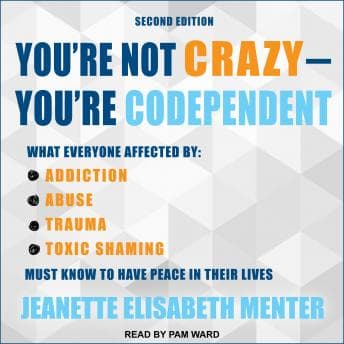

Okay so here's the thing - I didn't pick this book up because I'm having some kind of breakdown. I picked it up because Kevin's sister recommended it after a really raw conversation at Thanksgiving, and it had been sitting in my Audible library for two months collecting digital dust. Then last Tuesday I couldn't sleep after debugging a gnarly race condition that had been haunting our service mesh for three days, and at 1AM I figured, you know what, let's see what 5.5 hours of self-help feels like when your brain is fried and your cortisol is already through the roof.
Turns out? Pretty effective timing, actually.
The Part Where a Self-Help Book Actually Taught Me Something
TL;DR: Worth your commute if this topic is relevant to you, but with a significant caveat I'll get to.
Menter's central thesis is basically: codependency is a downstream bug from addiction, abuse, trauma, or toxic shaming in your environment - and most people don't even know they're running that corrupted code. She frames it as a pattern recognition problem, which honestly spoke to me more than she probably intended. The book walks through how codependency manifests (guilt loops, perfectionism, control issues, depression) and then - and this is where it actually earns its runtime - provides what she calls a "Guide to Recovery" using mindfulness techniques.
What surprised me was how interactive the format is. Menter structures sections almost like a workbook, asking you to pause and reflect. At 1AM in my apartment with the Caltrain schedule pulled up on my phone for no reason (habit), I actually did stop and think through some of her prompts. There's this section where she walks through the difference between the lies codependency installs in your belief system versus the actual truths underneath them, and she's specific enough that it hits differently than the generic "love yourself" stuff. She writes like a former newspaper columnist who's also been through it - direct, clear, zero academic fluff.
Pam Ward's narration has this quality where it feels like she's talking to you specifically. Not in a performative podcast-host way, but more like a steady, clear voice that doesn't try to dramatize the heavy stuff. For a book dealing with addiction and trauma, that restraint matters. She doesn't oversell the emotional moments. Clean production, no weird audio artifacts, just straightforward delivery.
The God Variable You Need to Know About
Here's where I have to be honest, because this is the thing that'll be a dealbreaker for some people and a feature for others: there's a significant spiritual/religious thread running through this book. Menter is a Christian Lay Counselor, and she doesn't hide that. Some sections include prayer, references to God and a higher power, and the recovery framework leans into a relationship with a higher power as part of healing.
Now - I grew up going to church in Seattle exactly twice a year (Christmas and Easter, Asian parent special), so I'm not the target demo for the spiritual stuff. But I'll say this: if you mentally s/God/whatever-grounds-you/g, a lot of the underlying framework still works. The mindfulness techniques, the pattern identification, the practical guidance on breaking harmful thought loops - that's solid regardless. The shame mechanics specifically - the way corrupted self-belief gets installed and then defended - are explored even more rigorously in Healing the Shame That Binds You, which goes deeper on the psychological scaffolding without the faith framing if that's what you need. But if religious framing is a hard no for you, you should know what you're getting into. It's not a Bible study, but it's not secular either.
How This Stacks Against Codependent No More
If Melody Beattie's Codependent No More is the comprehensive documentation, this is more like the getting-started guide with worked examples. Shorter (5.5 hours vs Beattie's longer treatment), more personal, more interactive. I'd actually recommend this as a first pass if you're new to the concept of codependency, then graduate to Beattie for the deep dive. The ROI on this audiobook is decent for the runtime - Menter doesn't pad, and at 5.5 hours it respects your time more than most self-help books.
I listened at 1.25x and that felt right. 1.5x was too fast for the reflective pauses she builds in - you actually want the breathing room here.
Perfect For / Skip For
Perfect for: focused listening at home, quiet commute moments when you want to actually think. This is NOT a background listen - the interactive elements need your attention.
Skip if: you need your self-help completely secular, or you're looking for clinical depth with citations. This is experiential and faith-informed, not academic.
If you've got someone in your life dealing with addiction or you grew up in a chaotic household and you've never quite been able to name why you operate the way you do - this book might hand you a vocabulary you didn't know you needed. It did for me at 1AM on a Tuesday, and I'm not even mad about the lost sleep.